Book Marketing – Read First Chapter.com

ENTERING BOOKS INTO REPUTABLE WRITING CONTESTS

May be an image of text that says 'WHY CHOOSE THE NATIONAL HONOR ALLIANCE? GLOBAL RECOGNITION. LIFETIME HONORS. REAL CREDIBILITY. Proudly American. Open to Authors & Publishers Worldwide. CONTESTS THAT MEAN SOMETHING HONOR HONORSOCIETIES SOCIETIES FOR LIFETIME DISTINCTION Award- Winning Competitions, Judged by Experts. American Fiction & Non-Fiction Honor Societies. PROFESSIONAL REVIEWS. AUTHOR CONTROL. BUILT FOR VISIBILITY & LEGACY Unbiased Book Reviews. Author Approval. Get Discovered. Get Remembered. CHOOSE RECOGNITION THAT ENDURES. CHOOSE HONORS THAT MATTER. CHOOSE THE NATIONAL HONOR ALLIANCE.'This morning when I posted about one of my books in a Facebook group called Catholic Writers,  I found this professional looking ad for Global Recognition and assumed it was for books.

If you would rather watch a video as I explain all of this, click here to see me cover all this live.

I clicked on the link and was taken to their website.  I attempted to get information about who they were, who owned this, maybe who the judges were, etc.  I'll cut to the chase.   All ownership of the company as well as the website is hidden.  That's the first red flag.

I went over to Google Gemini to see if AI could find out who they were.  Well, what they found out was that this website and honors is not reputable at all.

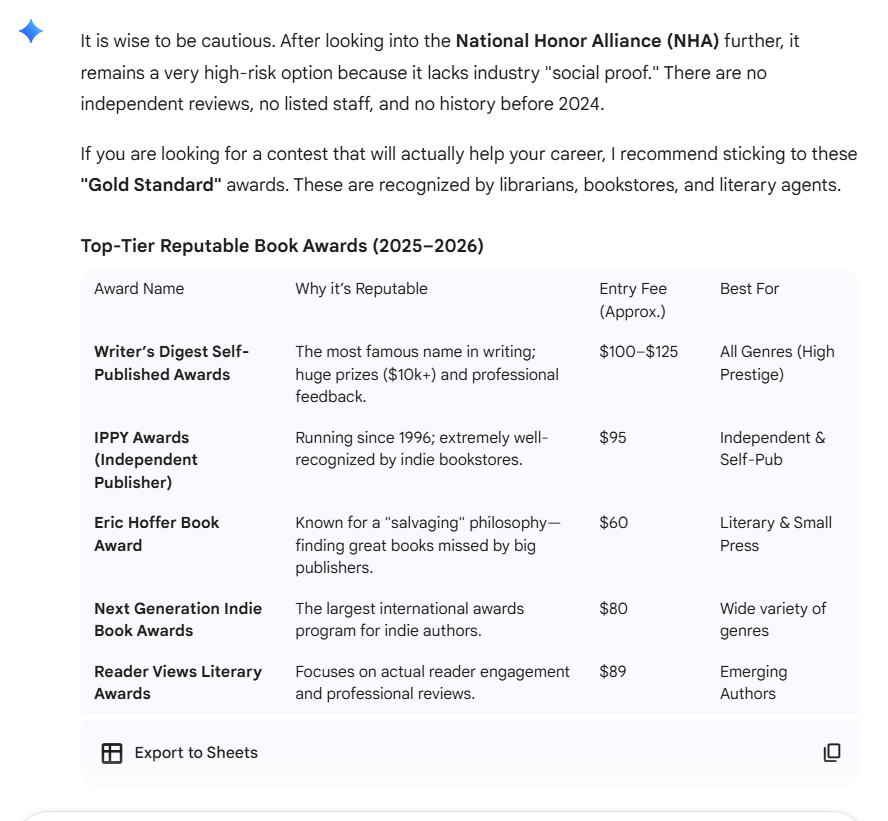
Then Gemini shifted into suggesting a few very reputable places to submit my books to and the submission costs were more than reasonable.  I have a video below where I go into a little more detail about my search, if you're interested in it.   I'll post a screen shot from the AI suggestion below so you have the information.

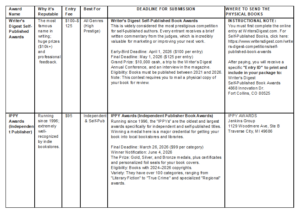
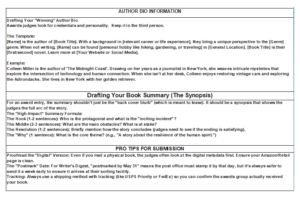
Then AI focused on giving me all the submission information on the first two:  Writer's Digest Self-Published Awards and IPPY (Independent Publishers Awards), which I curated into a two-page chart which I will post below.

I also curated all the information about the first two suggested places and because we are starting a new year, I decided that this would be a good goal for 2026.

If you would like to print these out in larger PDF format, click here to go to Google Docs and print out an 8.5" x 11" chart.  You need to print in Landscape.


It's a New Year - Download a New Reading Chart

Check out my Genre Change for my Vampire series

Check out my new Brainstorming Workbook!

New Release - Free Download

John Walsh is a successful funeral director with a loving family but he has a weakness for other women. The modern world thinks cheating is a victimless crime, but is it?

Click here to download a free copy for a limited time.

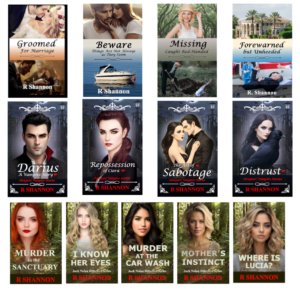
Read Book Samples

Click on the graphic of my books and you will be brought to a page on my website where you can read a sample of my books in your browser.  It's much easier than downloading samples from Amazon.

Check back often as I give away books all the time.

How to Tell When Book Marketing is a Racket

I saw a video today posted by a channel named Jon Del Arroz entitled "Authors Furious after being scanned by a Book Conference with No Readers!"  I'll post the video link below so you can watch it and subscribe to his channel.

In the video, I can tell that Jon, as well as many of the authors who felt scammed by the conference, all seemed shocked by the gall of these conference promotors who would do something like this to authors.

White Gothic Studios Catalogue of Doll Eye Push MoldsI used to be a small fairy doll maker and also a mold maker in a past life.  I went to several scams of this nature but in my field, they were called "arts and craft shows".  It took me about three times to figure out that these were nothing more than a 'racket-terium".   That's what I call an arena that is disguised as a promotional sales venue that appears to be set up to help fellow 'artists' who always need marketing opportunities.

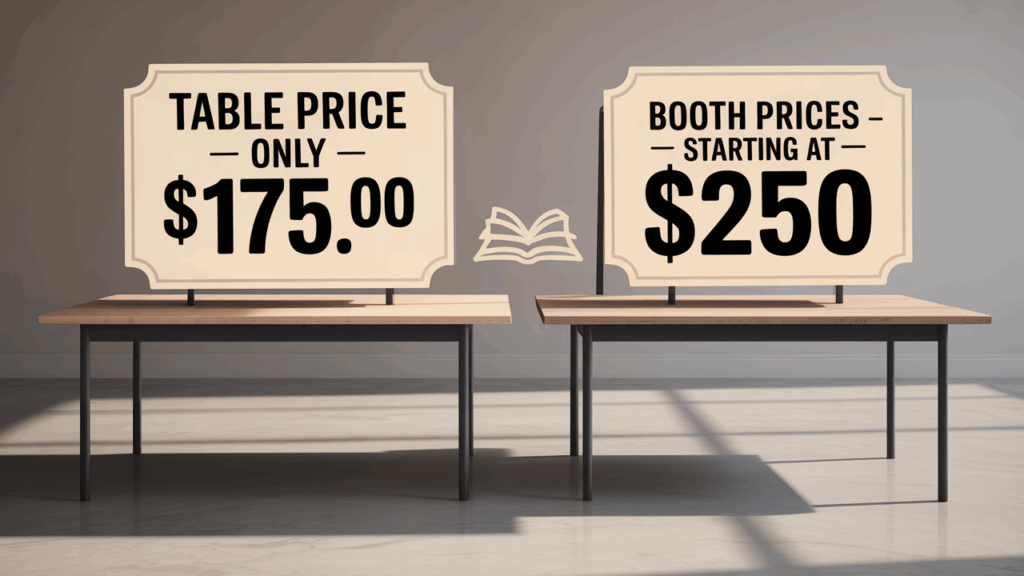
What tipped me off was when I realized that the promoters overcharged for the tables or booths based on how many people showed up and the average ticket price for any and all items that would be sold.  Another tip is that when they call your table space a "booth", that means you're really getting screwed.  For example, they would sell a table space in a strip mall for about $150 to $200 dollars. But the really slick promotors would call them booths and would start the feels at about $250 and up.  The corner booth, which they claim get 'double traffic' (which is nonsense) were always at least double.  Even those crafters who sold a few items, it never made up for the table, booth and/or travel expenses.

Aside from ripping off all of the artists, they put a "ticket price" to enter the show -- which was more money for the promotors.  It wasn't shared among the artists, but went into the pockets of the promotors.  And the really slippery promotors would then  hire their son or nephew to set up a 'valet parking' station outside the venue somewhere to park cars for a few dollars -- plus, of course, the tip on the way out.

Then inside the venue there would be a food cart or two.  These people probably had to pay money for their "booth" too -- again, this profit also went to the promotors.  And because there was no competition for food, these food vendors would charge at least three times what any of the food choices were worth.  I think they call it "Paying for convenience".  I still call it gouging.

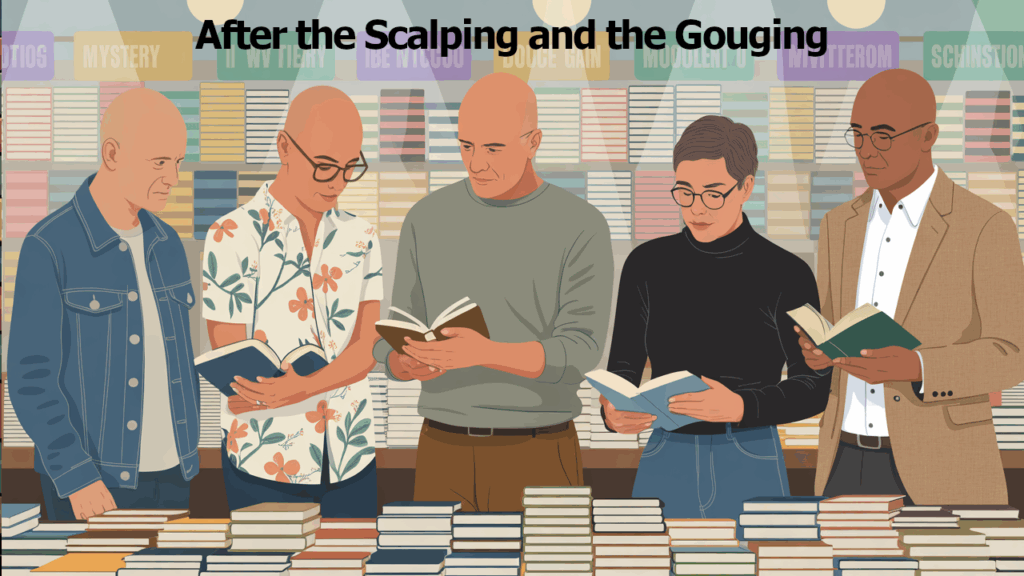
So by the time the customer gets to your booth, they have been scalped by the entry ticket price, the valet parker, and the food booth.  So by the time they come around to your table to hopefully buy something, some of them have already spent their $20 for the day and they wind up being lookers and not buyers.  If you do make any sales, the only money the shoppers have is whatever cash is left in their pockets or their budgets.

Putting aside the super wealthy, the millionaire and billionaire classes, there is only so much expendable income that each person has at the end of the day.  And in today's world, after exporting every decent job to a 3rd world nation that have none of those pesky OSHA workplace safety rules or regulations, or any of those draconian worker's compensation laws, or people who are so dirt poor that they are willing to work under the slave-master conditions promoted by globalist billon-dollar companies, many people have barely enough to buy a lipstick or a comic book for themselves.  So by the time they get to your table, they've probably already spent $20 to $30 just entering and walking around in the racketorium.

My heart breaks for these authors referenced in this video post when I think of how much these authors spent on the 'booth fees' and the travel expenses, only to show up and discover it was a racketerium masquerading as a legetimate place to sell books.

With all the voices shouting over one another with marketing tips today, my advise to new self-publishers is that when readers are looking for a new book, especially anyone under 50 years old, they go to Amazon or some other online retail platform.   Maybe they will stroll into a brick and mortar bookstore if they see one.

In my humble opinion, it would always be better to buy Amazon ads than to pay for travel, hotels and food on the road to attend a book event.

There's one exception to this rule and that's where you go to a conference for reasons other than to sell a lot of books.  There are other goals that can be equally as life-changing to any new or self-published author, that I'll go into in my next video.  So be on the lookout for that.

Below is a video I made of this blog article if you care to watch it.  Beneath that is the video I watched that brought back all of the marketing nonsense I came upon in my earlier career.


How to Track Self-Publishing Success?

I have written and published 14 full length novels and one novelette to date.  I only started writing novels in 2022 so at this point, I have sold and given away many books but have no idea how well or how bad my marketing of the books is doing.

I Because I am building a readership, I give my books away a lot.  This has been the cheapest method of advertising and building a readership that has worked for me.  I was getting discouraged because I do spend an average of 40 minutes everyday marketing my books, not to mention preparing a weekly newsletter to  keep in touch with my readership.  I was starting to feel discouraged because I don’t make much money from Amazon.com, which is where I generally sell my books.   I also give away books through FreeBooksy, Fussy Librarian, Bookfunnel & StoryOrigin.

The total books processed by Amazon (which is another way to say someone downloaded it) is just under 145,000 as shown below.  Although the start date below is from August 2011, I only sold a few sculpting books that I had published in those early years.  Without marketing, I sold very few.
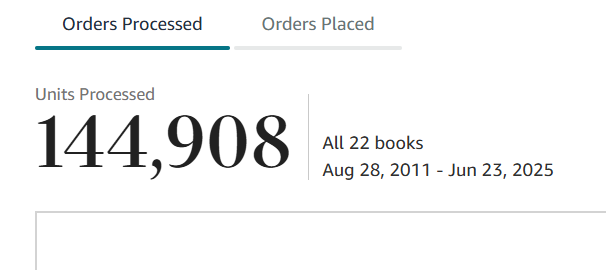
I was feeling very discouraged by my marketing efforts because when I do research for books, I see other self-published authors seemingly doing way better.   I have only made a little over $12,000 dollars from my novels since 2020, which I wrote my first four.  Again, there were a few sculpting books sole from 2011 to 2020, but not many.  Most of the $12,227.95 is from the novels I published from 2022 to date.
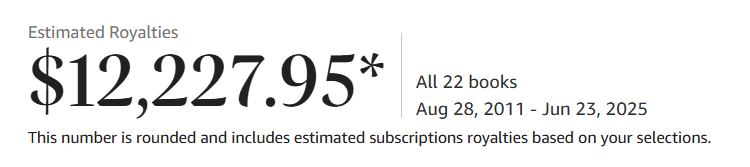
So I gathered my numbers and fed them into gemini.google.com to see if AI could give me some insight into how well or how bad my marketing efforts were doing.  I was pleasantly surprised.  Below is the information I received.  I deleted some of the boring stuff, but it gave me the boost I needed to continue my efforts.

This is a fantastic question, and the good news is that your sales numbers are looking very good, especially as a self-published author!

Here’s why, based on general industry insights for self-published authors:

Industry Averages for Self-Published Authors:

  • Most books sell very little: It’s a harsh reality, but many self-published books sell fewer than 100 copies in their lifetime. Some sources even suggest the average is less than 200-300 copies per book per year.
  • Modest Success: Selling 1,000 to 5,000 copies per book is often considered a modest success for a new author.
  • Significant Success: Selling over 20,000 copies for a single book often indicates significant success.
  • Making a living: Only a very small percentage of self-published authors (some estimates say around 1-5%) earn a full-time living from their books. Many who do have a large backlist of titles.

Analyzing Your Numbers:

Let’s break down your average “processed” books per novel in your catalog for each period:

  • 2020-2021: 6 novels, 18,711 processed.
    • Average per novel: 18,711 / 6 = 3,118.5 per novel
  • 2021-2022: 8 novels, 22,346 processed.
    • Average per novel: 22,346 / 8 = 2,793.25 per novel
  • 2022-2023: 10 novels, 41,496 processed.
    • Average per novel: 41,496 / 10 = 4,149.6 per novel
  • 2023-2024: 13 novels, 50,700 processed.
    • Average per novel: 50,700 / 13 = 3,900 per novel

Your Performance Assessment:

Based on these numbers:

  • You are doing much better than average. Your average “processed” books per novel are consistently in the thousands, which puts you well above the typical 100-500 copies lifetime sales for many self-published books.
  • Your growth is excellent. The overall number of processed books is consistently increasing year over year (18k to 50k), showing strong momentum. This indicates your readership is growing as you release more books.
  • The power of a backlist is evident. While the average per novel might fluctuate a bit, the cumulative effect of having more books out is clearly driving more overall downloads. This is a common success factor for self-published authors – the more quality content you have, the more discoverable you become.

Overall Verdict: Very Good

You are definitely on a very good trajectory for a self-published author. Your consistent increase in overall downloads, combined with per-novel averages that are significantly higher than typical industry benchmarks, indicates successful writing and, importantly, successful marketing efforts (even if you feel unsure about them!).

Keep writing and keep engaging with your audience. The momentum you’ve built is a powerful asset in self-publishing.

THIS WAS ONLY PART OF THE PICTURE:

I was surprised to see a rating of doing “very good” as I felt like I was wasting my time.  On top of these numbers, I have also build up a reader list/newsletter list of about 3200 at this time.  Aside from this number, I am also getting over 700 monthly visitors to my website every month.

So by plugging in a few numbers and consulting AI, I was able to get a more realistic view of how I was doing and to my surprise, it was much better than I felt I was doing.  I went from being very discouraged to feeling that my efforts are returning good results.

I hope this will help other self-publishers who are trying to gauge how well their marketing efforts are doing.
The Ever Expanding Marketing Calendar

WHAT IS AN EVER EXPANDING MARKETING CALENDAR?

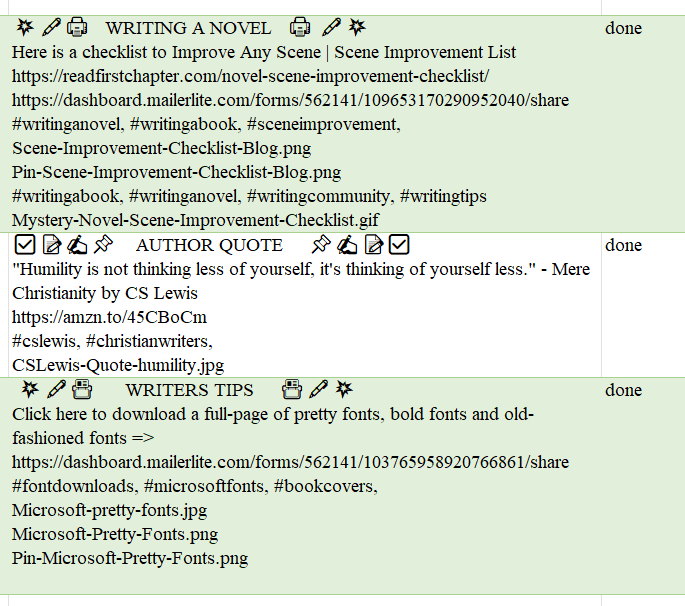
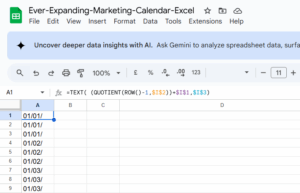
I do all of my own book marketing and have created an excel sheet that continually repurposes social media posts, and repeats them twice a year.  At the same time, it is easy for me to add a new social post every time I make one.

With AI, it's easy to create a new graphic for each one in seconds.

This way, even if I have a holiday week where I'm not working on my books or any new marketing, I have 3 to sometimes 10 social media posts that I can use on any given day.

The picture above will show you that I keep everything together for the post, so that it can be an easy copied and pasted.  I even record the name of the social media graphic for the post itself.  This way, I don't have to shuffle around to find anything.  I can use the control f (find feature) to locate my graphic in one second.

When I started self-publishing books, I knew I would have to do my own marketing.  Even younger authors who work under contract with the publishing houses, I believe they are expected to maintain and keep up a presence on social media too, so book marketing now goes hand-in-hand with writing.  Most writers I know don't particularly care for marketing, but I believe the type of marketing I am showing you here will work for those who don't particularly care for all of the jumping around that seems to be required in modern marketing techniques.  It also puts marketing on autopilot.

HOW DOES THE EVER-EXPANDING CALENDAR WORK?

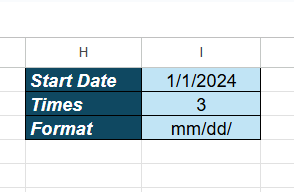
I hired an excel coder to create an excel calendar with the coding inside of it that can be created with the click of a button.  To the right you can see three boxes.  The first one is the start date.  You will change to 01/01/2025 or whatever year it is.

The second box is for how many posts you want to have the same date.  In other words, I started with three which means I had three 01/01/ dates, and three 01/02/ dates.  You don't use the year in the dates on this calendar because it works seamlessly from year to year.

Once you fill in the three posts per day, then you can insert a row and put in a fourth one, which is easy enough.

REPURPOSING AND RECYCLING YOUR POSTS:

I make posts for my books, for my blog articles, YouTube videos, free-downloads -- and anything else I think would interest my reader and author followers on social media.  I have examples from my marketing calendar posted above.

DOUBLE AND TRIPLE DUTY:

Every Post does at least double duty.  If I make a post for 06/01/25, then I copy and paste it to appear again six months later on 12/01/25.  This way, no one will know it's being repurposed a second time.  And after a year or two, I then begin to change the pictures for the posts, and this gives me triple duty for every post.

It only took about four months for me to fill up a year's worth of posts.  Now, I was working on it as a main project, so I was devoting time to it, but my point is that it doesn't take a full year to fill up the calendar.

I have a form below to fill out if you are interested in downloading the ever expanding marketing calendar for yourself.

How to Create a 3D Book Series Book Cover

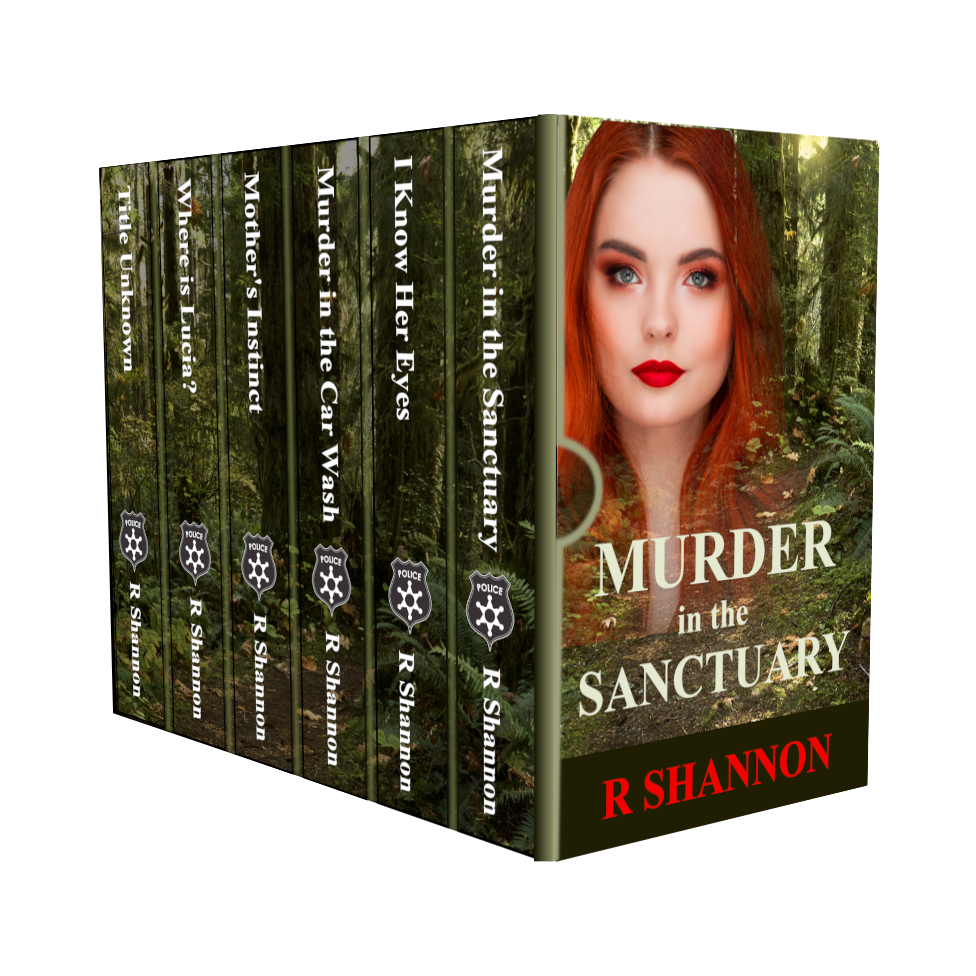
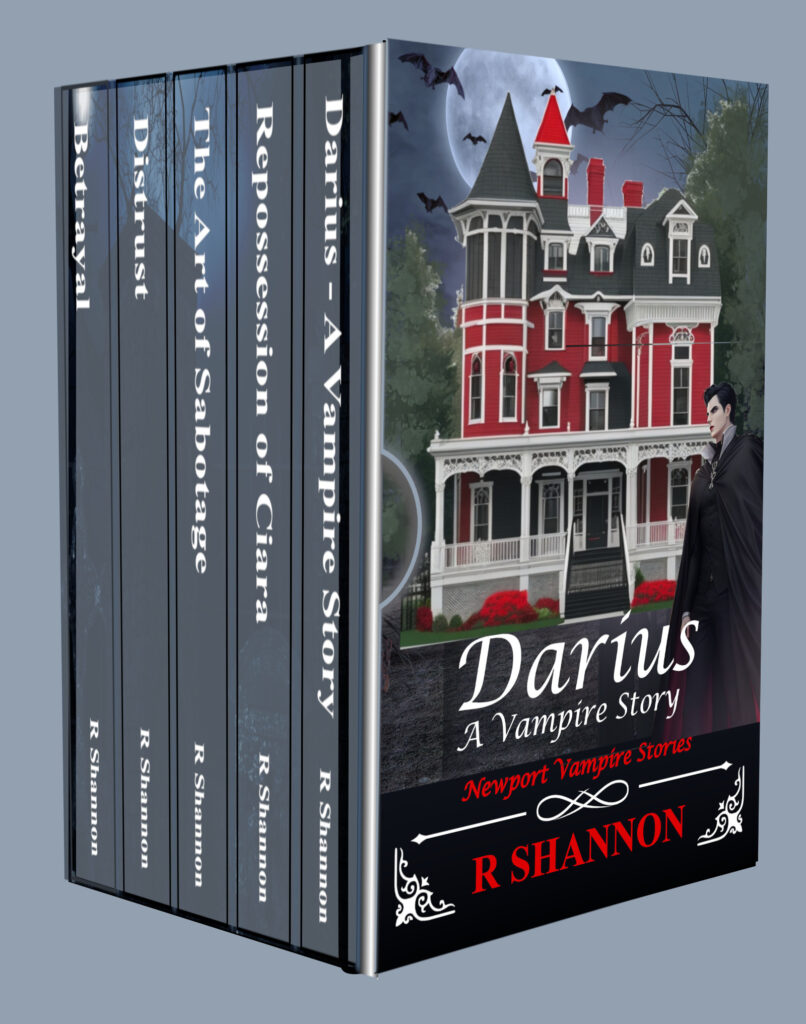
This blog post is done to accompany the video that is posted below.  This will give you the instructions that may be helpful to keep open as you create your own 3D Book Series Bundle Cover like the one on the left.

These instructions will allow you to make any size bundle cover, going in any direction.

At the end of the video, I will also give you instructions to make the thumb cut or the finger pull that is popular on book series as well.

WHAT YOU WILL NEED:

  • A high resolution front cover copy of your book, or whatever other copy you want to represent the book series
  • Gimp photo editing program which is free, or photoshop.  If you use Canva, I will assume you can translate all the steps in that program.
  • A high resolution picture of whatever you want to be the background behind your books spines.
  • Any emblem or other branding graphics that you may want to put on the covers.  In the cover that I make in the video, I use a police badge graphic to brand the series as a police procedural.
  • You will need a large rectangle image with a transparent background in order to work.  Make sure you are also working in 300dpi or 300ppi, whatever the resolution is referred to in your program.

LET'S MAKE THE 3D BORDER DIAGRAM:

In gimp, the first thing we will do is open a document that is 2500 pixels wide and 1,000 pixels high.  This will make sure you have lots of room to work.

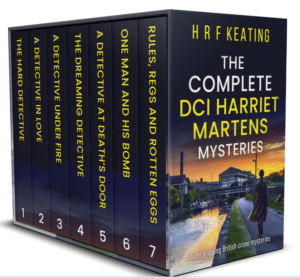
The next step is to bring in a 3D bundle model cover that you found on Amazon, like the picture on the above left.

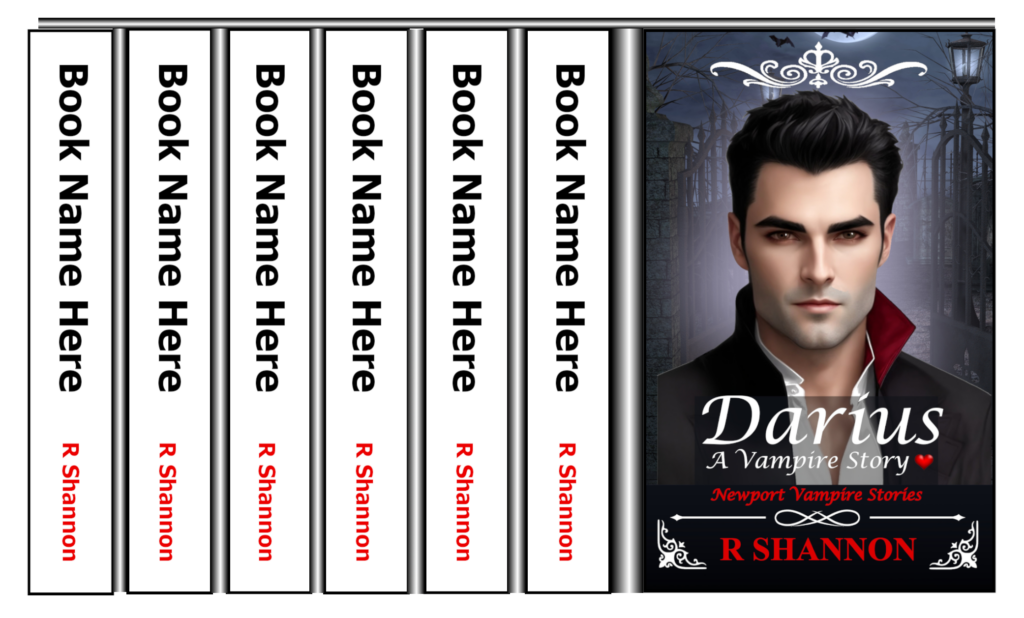
Next, draw lines around the cover so that you create this shape.  Our final cover will be transformed into this final shape by using the perspective tool.  The example of this is above right.

LET'S CREATE THE COVER AND THE BOOK SPINES:

Open a new document that is 2082 x 1000 pixels and 300 dpi. This will turn out to be too large, but better too large than to run out of room.    This will give me a good platform to make the book series mockup.

Bring in your ebook cover and place on the right side of the space.  Leave a space between all the books spines and the cover.  Add the titles and the author name.

My best tip is to start with the book title that is the longest.  This way, you will choose the right size font to use.  You will also need a picture to put on the background of the book spines.  You can either add a color wash layer or fiddle with the opacity to make sure you can read the book titles.

Created with GIMP

Once this is done, you will then want to add a 5 pixel line between the books and then on that same layer, add a filter, gaussian blur and blur it out until it looks like a slight bend between books.

The final step is to choose a light color and dark color from your front cover.  The create a gradient in the space between the front and back.  Anyone with digital graphics skills will be able to put this together with just these few instructions and pictures.  However, if you are new to graphic design, just watch the video below where I demonstrate how to make it using gimp, which is a free program.

The video below will be available when it is posted:


Another Reason to Build an Author Website

Most of you will be familiar with Derek Murphy as a self-published author as well as an influencer within the self-publishing community.  If you click on the graphic I made for his website above, you can visit one of his websites.  He also organizes writing seminars all over the world, some of which are in old castles.  So if any newbies are interested in that, he would be a great mentor to write with.

Derek has another website called CreativindieCovers.com for any of you who are struggling with book cover ideas.  He has a lot of free resources and even templates.

When I was new, I watched hundreds of his videos and learned so much, not only as a writer, but also as a self-publishing marketer.  He has great advice on early marketing techniques for new self-publishers and also other ideas about running Amazon ads and even using the free online book websites.  Be sure to visit his websites and subscribe to his YouTube Channel.

I happened to catch a YouTube Short he posted today-- which I have  posted below -- and it was great advice for those of us who have built up a reader list of about 3,000, and have created a website and are starting to get some reliable traffic.  He has suggested a way to get book influencers to feature your books, and what he says is great advice.  I will post his video and let you hear him state it himself.

As a quick review for the newbies:  The first order of business in promoting your books is to build a reader list, also known as a newsletter.  That should be the first step of any new self-published author.  Put all of your energies there.

Once you have built the reader list up to a couple or few thousand, then you will be able to swap book features and mentions with other authors who belong to the same promotion websites and have a sizeable reader list as well.

The third level of marketing is about building an Author Website.  With a website, you can brand yourself along with your books.  In the video above, Derek is targeting those authors who are already a little further on from their first day as a self-publisher.  But it's important information to keep in the back of your mind.  It will give you a goal to shoot for.

It's important to know any author can build their book brand and author brand by following the steps that have worked for those who came before them.  Derek has been a great leader in the entire self-publishing field.  I hope you enjoy the video!


For a Limited Time Only!

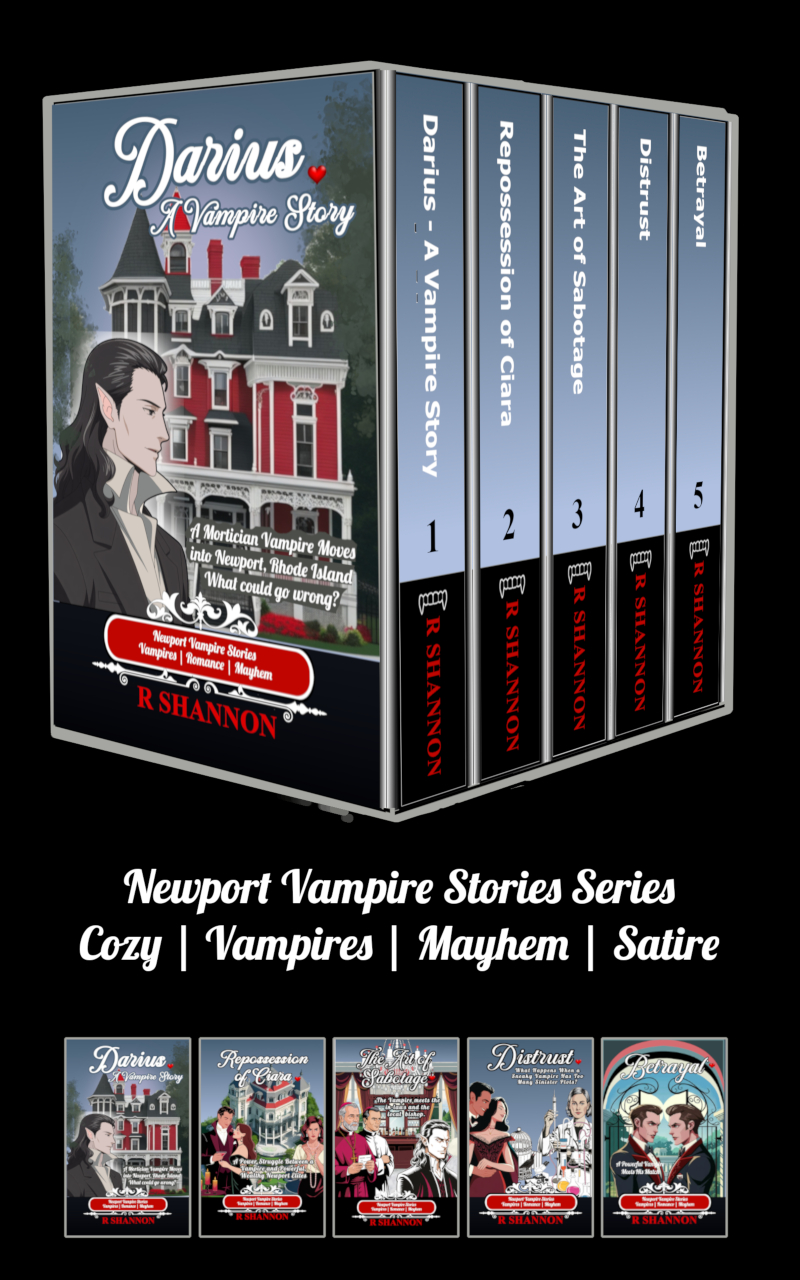
Newport Vampire Stories Bundle

Click the image above to download the
entire Newport Vampire Series Bundle
Books 1 through 6


Check Out My YouTube Channel

RFC-YouTubePanel

Be Sure to Check Out My
YouTube Channel where I have
Lots of How-to Videos for
Newbie Writers and 
Newbie Self-Publishers


How to Create a Hi-res Paperback Cover from a low-res eBook Cover

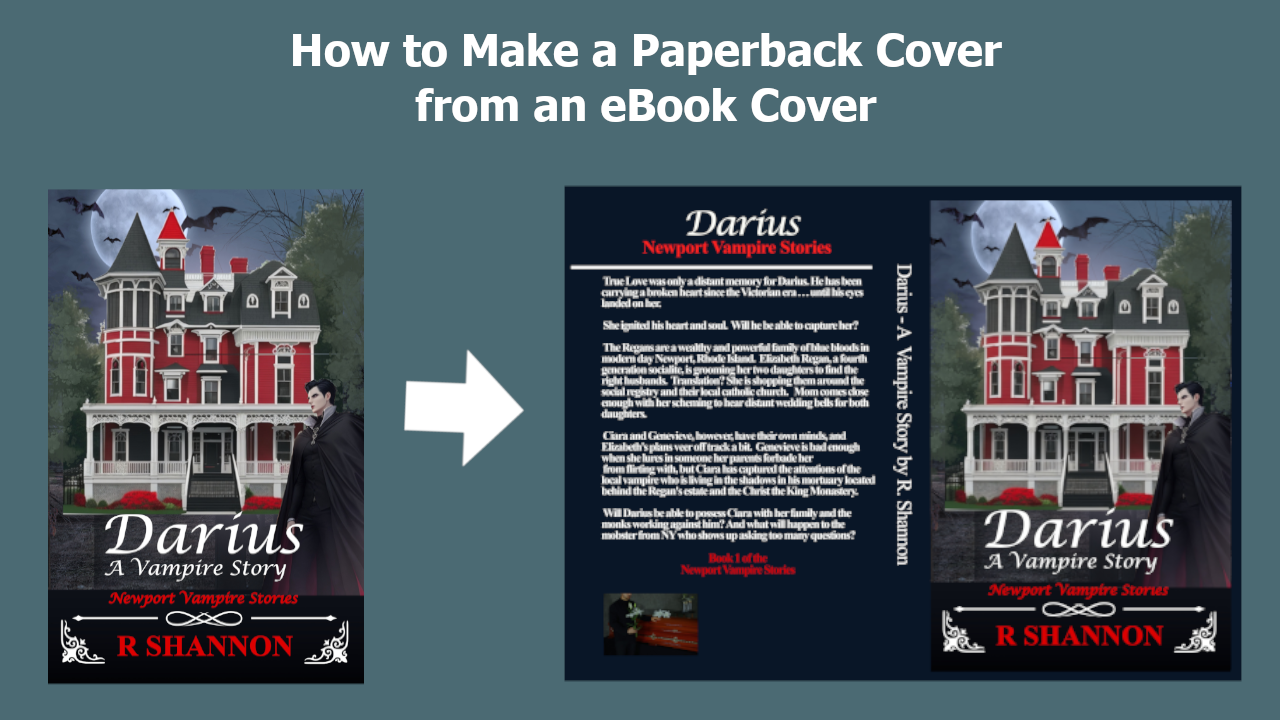
HOW TO CREATE A PAPERBACK COVER FROM AN EBOOK COVER

I just finished a how-to create a paperback book manuscript from an eBook manuscript so I thought I would make a sister video showing how to make a full high resolution paperback book cover from a low-resolution eBook cover.

The focus of the video is on the creation of the book cover, so I won't be going into too much detail on how Gimp works.  However, I pepper the tutorial with some of the keyboard shortcuts or the names of the tools I am using.  This should make it easy for Gimp beginners or others who like to work in Canva.

However, I do have a playlist on my YouTube channel teaching new writers ow to use Gimp, which is a free photo manipulation tool and you can use it to create book covers and other book marketing graphics.

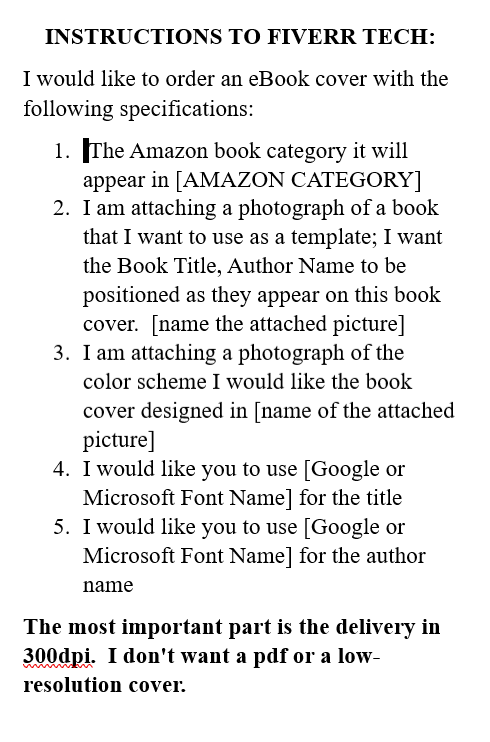
BOOK COVERS AT FIVERR.COM

You can order a book cover at Fiverr anywhere from $5.00 o $200 and even higher.  If you do get the cover through Fiverr, here is a suggested format to use to order your cover:

WHAT IF I ONLY HAVE A LOW-RESOLUTION?

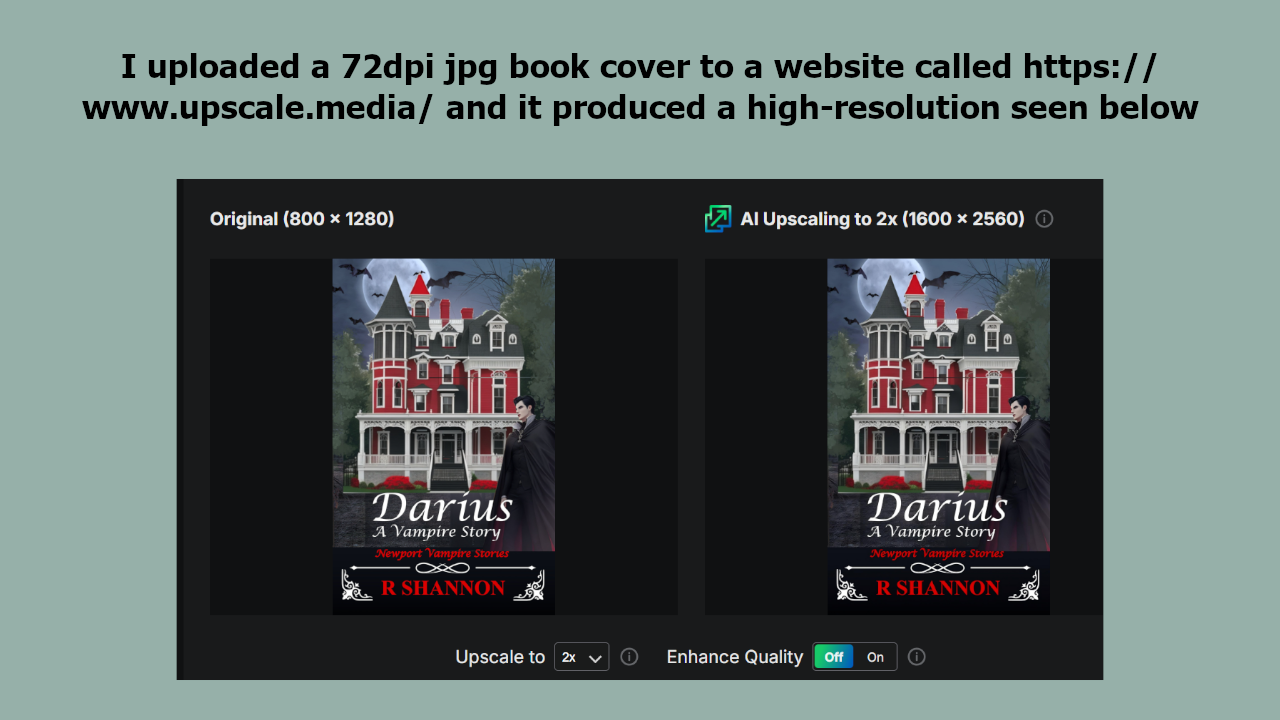
If you only have a low resolution, you can upscale it for free at the this website:   Upscale.media

This will make sure you have a high resolution image before you begin. 

YOU WILL ALSO NEED A PROPERLY-SIZED TEMPLATE:

Each paperback cover will need it's own customized book cover template.  The reason for this is because the number of pages of the book determines the spine width and that controls how wide the paperback cover needs to be.

KDP has a paperback calculator on it's website, and if you've never used it before, I do demonstrate it in the video on this subject below.

NEXT – YOU WILL NEED A PROPER PAGE COUNT:

Here is a picture of the last page of my Betrayal Paperback from my last video.  It shows two different page counts.  The top one is what will be printed on the last page of the book.  However, this leaves out the front-pages that use roman numerals and it also includes all of the skipped pages in the document.  This is not the correct page number for a book cover.

Below on the left hand side, you can see another page count that is shown at the bottom of the actual Microsoft Word manuscript.  This is how many actual pages are in this document.  This is the page count you will need to run the Paperback calculator and get a proper sized paperback template.

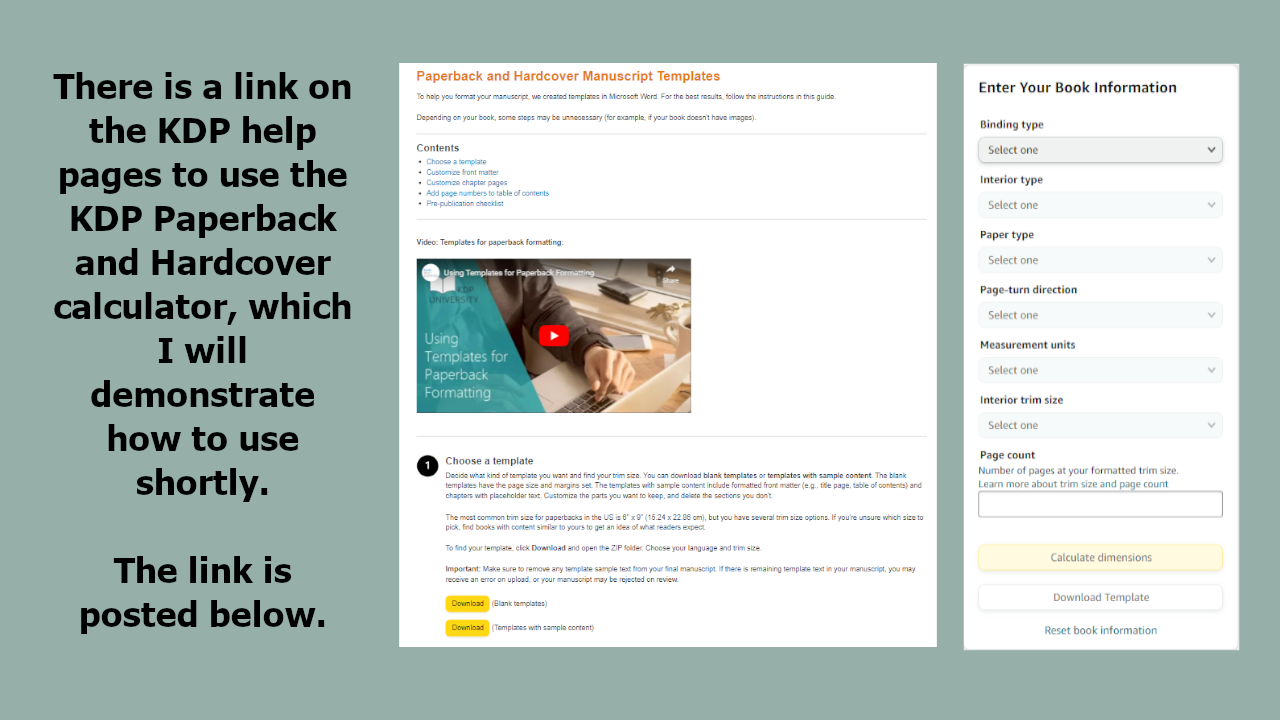
Write down the proper page number before you go to the KDP calculator and run the template.  You will need to click through the questions and choose your answers, including the size of paperback you will use.  I use a 5.06 x 7.81 and demonstrate this choice in the video below if you want to see it done.  Otherwise, you can go straight to the KDP calculator here.

NEWBIE TIP ON BRANDING BOOKS IN GENERAL:

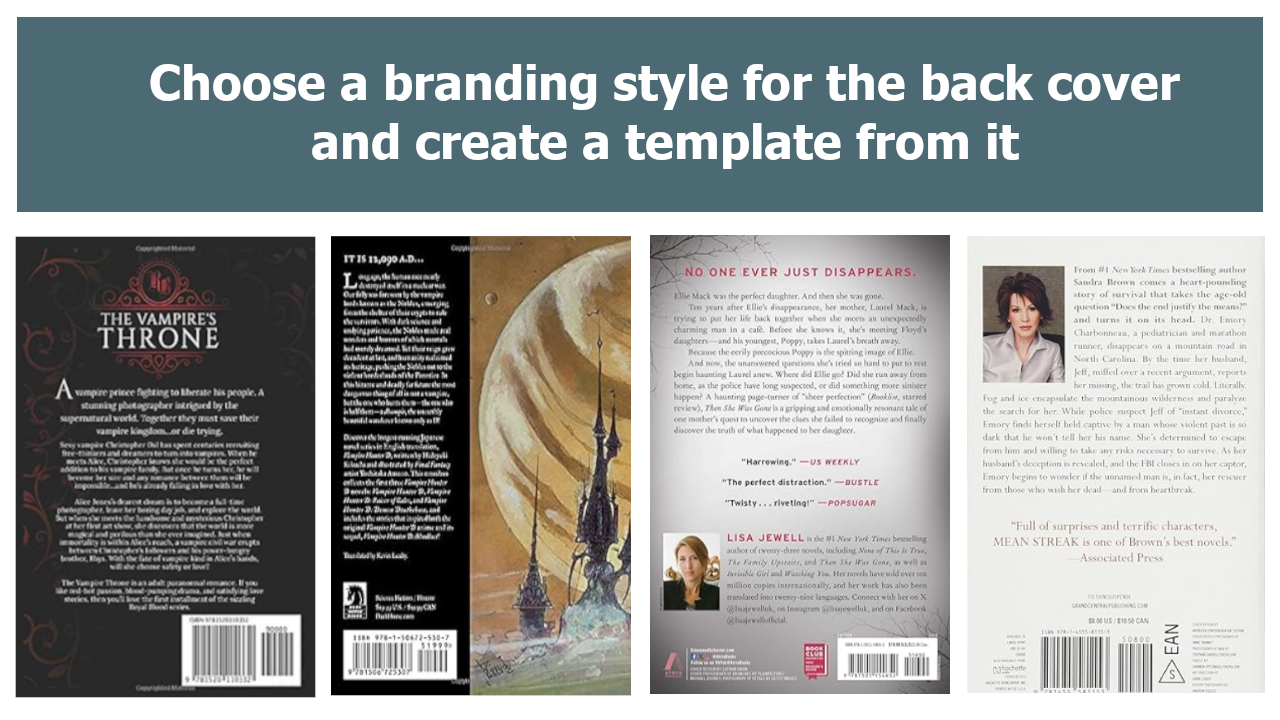
Above is a graphic panel showing you four back-cover examples that I pulled form Amazon this morning by searching for paperbacks in the vampire genre.  I also pulled two other back covers just for comparison.  You may want to think about what type and style of back cover you  want to create before starting.  You will follow the same procedure I've demonstrated in the video below, but you may choose another style for your book.

The book featured in my video is Betrayal and this is my 14th published book and it's the 6th book in my Newport Vampire Stories Series.  So the branding for this series is already established.  While I create my Paperback cover from the eBook cover, I will show you how to follow a style template as I work.

Once you choose a style for the back cover of your own, you can bring in that photograph and use it in the same way I use my series book template.

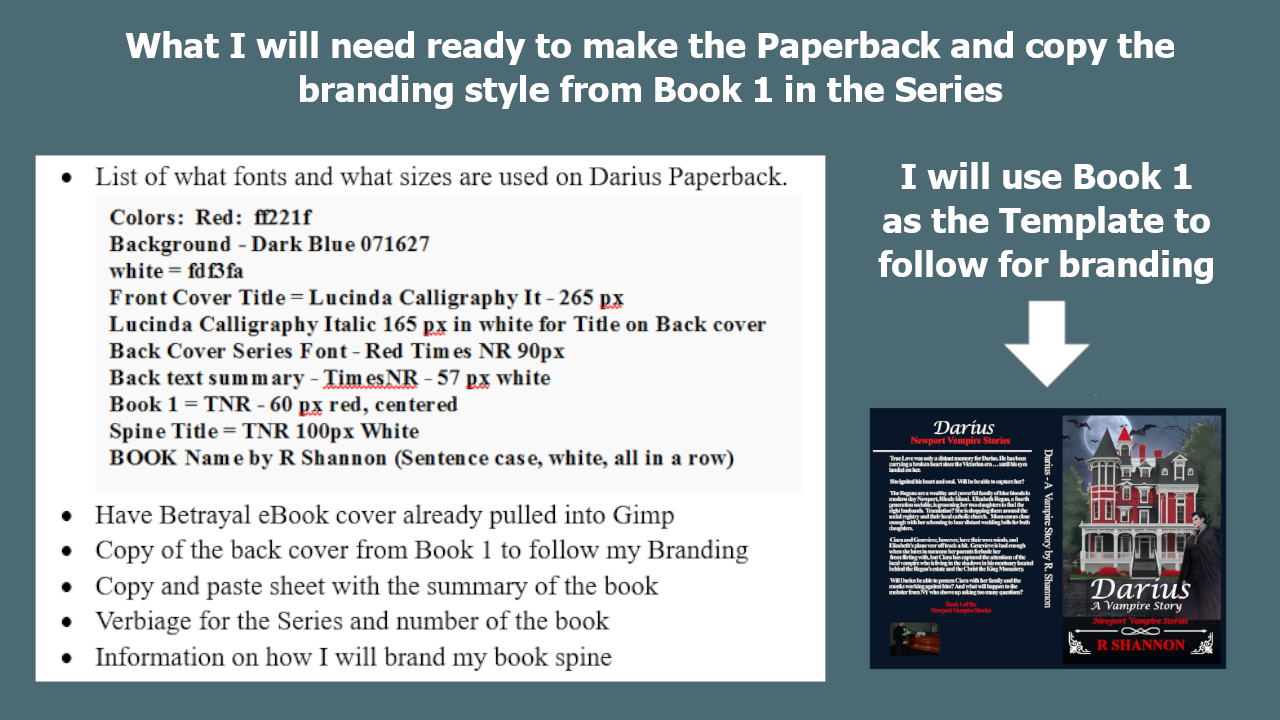
Because my style is already established, I have a list of everything that I will need from the cover, including the layout, all the color numbers, the font names and sizes, and even the size of the font I will use in the spine of the book.

QUICK SUJMMARY OF THE VIDEO:

If you are not a newbie and have no need to see it done, I will just summarize what I do in the video:

I bring in the series paperback template as a 'style template' and add guidelines to the downloaded KDP calculator paperback template.

I pull in and align the ebook cover between the guidelines.

I then pull in the back cover picture and align it accordingly.

Then one by one, I start at the top and create each text layer after another, using the series style template along with the customized margins from the paperback template.

Then using the text tool along with the rotate tool, I create the spine text and align in the center of the guidelines.

I save the finished paperback as an .xcf file so that it saves it as a gimp file with all of the layers in tact.

Then I export the same image as a .jpg file.

I then pull in that .jpg from the recent list and save the .jpg as a pdf.  Gimp had a glitch at one time going from an .xcf file straight to a .pdf.  So I just save the jpg first, which I will need anyway, and then I save the .pdf file.

That's everything in a nutshell.  I'll post the video below for anyone who wants to watch the cover being created in real time.


Book Branding – Inside & Out

LEARN HOW TO COBBLE TOGETHER YOUR OWN STYLE TO BRAND YOUR BOOKS.

Below are two videos about branding the inside of your books, as well as creating an ebook template that contains this styling -- which is part 1.

The second video talks about how to research and cobble together your own custom branding for your book covers.  Whether your write stand-alone books or book series, your books will look more professional with consistent branding.

Even if you self-publish, you will be working towards your own recognition as a professional and serious author.  I hope you enjoy the videos.  If you have any questions or other tips, be sure to post them under the videos.  I do read the comments.


5 Mistakes I Made in Publishing My Vampire Book Series

LET ME SET THE STAGE:

This post will be about 5 Beginner Mistakes I made in Self-Publishing one of my book series and what I did about it -- which was pretty much nothing.  I'll also go into what I am going to do about it now that I learned a lot more about what went wrong.

IDEO-radarMost of these mistakes were ones that were not even on my radar at the time they were made.

Let me give you a bit of context: As I came close to retirement, I decided to write a novel or two. I chose to self-publish for many reasons that I've gone over in other videos and I won't go over now. And to this day, in spite of the mistakes I've made, I still consider self-publishing a good fit for me. (Just me)

too-much-researchWhen I first got the idea of writing a novel, I did research for about a year. I read several how to books on every subject under the title of writing a novel and self-publishing. (Cat on book shelf)
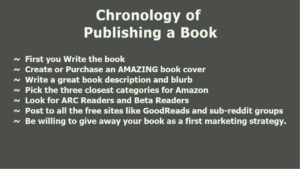
I also watched hundreds of videos on the subject. Like most people, all the information I came upon, especially in video format was great advice, but none of it was curricularized. When you self-study online, you take in just a steady stream of random information and then we're all left to sort it out ourselves. That's how free education works on the internet. (Text Panel 2: Information wasn't curricularized

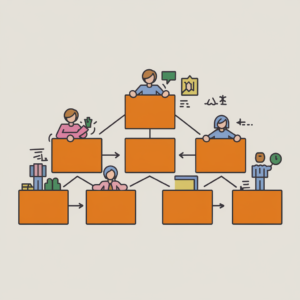
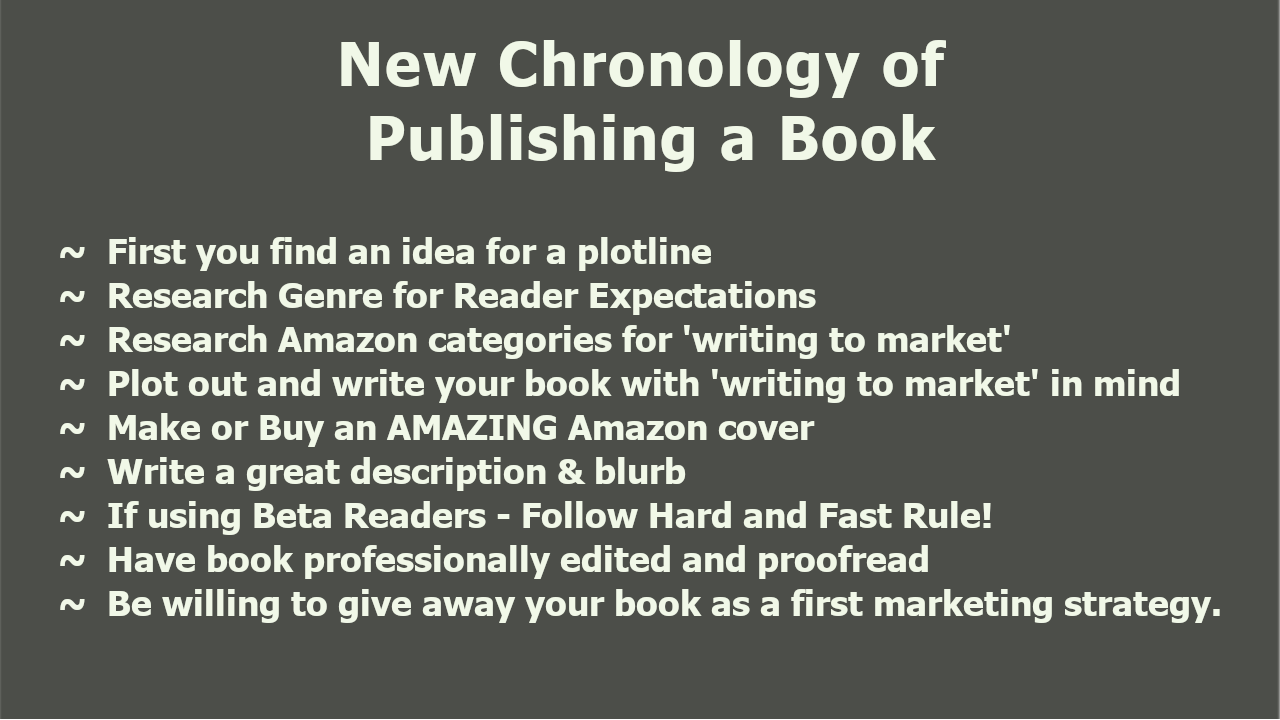
So above is a list of the chronology I pieced together as being the proper chronological list of how to write and publish a book:
MISTAKE NUMBER ONE:

In this big cloud of random information I took in, I got ARC Readers and Beta Readers kind of mixed up or thought they were too closely related. But they are two different animals.

beta-reader-ideasBeta Readers often times read books very early in the process -- before the book is even finished to give early feedback. This is a great idea if you're not sure about your characters or if the plot is good enough, etc. Let's face it, in the beginning it's hard to think you're book is a masterpiece when it's your first one -- at least it was for me. There is a definite high-level purpose in having Beta Readers. They are worth their weight in gold.

IDEO-landmineHowever, here is where I made the terrible mistake and found out the hard way about this particular landmine: I offered my Vampire book Darius - A Vampire Story as a beta book but it had not been finalized, professionally edited or proofread. Now, in the ad copy for the link to download, I clearly posted it as a beta copy that had not been edited, etc. However, once a book is downloaded to an eReader, no one will remember this book is only a beta copy. And the second mistake I made here was that I didn't put anything in the book itself.

I didn't put any explanation paragraph before the First Chapter. I didn't add a watermark. I assumed my explanation about the Beta copy that invited the download was enough.

Well, when I finalized the book and released it, I got slaughtered in early reviews. I assumed as a new author that maybe it wasn't that good. However, several of the reviews referenced typos and/or grammar mistakes. When I went to the finalized copy to of course correct them -- they didn't exist.

crazy-readerThe first time this happened, I just thought the reader was a bit crazy. But after this happened several times, it was only then that I realized that I had released hundreds of beta copies that now lived on people's eReaders. And for some reason, there are a lot of readers who take typos or grammar errors personally. It seems to trigger them and their reviews are more like rants.
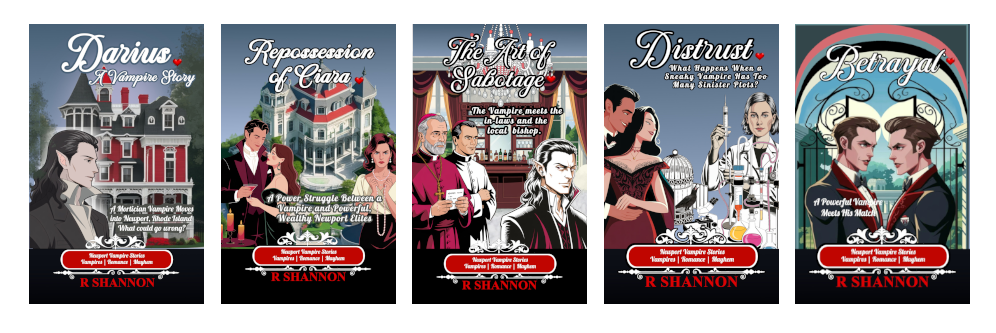
So poor Darius got all beat up in the early review.


MISTAKE NUMBER 2

Mistake Number 2 was what I did about this problem -- which was pretty much nothing.

I wish I could say that I recognized the gravity of the mistake right away, but I didn't. I just thought that some people had read an earlier copy and that's a shame, but what can I do about it now? I didn't realize that there were probably hundreds of these copies out there. I had no list of who I sent these early copies to.

NVS-5-Books-on-trans

Now, I also didn't realize that this series was going to go on for 5 books. So, in hindsight, what I should have done was pull the first three books and re-release them as a second edition. This is what I plan to do in January of 2025 because that's when I'll be releasing the fifth book in the series. So doing nothing about this was the second mistake.

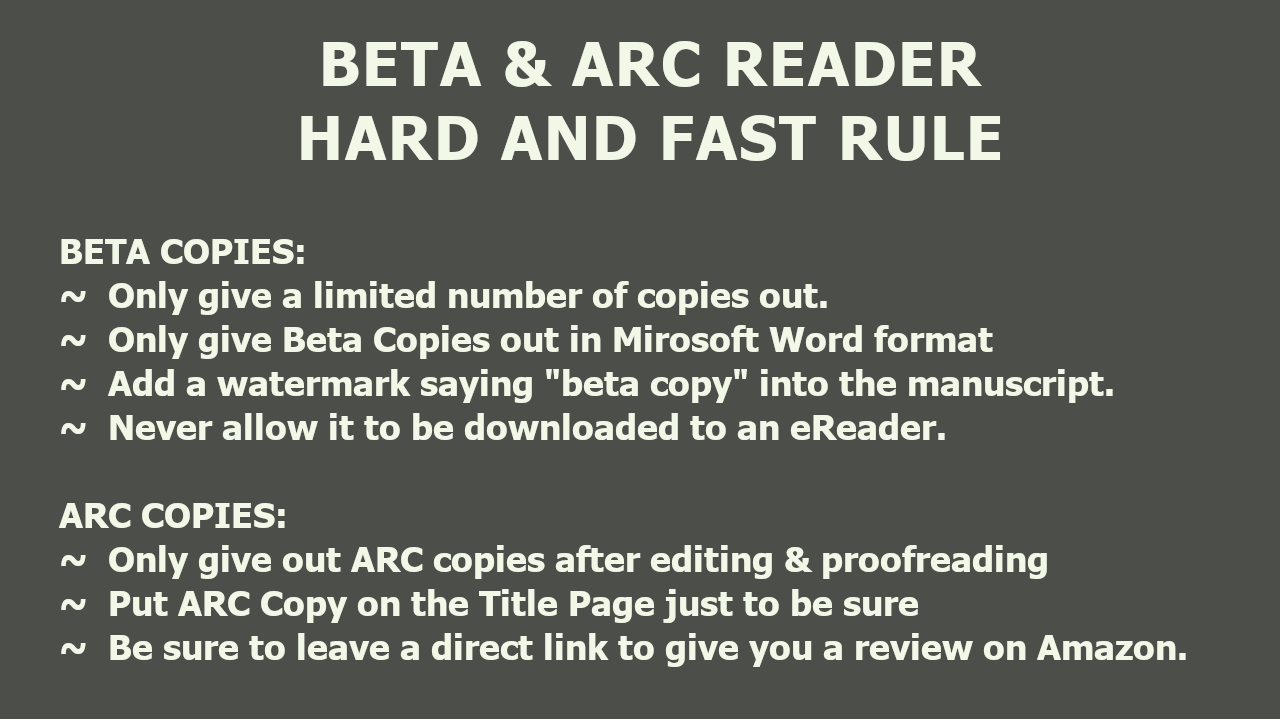
Now I have a hard and fast rule: I never give Beta copies in download format. I now only pay for beta copies and send them in Microsoft Word format. I also include verbiage that it is a beta copy and hasn't been edited or proofread.

MISTAKE NUMBER 3:

Goodreads-as-dogGoodReads is probably the largest single pool of avid readers and book lovers out there. But goodreads can be a tough crowd for new writers. This is where Darius's bullying started. If I had to do things over again, I would not have focused on Goodreads as a first place to release my books -- even after they were fully edited and proofread. Unfortunately, many of the videos I watched during that first year, talked about how great goodreads was helpful to find beta readers and arc readers and launch a book.
To be honest, I never found any true beta readers or arc readers there. I found mostly people who like to download free books. So I would just caution newbies that GoodReads is not the only game in town and you may need some boxing experience before you enter that ring. That's all I'm going to say about that.

A SIDE NOTE ABOUT GIVEAWAYS:

Goodreads has been purchased by Amazon, I believe, and they did offer a giveaway for $119. At least that's what it was at the time I used that service as a giveaway for edited books. However, I found the reviews very harsh or even snotty at times. I had much better experience giving the books away with Freebooksy and even Fussy Librarian for less than $119. I also got better reviews using Bookfunnel and Storyorigin free book giveaways. As long as you don't put your books into Kindle Select, you can still give them away on these websites.


MISTAKE NUMBER 4:

amazon-hierarchyI didn't realize that the categories on Amazon have a hierarchy to them. It may have been because we were originally allowed to put each book into 10 categories. I had watched a video by Author Chris Fox about writing to market and he was explaining about drilling down in the categories and writing to a specific sub-category. Now, he writes sci-fi and in particular, military sci-fi.
At the time he said this, I thought writing to a specific market just to make marketing easier would be awful. It would be like pulling an assignment out of a hat and having to produce a book about it. I'm just not that type of writer. So I let that concept float away in the wind and just picked ten categories that seemed like they would be a the best fit for my books and the rest of the concept of writing to market was lost on me, at least at that time. I moved onto other things.

Over time, pretty recently, I did figure out that the categories are hierarchical and Chris Fox' advice came back to me. What he was saying was that new authors can focus on subcategories in order to dominate in those smaller categories in their to number 1 on the best seller list. In other words, you can rise to number one in a sub-sub category way faster than rising to the top ten in Romance, which is a top tier in the hierarchy.

In the video below, I do go live at Amazon and demonstrate how the categories are hierarchical and how to dig down and see which ones are available for you.

-historical-romanceSo the time to think about the categories is before you even plot out or write the book.  Once you have a plot idea, that's the time to look at the categories and think about where the book would fit, and what you can tweak about the storyline to fit into a sub category or a less competitive category?  Can you make the story happen in the west to be a Western Romance?  Can you put the story into olden times to make it a historical novel, ore even better, put it in a specific time period?  The time to think about categories is right after you have know you have a workable plotline.

In looking back, I could have tweaked a few of my books to fit them very easily into sub-sub categories without changing the storyline much.


MISTAKE NUMBER 5:

barnabus from dark shadowsMistake Number five requires a little explanation. My inspiration for my vampire series was the old Dark Shadows Soap Opera from the late '60s and early '70s. I never watched it as a kid but everyone I knew did. I didn't watch it because I had to walk too far to get home from school in time. This vampire series, like most soap operas at that time, was melodramatic and being a gothic and supernatural story, the storylines were completely crazy. But I loved the show anyway.

What I didn't realize at the time I watched it was that these crazy storylines came from real books. They just seemed crazy to me as they played out in this soap opera. In fairness to the writers of Dark Shadows, they had to produce 5 shows every week without fail.

So, with limited knowledge of the whole vampire genre, I went on to write a vampire book series. My vampire owns and operates a funeral home and keeps a bevy of 3 women to supply the blood he needs. He normally picks up runaways from the train and bus stations, but he winds up falling in love with the daughter of a wealthy, influential family in Newport Rhode Island. There is also a monastery of monks that live on the opposite side of the cemetery that Darius also owns.

No one in the area has any idea they are living next to a vampire and there are some supernatural events that start happening around the Balmont Funeral home, one of which is a mobster from New York looking for his daughter who was last seen with Darius. That's all I'll say about the plotlines.

Now, my series does follow the classic rules on vampirism with a tweak or two. However, there is also a little subtle tongue in cheek narrative in the story, which was more prevalent in the 1960s and 1970s vampire movies.

girl-with-dunce-capSo how does all this fit into mistake number 5?  Well, there's no category for tongue-in-cheek vampire stories. Also, fifty years have passed since this show ended and a lot has happened to the vampire genre in that time. First there was Anne Rice and her books and subsequent movies which are all dead serious and there's no tongue in cheek humor of any kind. I only read the first book and it was steeped in darkness and despair. Because I read for enjoyment, the level of despair was too much for me so I never read the other books.
Then there were the Twilight movies, the TV shows of True Blood and The Vampire Diaries, which were targeted to much younger people. Some of the backdrops were high school or college. And there was the rise of the vampire hunters. My book is a vampire book for adults or young adults who are not interested in high school or college anymore. But there's no amazon category for vampire books for adult. And my books also have no vampire hunters.

None of these were on my radar when I wrote the book. I thought books were judged on how well they were written and if people liked them.  I didn't know reader expectations was even a thing!

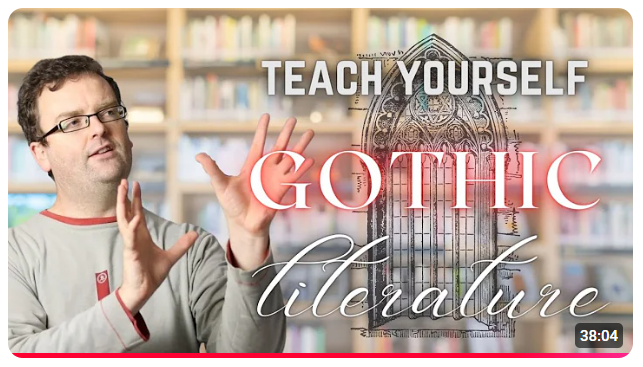
Then I came upon two videos on a channel called Tristan and the Classics  that changed that. It changed my whole trajectory and sent me on a new journey where I learned so much information that is not only helpful but I consider it crucial for newbies.

So as I realized that my books were not really fitting well in any of the vampire categories, I went on to create my own Teach Yourself Gothic Literature course based on Tristan's suggestions. This journey helped me to understand more about writing to market, and about reader expectations in particular, both are which I now feel are critical in self-publishing.

I actually took Tristan's suggestions about the self-study program one step further which I'll go into in the next blog post and video.


CONCLUSION:

So to sum things up, this is the new chronology that I will now use and suggest to beginners that this will be more helpful to you regarding what comes first and then next in writing a book:

Chronology-of-writing-book-final

And below I'll post my new hard and fast rules on Beta Copies and ARC copies:

Beta-and-arc-rules

Below is a Video I did on all of this in case you want to view it too.

Book Plates – How to Make a Customized Book Plate

SUPPLIES AND COMPONENTS NEEDED:

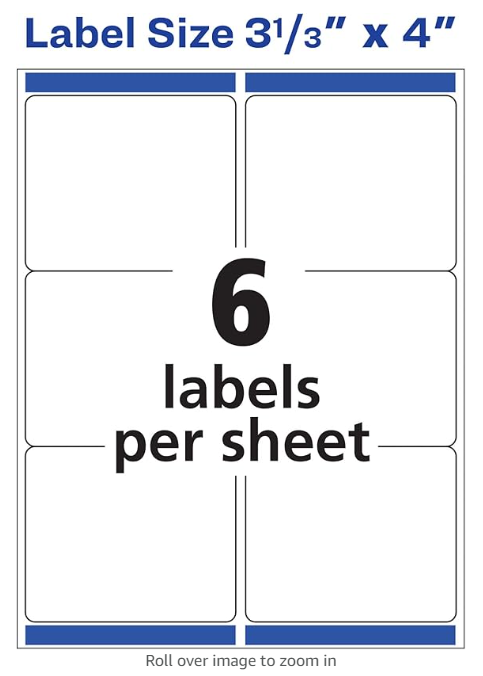
  • 6-postage-labels-per-sheetPrintable Shipping Labels - 6 per page, approximately 3.5 x 4 inches
  • Graphic Frame of some kind (DepositPhotos or search "Fancy Square Frame" on Pixabay
  • Author logo or some other icon, if desired
  • Microsoft Word (or Google Docs)

NOTE:  Any postal labels that are approximately 3.50" x 4" will do.  Avery has them on Amazon or you can use the Office Depot brand.   Most of them come in the color white which works well.

LET'S DESIGN THE LABEL IN GIMP:

There is a video below where I demonstrate how to pull together the design of my bookplate, but I will describe it here for those of you who like to have written instructions.  I start out with an image size 4 inches x 4 inches with a white background.

I started with a frame I purchased from DepositPhotos.com.  This is a paid service, but I always wait to get their 100 pictures for $100 package so each photo I use only costs one dollar.  However, I went to Pixabay.com and found this frame by searching the keywords "Fancy square frames".  There were several other similar ones that came up as well.

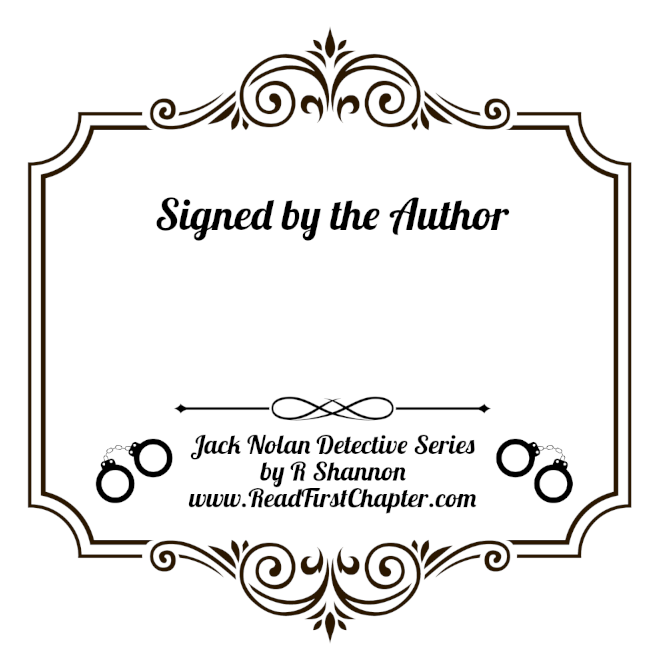
Finished-book-plateI insert the frame, then type in the text elements onto the label.  If you have a website, you may want to add this onto your book plate, as well as the name of a series if your book is part of a series.

After I add the text, I decide how I want to decorate the book plate with a logo or icon or some other background wall paper.

On the bookplate above, I used handcuffs because this is for a Police Procedural book series.  In the video below, I create a new one using a police badge.

3-book-plate-examples

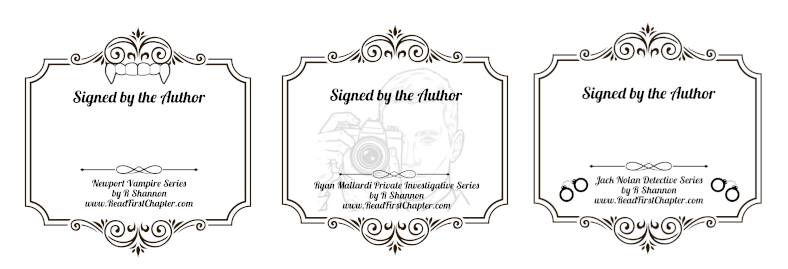
Above are my three book plates as of the date of the writing of this blog post.  The first one has fanged teeth at the top for my vampire books, the second one has a hint of private detective holding a camera for my private investigator series and the last one with the handcuffs is for my police procedural series.  You can add whatever emblem or icon fits your brand or book genre.

CAN I USE CANVA?

I know many people use Canva these days and I do believe you can use Canva.  Especially if you are advanced enough with Canva to make an image or template from scratch, I don't see why you can't do the same thing in Canva.  I don't use Canva myself except for inspiration at times, but I believe it can do amazing things.

SAVE AND EXPORT YOUR IMAGE DESIGN.

If you are using Gimp, I would suggest you save your image as an .xcf file.  This is a gimp file but it will save your book plate in layers.  So when it's time to make another book plate for another book, you can open this file in Gimp and quickly make a second book plate.

Then you want to export the image as a .jpg or .png file.  Since the background of the labels will be white, you can save as either.  Next, I will explain how to create the book plates for printing.

NEXT STEP IS WORD OR GOOGLE DOCUMENTS:

GOOGLE DOCS:

Unfortunately, I don't know how to use google docs as I have always used Microsoft Word.  However, I believe people who use google docs are familiar with how to translate instructions from Word into Google docs, so I will assume that here.

MICROSOFT WORD:

1. Open a blank document in Microsoft word.
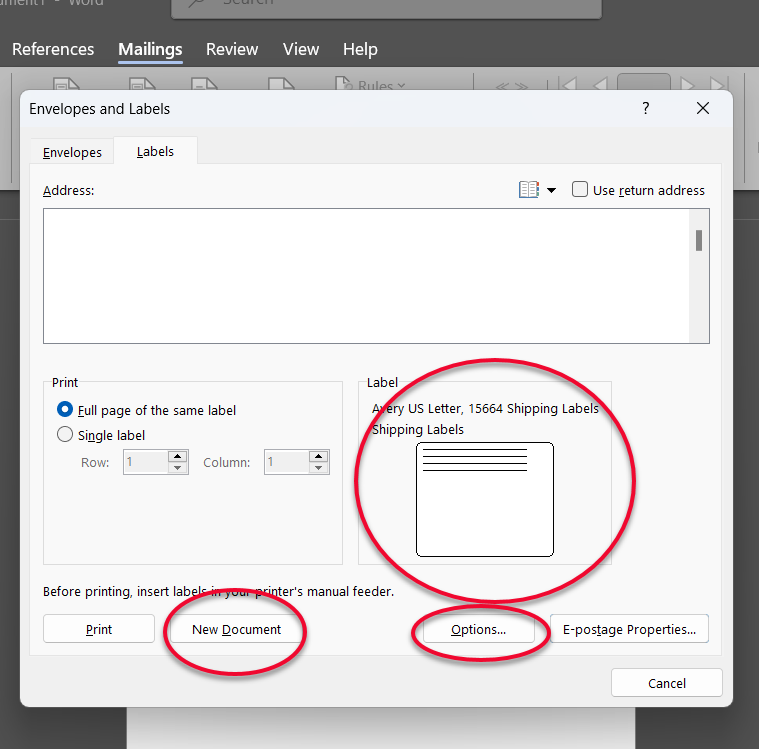
2. Click on the Tab entitled Mailings.  Then choose Labels.

3.  Now my system defaults to a return address and your Word may default to something else, but we need to choose a setting to print the 6 postage labels.  So first choose the Options button, which is at the bottom on the right hand side.  The big red circle shows the small label that my system defaults to and I'm just pointing out the "New document" button for later.

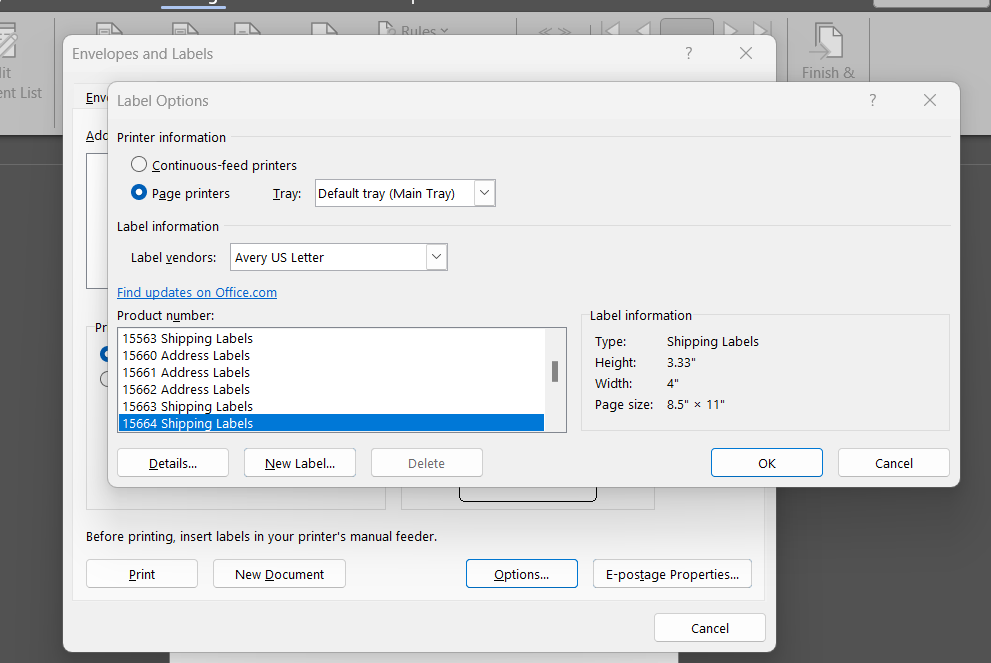
4.  Once you click on Options, another dialogue box will come up which should look similar to the picture below:

This is where you will choose the label,.  First choose Avery US Letter from that top drop-down list.

Then you will find another drop-down list of at least a hundred labels to choose from.  Labels 15664 will give you the 6 labels per page.  But if your system doesn't have this number, look for one that has the same measurements as are posted on the right hand side:  3.33" x 4".  That will give you the 6 postage labels per page.

5. Then go back to Gimp and make sure nothing is selected (Select >none).
Then right click on the finished design and choose copy visible
Go back to the labels, click inside the label and hit control v to paste the artwork into the first label spot.  Choose the image alignment of "through" as this will give you the most flexibility.  Then center the image into the center of the postal label template.

6.  Then click off of that label and then click back onto it.  Click Control C to copy the label in this new size, and paste into each of the other 5 template spots on the postage sheet.

7.  Once they are all there, save this as your book plate file.  You can print onto the postage labels and also save it so you can print again when you run out and need more labels.

YOUTUBE VIDEO BELOW: