WHAT IS PULP FICTION?
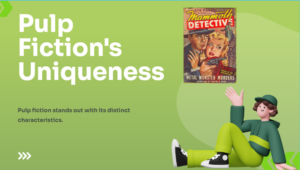 Pulp Fiction become popular during the depression of the 1920s and 1930s. Publishers at the time used a very cheap “pulp” paper in order to produce these short stories and magazines that cost about a quarter. Yes, twenty-five cents!
During the depression, life was difficult and people didn’t want to struggle to make sense of what authors meant by long run on sentences. They didn’t have the stomach or patience for prose. During a depression, people are lucky they can concentrate at all. They wanted escape and the publishers gave it to them in the form of pulp fiction.
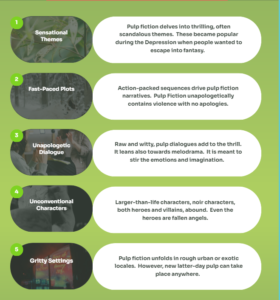
Pulp magazines were filled with adventurous stories with hard-boiled detectives, larger-than-life heroes, space travelers. There was no subtlety. It was all straight-talking dialogue. The plots were fantastical and melodramatic, but easy to follow and easy to read.
A QUICK HISTORY OF PULP FICTION:
In the late 1800s and early 1900s, classical literature was popular. I would even refer to it as high-brow fiction. Oscar Wilde, H G Wells, Jack London, Upton Sinclair, F. Scott Fitzgerald, Ernest Hemingway, William Faulkner. These authors are known not only for their storytelling ability, but their prose, their wordsmithing. This is what I consider ‘high-brow’. Their books are not read-’em and toss-’em books. They are written to read and contemplate, maybe even read again and again.
Agatha Christie was also a part of this list of popular authors at the time, but she may have influenced the pulp fiction genre more than any of the other authors. Her multi-suspect mysteries were extremely popular
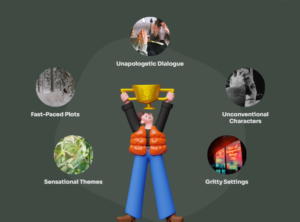
Pulp fiction’s prose was everyday tough talk. There were clever phrases to read and re-read. There was no deep concepts to contemplate. It was mostly action, reaction and romance. The plots were sensational, violent and maybe strange, but they were easy to read; perfect for people who are distracted and worried.
WHAT MAKES PULP FICTION DIFFERENT?
WHAT CAN NEW AUTHORS LEARN FROM READING PULP FICTION?
- Reading pulp fiction can help new authors know the difference between believable action and over-the-top action.
- It can help an author know the difference between writing emotions and over-the-top melodrama.
- It can help an author know how to quickly introduce a character.
- It can show a new writer how to quickly get to the point of a story and keep it lean and tight.
- It can help an author learn how to handle the passage of time, and much more.
Because most of the pulp fiction is short, it can help an author to easily see how the pulp fiction writer handled foreshadowing, passage of time, action scene descriptions, fight scenes, how much and how little back story is needed in a short story. There is much more for a new author to learn from reading pulp fiction.
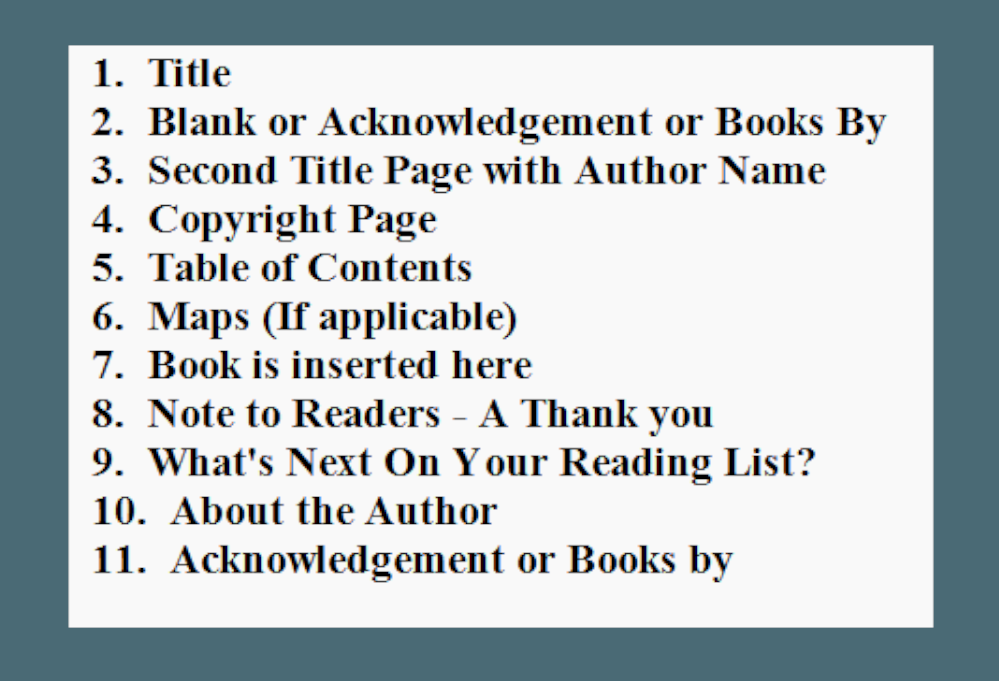 This book is for beginners who are publishing their first or second novel and they are still a little skittish about what else goes into a book. I’ll lay it out so you can easily follow the list and be confident that you’re not forgetting anything. These page suggestions are taken from the publishing industry. These are the pages that appear in a book published by a publishing house.
 Writing a novel is a huge undertaking. There are many things that go into the writing of a fiction story. The best tip I can pass on is this: Break everything down into little bite-sized pieces. By doing this, you can reduce a huge project down to do-able portions that can be done whether you have 2 hours a week to write or two full days! It only requires a little planning and organization.
 It’s important to keep reading as your own journey as a writer continues. Each author has a different style and uses different storytelling techniques. The stories don’t even have to be great. You can learn from the good, the bad and the bland. Just analyzing what made a book bland is a great lesson in itself. Did the story need more action? Did the story get stuck somewhere?
  or other books you read. Reading other authors is crucial no matter where you are on the writing spectrum. However, when you’re new, you can learn a lot from watching mystery or crime noir movies. I like movies from the 1940s, 1950s, and 1960s. The movies in these decades didn’t have CGI and the directors had to use the stage to tell the story. They used wider shots and props to assist the storytelling. By watching these older movies, you can learn a lot regarding writing.
  It’s a good idea to read the synopsis before you view the movie. Knowing at least a basic outline of the story will allow you to absorb more as an author. If you go into the movie blindly, you will be “experiencing the movie” as a viewer only. By knowing ahead of time what story will be unfolding, it will allow you to watch specifically for certain scenes to unfold. You can watch what tools are used to move the story along.
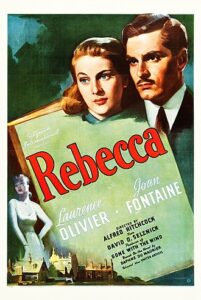 If you are looking for a suggestion, I would suggest Rebecca for the first movie. This movie was directed by Alfred Hitchcock and it has a lot of gothic atmosphere. There is also a psychological plotline in this story so it is a goldmine for learning storytelling tools.
  veryone writes for a reason. Knowing why you write is important, especially as a beginner writer. Writing a book is not hard, but it can be a long process. If your purpose for writing is clear, this will give you the energy and inspiration to spur you on if and/or when the going gets a little tough.
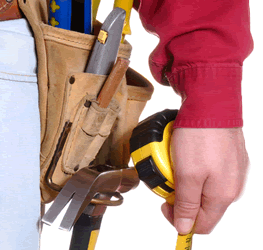 I'm old enough to remember 'phone guys' that worked for Bell South or whatever the phone company was called back then. These men -- they didn't have phone women back then -- would show up with big toolbelts and gaffs or lineworker boots on. These boots had cleats or little metal spikes in them that was a safety feature. These men know everything about the phone system. They would climb the wooden telephone poles and they could fix phones outside on the pole or inside in the houses. They were familiar with the entire system. That is one group of technical workers that have fallen away.
 Very often life dishes out some hard times to some of us. Did you experience, survive and prosper through some difficult times that you feel compelled to write a memoir about? You don't have to have been a famous celebrity or someone with a Moses-like mission. You may have fell on hard times and you want to share your experience, strength or faith that kept you going. People love inspirational stories.

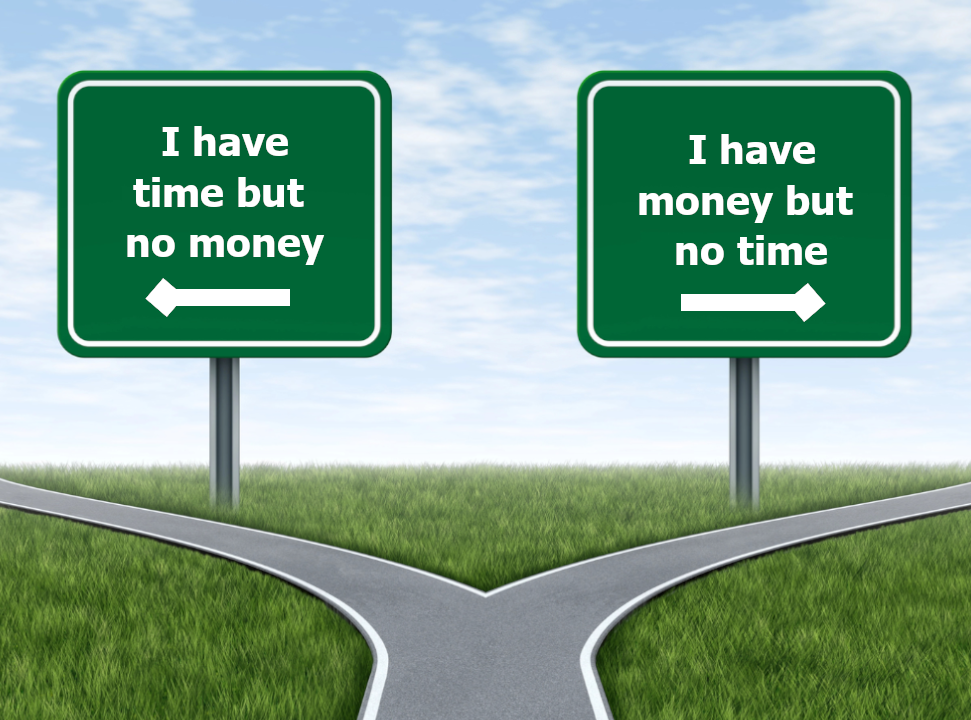
 This could be a person who works full time, lives alone, or has a few kids and there is just not enough extra money around to fund all the things necessary to do when self-publishing a book. Not to worry. There are a few choices for you.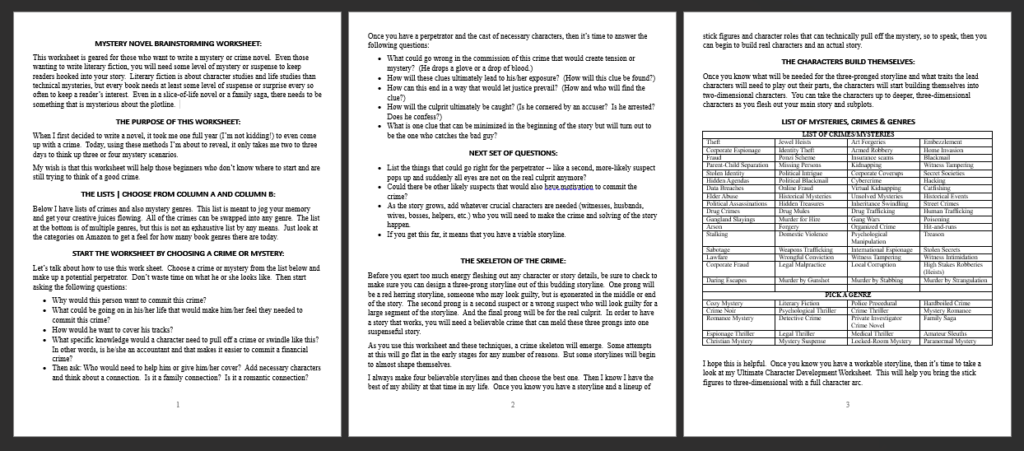
 When I first decided to write a novel, it took me one full year (I’m not kidding!) to even come up with a crime. Today, using these methods I’m about to reveal, it only takes me two to three days to think up three or four mystery scenarios.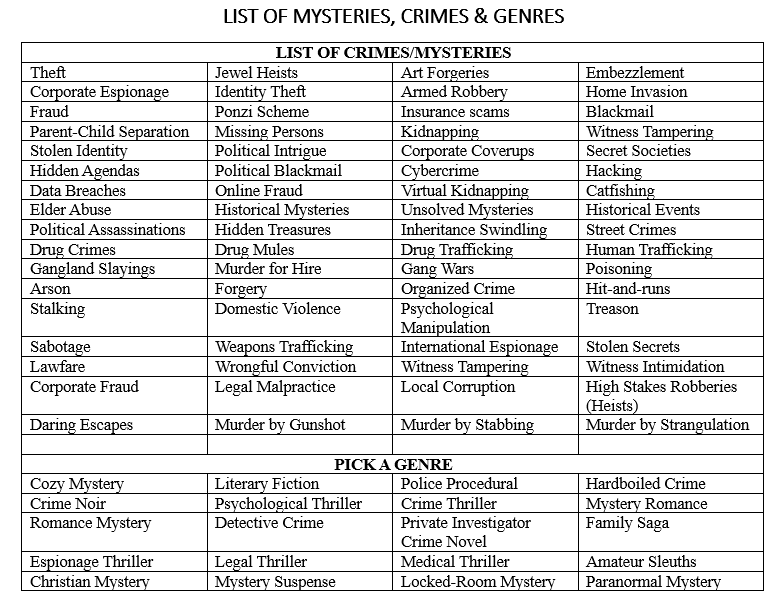
 Let’s talk about how to use this work sheet. Choose a crime or mystery from the list below and make up a potential perpetrator. Don’t waste time on what he or she looks like. Then start asking the following questions:
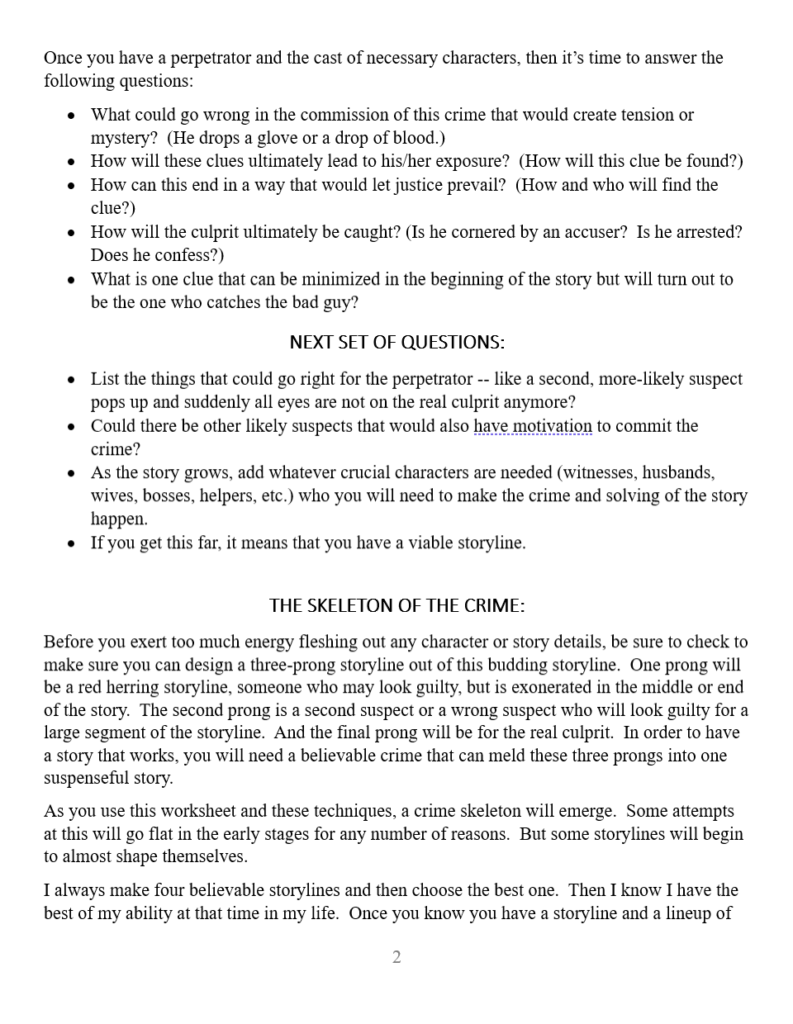 Once you have a perpetrator and the cast of necessary characters, then it’s time to answer the following questions:
 Before you exert too much energy fleshing out any character or story details, be sure to check to make sure you can design a three-prong storyline out of this budding storyline. One prong will be a red herring storyline, someone who may look guilty, but is exonerated in the middle or end of the story. The second prong is a second suspect or a wrong suspect who will look guilty for a large segment of the storyline. And the final prong will be for the real culprit. In order to have a story that works, you will need a believable crime that can meld these three prongs into one suspenseful story.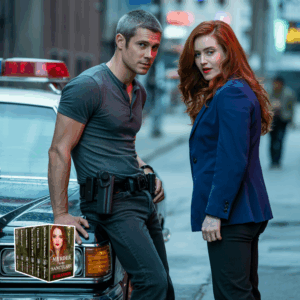
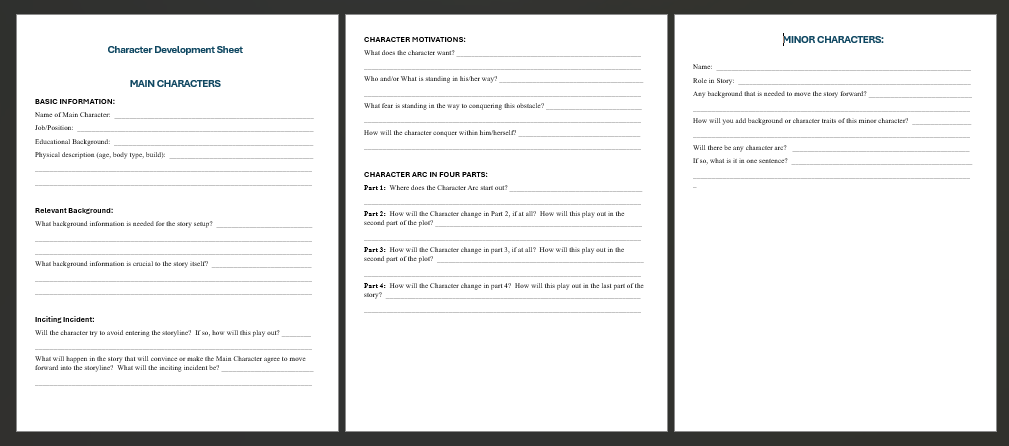
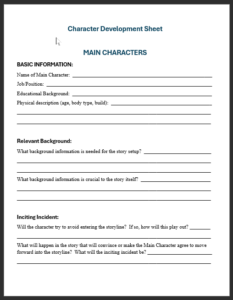 When I started writing several years ago, I came across the standard character worksheet and it focused mostly on physical attributes, occupation but there was a disconnect regarding their role in the storyline, which is the most important part.
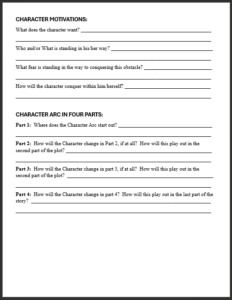 As a newbie, it took me awhile to remember that a character needs to have an arc over the storyline. So it's important -- and time saving -- to know what that arc will be before you even begin the draft. This character sheet can help you find this so you know where you are starting from and where you want to end up. The following questions should help you focus on what this character arc will be:
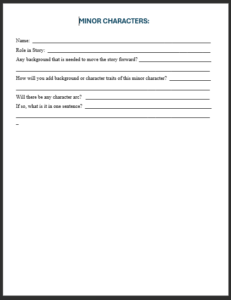 For minor characters, you only need to answer a few questions. It helps to know what role these minor characters will play and what, if any, background information is needed to support them in the storyline:
 Yes, a tax lien on a company is a public record. This means that anyone can search for and view the lien, including potential creditors, investors, and the general public. The lien will typically be filed with the county recorder's office in the county where the company is located.
 The purpose of a tax lien is to give the government a legal claim on the company's assets if the company fails to pay its taxes. The lien will remain in effect until the taxes are paid in full.
 If you are interested in finding out if a company has a tax lien, you can search the public records for the county where the company is located. You can also contact the Internal Revenue Service (IRS) to see if they have a lien on the company.
 Here are some of the reasons why someone (or a detective) might want to know if a company has a tax lien:
 Sometimes just having an overview of how things work can help you thicken the plot or add some details that will enrich the story. Below are some words and definitions that surround the subject of Tax Liens:
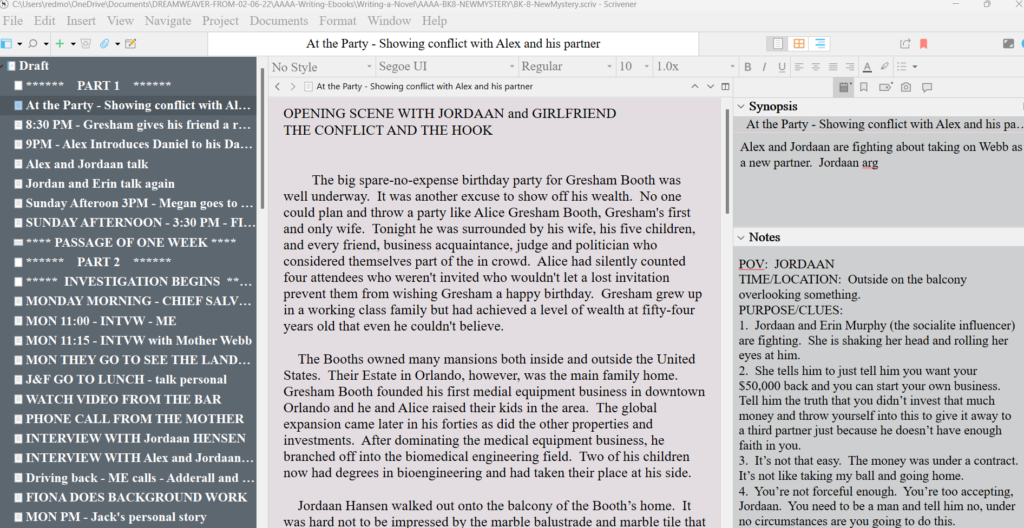 I am knee-deep in Level 4 of writing the next book in the Jack Nolan Detective Series. I thought this would be a good time for me to take a break and reflect on what happens when I'm 'in the weeds' writing a novel.
 When you first sit down to write a novel, everyone is filled with enthusiasm and creative energy. It's exciting. It's new. But as the manuscript begins to grow, before it feels finished -- or even ready to be polished, it feels cumbersome, heavy, and overwhelming. At least for me it does.
 It's possible to get paralyzed by a fear of failure at any point during the writing of a novel. It's not a one-and-done operation. No one sits down, starts writing, finishes writing and ta-da, there's a book. Writing a novel doesn't work that way. It's a long process. It's a multi-layer process.
 Writers block is another common problem among authors. This often sets in after that initial period of excitement about the novel wears off. At some point the writing of the novel shifts into a project requiring some heavy lifting. There's always a phase or two where the author has to tough it out. We have to keep at it.
 Will my readers like the book? Will the book be good enough to get a literary agent? What happens if my book gets bad reviews? There are any number of fears of rejection that can cause us to stop writing. Decide ahead of time you won't allow these fears to stop you. Like I said earlier, think of your writing as a mission God has given you. This is your life's work, along with your other worldly responsibilities. Your writing could be an opportunity to pass on things you have come to learn in your life. That's a purpose. Or maybe writing is a way for you to share the gift of storytelling that you know you were born with. That's a God-given purpose. Whatever the reason, it's important to not allow fear of rejection to get in the way.
 Distractions are one of the biggest obstacles to completing a novel. One reason is because life does serve up constant small and big emergencies that have to take first priorities in our lives. So an emergency distraction can throw a whole well-planned writing schedule up into the air in a heartbeat.
 Most novels require at least some research. The internet can be a blessing with research but it can also be a curse. It's a blessing because the days of having to travel to a public library are over. It can be a curse because the research can suck you in and you can use up all your valuable writing time doing too much research.
 Another trap to finishing a novel is to get caught up in a never-ending edit of the book. This usually hooks in with perfectionism problem in some way.
 Once you complete a novel, there is a little sadness that sets in. This book is no longer your baby. It's no longer your little pet project. Once you hand it off to an editor, it becomes a shared work, so to speak.
 For anyone who is new here, I use a Four Act Structure as opposed to the more-popular three-act structure. I find that middle section in the three-act structure too confusing. Over the writing of 12 novels, I gravitated to a four-part structure as it is more symmetrical and makes more sense to me. I also believe, for whatever it's worth to anyone, that this three-act structure is responsible for the 'lagging' that often occurs in the middle of a story.

 The end of Part Two usually marks the midpoint of the book. I like to end this section with a .big reveal of some kind. Or maybe a clue that turns the investigation into another direction. There could even be a new murder, or the surfacing of an unusual suspect, or someone gets caught in a big lie that changes the direction of the investigation.
 Now the investigation gets a little stressful. The detectives may not agree on who the guilty party is, or maybe they know who it is but can't find the legal evidence to prove it. Maybe they are operating only on gut feeling and speculation at this point. They are rushing against the clock or against other forces working against them to solve it, catch the guilty party or find compelling and irrefutable evidence.
 Part four is broken down into two parts. In the first half of Section 4, the crime or mystery is solved. There will be whatever drama you want to add about the solving of this crime. Whether your detectives are battling physically with someone, bullets are being fired back and forth, or entrapping the guilty party, or just uncovering that last piece of evidence that will legally prove guilt, this is where this is revealed.
 The second half of Part 4 is the 'wrap up'. This is where you will show the new normal, everyone's life 'in resolution'. This is where you will also explain the full growth of your characters. Many author's don't do this, but I don't like to read books where things end where the reader is left to decide what it all means. I may have my own opinions, but I like to know what the author meant by the story. So I make sure I explain, again very quickly, how things are ending in a narrator voice.