For Beginner Writers – Page 2 – Read First Chapter.com

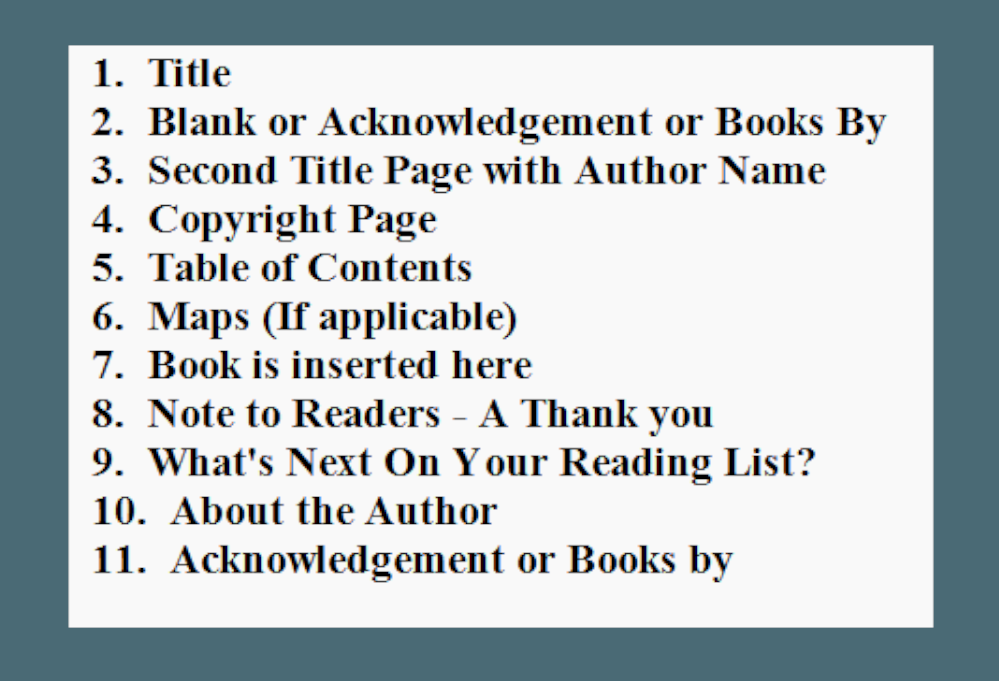
What Eleven Extra Pages Are Needed in a Published book?

This book is for beginners who are publishing their first or second novel and they are still a little skittish about what else goes into a book.  I’ll lay it out so you can easily follow the list and be confident that you’re not forgetting anything.  These page suggestions are taken from the publishing industry.  These are the pages that appear in a book published by a publishing house.

Often the pages before a book starts are referred to as “front matter”.  Pages 1 to 6 would be considered Front Matter.  The rest of the pages after the book is inserted are considered Back Matters.

PAGE 1:  A Title page with only the name of the Book.  The font is usually big enough for the title to stand alone.  It is usually centered on the page horizontally and vertically.

Page 2:  Either a blank page or a Books by Page.  If you have other books that are published, you can list them on this page.  The title should be something like “Other Books by AUTHOR NAME”.

Page 3:  A second Title Page, but this one will have the name of the book, and below it the name of the author.  Again, this is in larger font and it is centered vertically and horizontally on the page.

Page 4:  Copyright page.  I am not a lawyer so I can’t give you any information that is legally correct.  However, I can tell you that I cobbled together different verbiage that I found in other author books.  I made it long enough to cover my bases, but not too long.  Below is the verbiage that I used.


COPYRIGHT:
This book is a work of fiction. Names, characters, places, and incidents are the product of the author’s imagination or are used fictitiously. Any resemblance to actual events, locales, or persons, living or dead, is coincidental.
Copyright © 2024 by AUTHOR NAME
Forward copyright © 2024 by AUTHOR NAME
Preview of this book copyright © 2024 by AUTHOR NAME
All rights reserved. In accordance with the U.S. Copyright Act of 1976, the scanning, uploading, and electronic sharing of any part of this book without the permission of the publisher constitute unlawful piracy and theft of the author’s intellectual property. If you would like to use the material from the book (other than for review purposes), prior written permission must be obtained by contacting the publisher at AUTHOR’S EMAIL.
Thank you for your support of the author’s rights.
Then you can put the name of your publishing company, if you have one, otherwise, leave the rest of the page blank.

Page 5:  Table of Contents.  eBooks require links for chapter beginnings and Paperback and Hardcover require page numbers.

Page 6:  (If applicable) Any maps that you may be including in your book.

Page 7:  Next comes your book.

Page 8:  Note to Readers.

Dear Reader:

Thanks for giving your time  to read this story.  I hope you enjoyed it.

As a new fiction author, reviews are very helpful to me. If you enjoyed this novel, I’d be so grateful if you would leave a review on Amazon.com. Here is a direct link:  (Add link to the review for this book).

[In order to create a review link, you will need the ASIN number of your book.  Then swap out your ASIN Number or ISBN number for the X’s in the link below:

https://www.amazon.com/review/create-review?&asin=XXXXXXXX]

I love to hear any feedback about the book and enjoy interacting with my readers, so please feel free to email me at AUTHOR EMAIL

Thanks again!
AUTHOR NAME OR SIGNATURE

Page 9:  What’s Next on your Reading List?

Verbiage:  Below is a chapter or two of my next book (or the next book in a series) for you to sample.  I hope you enjoy it.

Then insert up to 9% of the next book.  I keep it under 10% in case you are in Kindle Select.  They allow up to 10%, but I like to keep it on the lower side.

Page 10:  About the Author:  Add a biography of yourself.  Be sure to add a contact email as well as a little personal information.

Page 11:  Acknowledgements:  This page can go here or in the beginning of the book.  You can put it in lieu of “Other Books By Page.”  If you do use the Acknowledgements in the beginning of the book, then you can add the Other Books By Page here at Page 11.


MYSTERY NOVEL BRAINSTORMING FOR BEGINNERS

THE BEST TIP I CAN PASS ON TO BEGINNER WRITERS:

bite-sized piecesWriting a novel is a huge undertaking.  There are many things that go into the writing of a fiction story.  The best tip I can pass on is this:  Break everything down into little bite-sized pieces.  By doing this, you can reduce a huge project down to do-able portions that can be done whether you have 2 hours a week to write or two full days!  It only requires a little planning and organization.
ALL NOVELS REQUIRE SOME SUSPENSE:

Regardless of what type of novel you choose to write, all stories require at least a semblance of suspense.  Suspense is what hooks the reader into the story, and it is what pulls the reader along the story and keeps them reading.  Suspense creates a question the reader desires an answer to.  The greater the suspense, the more hooked the reader will be.  

READING OTHER AUTHORS:

bite-sized piecesIt’s important to keep reading as your own journey as a writer continues.  Each author has a different style and uses different storytelling techniques.  The stories don’t even have to be great.  You can learn from the good, the bad and the bland.  Just analyzing what made a book bland is a great lesson in itself.  Did the story need more action?  Did the story get stuck somewhere? 
When I read novels now,  I can usually tell whether the author is a pantser or a plotter.  If the story sags in the third section, I can tell the author got caught in part two of the three-act structure. 

The books I read now are twice as enjoyable because I experience them as a reader but as an author too.  I get to enjoy the story itself but also watch and learn the author’s storytelling techniques too.  

WATCHING MOVIES FOR INSPIRATION:

When I am in the process of writing my own novels, I tend to read less because I’m reading and proofreading my own pages.  During these times, I like to vegetate by getting lost in a movie.  I watch movies specifically to learn from them.  Believe me, you can learn a lot about the actual storytelling craft from watching movies.  They can also be a source of inspiration for your own stories.  

It took me almost a year to come up with my first story for a novel.  One full year.  I didn’t know where to start.  I had ideas, but didn’t know how to brainstorm them into a potential story.  

WHERE CAN DO YOU GET IDEAS FOR A FICTION STORY FROM?

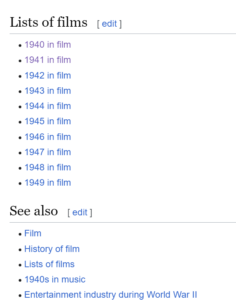
Ideas for stories in the beginning will come from TV movies, Cinema movies film list of the 1940sor other books you read.  Reading other authors is crucial no matter where you are on the writing spectrum.  However, when you’re new, you can learn a lot from watching mystery or crime noir movies.  I like movies from the 1940s, 1950s, and 1960s.  The movies in these decades didn’t have CGI and the directors had to use the stage to tell the story.  They used wider shots and props to assist the storytelling.  By watching these older movies, you can learn a lot regarding writing.  

The movies of today show the location scenes once and then do close up shots of one character talking and then follow it up with another close-up shot of a character talking.  There’s not that much to learn about storytelling from these movies.  It’s a shame because the sets are absolutely gorgeous, especially in the fantasy movies.  

To the left (or above) is a screenshot of the Wikipedia page that comes up when you search “1940 in film”.  This will give you all of the films and a tiny synopsis of what the films are about.  You can pick whatever decade appeals to you.

READ THE SYNOPSIS FOR THE MOVIE FIRST:

read-the-synopsisIt’s a good idea to read the synopsis before you view the movie.  Knowing at least a basic outline of the story will allow you to absorb more as an author.  If you go into the movie  blindly, you will be “experiencing the movie” as a viewer only.  By knowing ahead of time what story will be unfolding, it will allow you to watch specifically for certain scenes to unfold.  You can watch what tools are used to move the story along.   

For example:  Notice in the scenes how much information is passing to the viewer by the setting.  Besides the timeline of when the story is taking place, it often will give you shots of recognizable icons from certain cities.  There are so many techniques you can learn from watching these older movies about all of the tools used to lay out the facts of the story and how suspense is created.  Below is a list of things to watch for in stories:

  1.  How does the movie show the location of the story?  Do they use icons, or text on the screen?  Do they use snippets of dialogue?  Each movie you will learn different tricks for showing time and location.  
  2. How does the story show either poverty or opulence?
  3. How does the movie present the premise?  There will be at least dialogue about what the main character wants or needs.  Notice how this is done. 
  4. Notice where the suspense of the story starts.  Even in non-mystery stories, there will be at least a thread of suspense.  It might be suggested by a vision that one character and the viewer see and no one else does.  Or it may be a little gossip that passes in a short conversation.  
  5. Notice how the passage of time is handled.  Is the passage of a few years spoken in dialogue or is it projected in some other way?
  6. Notice how the writers show the character’s weakness or fallen nature.  
  7. Notice the change in locations in the story.  This is often how the story is kept moving forward.
  8. Notice when the suspense gets stronger.  
  9. Watch for how the writers will use lies to create a sense of worry or dread.
  10. For any twists in the story, notice how abrupt it happens.  Also take the time to notice if this was foreshadowed in the beginning of the story.  Readers love foreshadowing.  

MY SUGGESTION FOR A MOVIE:

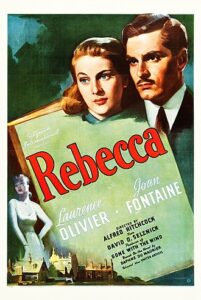
Rebecca-movie-posterIf you are looking for a suggestion, I would suggest Rebecca for the first movie.  This movie was directed by Alfred Hitchcock and it has a lot of gothic atmosphere.  There is also a psychological plotline in this story so it is a goldmine for learning storytelling tools.  
Most of the synopses on Wikipedia give you an outline of the story but they don’t have spoilers in them.  Sometimes I only read about six paragraphs on the really long ones because the purpose is only to know a little bit about what the story will be about so you can watch for how things are handled on film.  You can easily translate any of these tools to novel writing.  

GOTHIC MOVIES:  Gothic movies are great at showing how to introduce fear and suspense into a story.  They are also a great place to learn how to use the atmosphere and the location and backdrops to add to the suspense.

FILM NOIR:  These movies are great to learn character development.  Film Noir is usually about all fallen characters.  In other words, they are all sinners, but some characters are bigger sinners than others.  This is a great way to learn how to craft a fallen

LONG SERIES:  These are great to learn about how the location and things in the room or backdrop help to relay the story.  You can learn a lot about the passage of time, how flashbacks are handled, how to introduce new characters in preparation to take the story in a new direction.  Miniseries like Downton Abbey and other miniseries are a great place to learn about what is going on.  

MELODRAMA:  Melodrama has fallen out of favor in recent times, but I personally think it needs a comeback.  You can learn about melodrama from old world soap operas.  I think the only one I can think of is Dallas.  It’s on either Amazon Prime or somewhere else you can watch it.  These types of shows are good for showing how to blend romance, cheating, and other emotional scenes into the story. 

You don’t have to commit to watching the entire soap opera.  You can learn a lot about storytelling tools by watching only a few shows.  

Blow is a copy of the entire Brainwashing Sheet I referred to above.  You can read the blog post about how to use it here.  

And you can sign in to download your copy of the sheets below:

Writing Fiction or Memoirs With a Purpose

IT'S IMPORTANT TO KNOW WHY YOU WANT TO WRITE.

EWords-Writing-with-a-Purposeveryone writes for a reason.  Knowing why you write is important, especially as a beginner writer.  Writing a book is not hard, but it can be a long process.   If your purpose for writing is clear, this will give you the energy and inspiration to spur you on if and/or when the going gets a little tough.

Are you writing for pleasure?  Are you an avid reader and you want to write the books you never found?  Do you want to write around some social commentary you have a desire to share?  Writing is a form of sharing.  What is it that you want to share?  Your wit?  Maybe Satire? Have you always been told that you're funny?   Do you have a unique take on society that you think people would like?

I love stories and movies that have a backdrop of Catholicism in them, like The Godfather saga, or The Supranos, or even Ray Donovan.  The Catholicism in these stories felt familiar to me and I believe it gave the story a layer of depth as it tapped into religion and culture which tends to anchor a group or family.  So I write novels that have either a backdrop of Catholicism or a ribbon of Catholic sensibility passing through it.  Of course, I leave out the blasphemy that Hollywood loves to toss in there on occasion!

I also write as part of my legacy.  I began to write in 2018 when I moved to Central Florida, which I considered my pre-retirement.  Now I have retired and I write full time.  I feel that my books will be part of my legacy.  I'm clear on my purpose for writing.

ARE STORIES JUST BURSTING TO COME OUT OF YOUR HEAD?

Some people are what I call natural-born writers.  They do have stories bursting out of their hearts and heads.  Often, these people fell in love with reading as children.  Reading was an adventure.  It took them up, up and away.  Some people have always had a desire to author their own stories.  If this sounds like you, you are a natural-born author.

This is usually a sign that you have been given the gift of authoring.  These gifts are Heaven-sent, and predate schooling and other influences in your life.  If this is the case, embracing your fate is probably the next best step to take.

Words-You-Are-Your-Legacy

DO YOU WANT TO WRITE AS PART OF YOUR LEGACY?

There are trades and arts that seem to fall by the wayside in each generation.  But often, how to do certain things is lost to history.  Do you know how to do something that you feel you need to leave behind?  Do you want to write about how you did something that is now fading from the world?

There are young people who don't know how to write a check anymore.  They don't know how to address an envelope for the mail.  Some don't even read cursive writing anymore.

Listening to a lecture by the learned intellectual and researcher Thomas Sowell, he stated that when Rome fell, the western world lost the art of making bricks.  Then when the western world got back on its feet, they had to import brings from England because the art of making bricks died with the civilization.  Cement was invented in Rome.  They made all of those brick arches -- but the art was lost.  What is it that you know how to do that you feel compelled to record for prosperity's sake?

I'm old enough to remember 'phone guys' that worked for Bell South or whatever the phone company was called back then.  These men -- they didn't have phone women back then -- would show up with big toolbelts and gaffs or lineworker boots on.  These boots had cleats or little metal spikes in them that was a safety feature.  These men know everything about the phone system.  They would climb the wooden telephone poles and they could fix phones outside on the pole or inside in the houses.  They were familiar with the entire system.   That is one group of technical workers that have fallen away.

Is there something about an art form or a job that you knew that you want to pass on for prosperity sake?  You can write a novel around it and it will serve two purposes:  It will be a way for you to tell the story of your industry or job and you will be documenting how life was at a certain time in history.

DO YOU HAVE A BURNING DESIRE TO SHARE A UNIQUE EXPERIENCE?

Author signing autograph in own book at wooden table on white planks backgroundVery often life dishes out some hard times to some of us.  Did you experience, survive and prosper through some difficult times that you feel compelled to write a memoir about?  You don't have to have been a famous celebrity or someone with a Moses-like mission.  You may have fell on hard times and you want to share your experience, strength or faith that kept you going.  People love inspirational stories.

Writing a memoir can also be part of your legacy.  Someone three generations down the road may be curious about how the family was back in your times.  By having a published memoir, you can share your perspective on things during the times you lived.

Today people no longer write letters.  Most photos live on phones that may be lost or stolen.  Even photos in the cloud could easily be lost to history without the right username and password.  By writing a memoir, you may be someone who is documenting the present in a way that historians in the future may be very grateful for.

SO WHY DO YOU WANT TO WRITE A BOOK?

What do you think?  Do any of these reasons resonate with you?  Make your first writing assignment to list the reason or reasons why you choose to write.

Here is a video where I had a few more words to say about finding your reason to write!

Free eBook Download

Weekly Newsletter


Brainstorming Workbook

Free Novelette Download

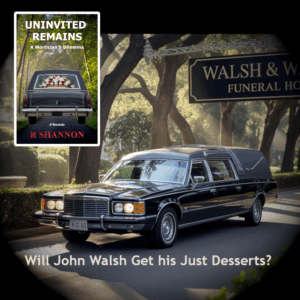
John Walsh is a successful funeral director with a loving family but he has a weakness for other women. The modern world thinks cheating is a victimless crime, but is it?

Click here to download a free copy for a limited time.


Where to Find Beta Readers

WHERE TO FIND BETA READERS
DEPENDS ON TWO THINGS:

Blog-MoneyvsTime

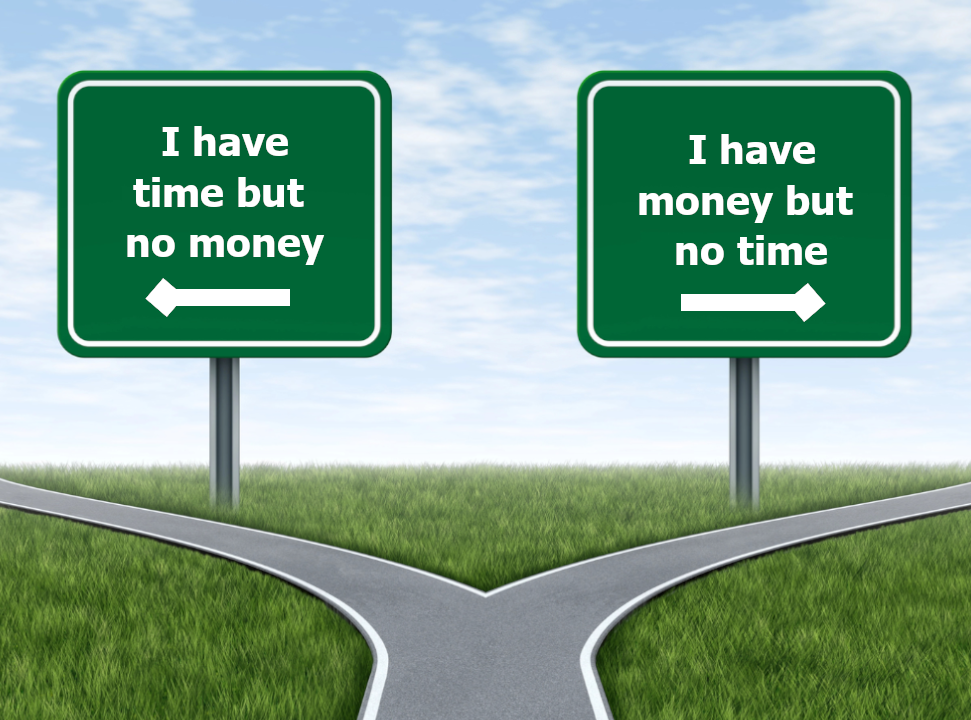
Some writers have no-to-little money to work with and they will take one route. Other writers have no time but have some money to work with. Where you are on this road will determine what your choices are.

I HAVE TIME BUT NO MONEY:

beta-reader-ideasThis could be a person who works full time, lives alone, or has a few kids and there is just not enough extra money around to fund all the things necessary to do when self-publishing a book.  Not to worry. There are a few choices for you.

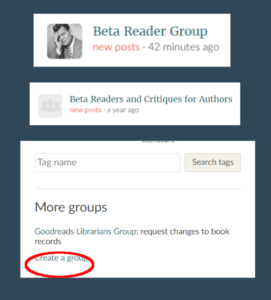
Goodreads.com is an active website for readers and authors and is filled with other authors who are also looking for help to publish their books. The trick is to find them.

If you search "Beta Readers" in the search box on Goodreads, it will bring up all of the beta reader groups that are available to you at that time.  You can access this under the community tab on the navigation menu. Be sure to read the rules and regulations for the specific group because the last time I looked, there were a few Gestapo-like warnings and instructionals about  how people should post.

If you happen to be extraverted or bubbly, good with people, you will have no trouble finding someone in one of these groups or forums to help you. I'm introverted and don't do well in these large groups because I always feel like I'm bothering people.  But not everyone is like this, so if you are good at making acquaintances and friends, give Goodreads a try.

Try to google "beta readers" as well and you will find other forums that claim to have people willing to read your book.  I never gave this much patience because I chose to just pay someone.

TRY A FAMILY MEMBER AS A BETA READER:

If you have a family member who you can trust to give you honest feedback and gentle criticism, this is probably the best choice.  Make sure it's someone who will want to do a good job for you and they will know you are counting on them. That's what I did.  My Aunt Gen offered to read my books and I jumped at the chance. She read them and kept a notepad by her book and jotted down everything she thought about.

I also had a friend who needed computer help and I bartered with her for beta reading.  That was also a great experience.

The trick to making working with amateurs, so to speak, work is knowing two things.  (1) Your readers will feel that they have to give you some level of criticism so you have to be ready to make that work for you.  I'll go into that below.  (2)  The second thing is that sometimes people will give you advice about writing books that come out of left field.  They will not know what they are talking about, so it's important to be prepared for this.  Just be ready to thank them for their ideas.

Once you have chosen a family member or friend to beat read for you, you need to direct their attention to what it is you are interested in having them do. Tell them that after they read the book, you will want to know the following 5 things:

  1. Do you like the characters?
  2. Is the plot easy enough to follow or was it confusing at any point?
  3. Were there any plot holes or anything about the plot that felt unfinished?
  4. How were the character and location descriptions?
  5. Did my prose read easily or did you find yourself having to re-read sentences sometimes?

That's it.  Let them have the book with those questions.  Then after they're done, you can ask them other questions.  By guiding them as to what you want to know, you will get feedback and criticism that is helpful.


I HAVE MONEY BUT NOT TIME:

If you are working, raising kids, or just working 60 hours a week, you probably have a few extra dollars and will need to get someone two help you for a reasonable price.  There are full industries that have sprung up around the entire self-publishing industry, but it's important to know how not to be ripped off!

I used Fiverr.com for my beta readers.  I found someone who was willing to read my book and give me feedback.  The person I chose read the book in Microsoft Word and she used commenting in the Track Changes feature.  I hadn't thought of this myself at that point.  She commented all throughout the book.  This was so valuable because it was like being in the reader's head when she read the book.

I gave her my list of 5 questions above and between her answering the questions and commenting throughout the book, she did a great job.  She charged me $80.  This was back in 2022 so it may have gone up to $100, but I believe it's still worth it.

I have become a repeat Fiverr user as I have had nothing but good experiences on their website.

Here is a video you may like where I go over pretty much the same material I just explained in the blog post.


MYSTERY NOVEL BRAINSTORMING WORKSHEET

This worksheet is geared for those who want to write a mystery or crime novel.  Even those wanting to write literary fiction, you will need some level of mystery or suspense to keep readers hooked into your story.  Literary fiction is about character studies and life studies than technical mysteries, but every book needs at least some level of suspense or surprise every so often to keep a reader’s interest.  Even in a slice-of-life novel or a family saga, there needs to be something that is mysterious about the plotline.

THE PURPOSE OF THIS WORKSHEET:

cop examining ballistic reportWhen I first decided to write a novel, it took me one full year (I’m not kidding!) to even come up with a crime.  Today, using these methods I’m about to reveal, it only takes me two to three days to think up three or four mystery scenarios.
My wish is that this worksheet will help those beginners who don’t know where to start and are still trying to think of a good crime.

THE LISTS | CHOOSE FROM COLUMN A AND COLUMN B:

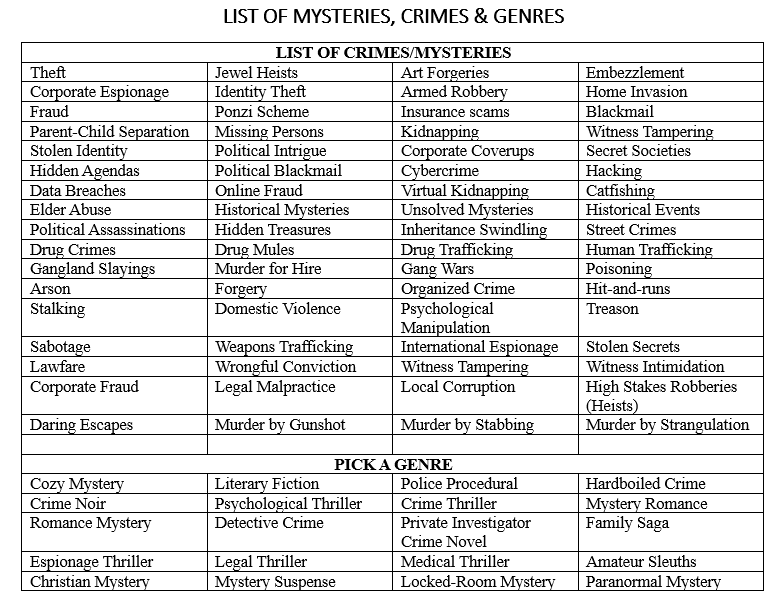
Below I have lists of crimes and also mystery genres.  This list is meant to jog your memory and get your creative juices flowing.  All of the crimes can be swapped into any genre.  The list at the bottom is of multiple genres, but this is not an exhaustive list by any means.  Just look at the categories on Amazon to get a feel for how many book genres there are today.


START THE WORKSHEET BY CHOOSING A CRIME OR MYSTERY:

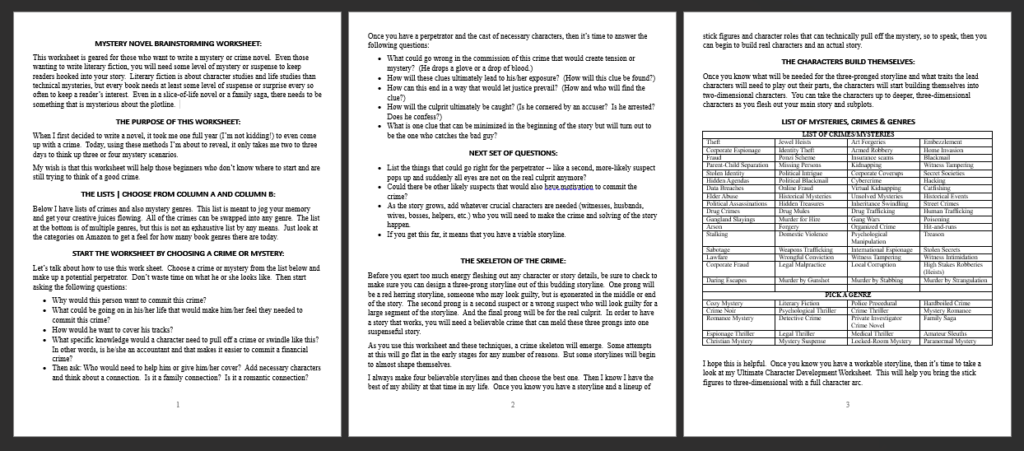
mystery-novel-brainstorming-worksheet-pg1 Let’s talk about how to use this work sheet.  Choose a crime or mystery from the list below and make up a potential perpetrator.  Don’t waste time on what he or she looks like.  Then start asking the following questions:
  • Why would this person want to commit this crime?
  • What could be going on in his/her life that would make him/her feel they needed to commit this crime?
  • How would he want to cover his tracks?
  • What specific knowledge would a character need to pull off a crime or swindle like this? In other words, is he/she an accountant and that makes it easier to commit a financial crime?
  • Then ask: Who would need to help him or give him/her cover? Add necessary characters and think about a connection.  Is it a family connection?  Is it a romantic connection?

THE NEXT SET OF QUESTIONS TO ASK:

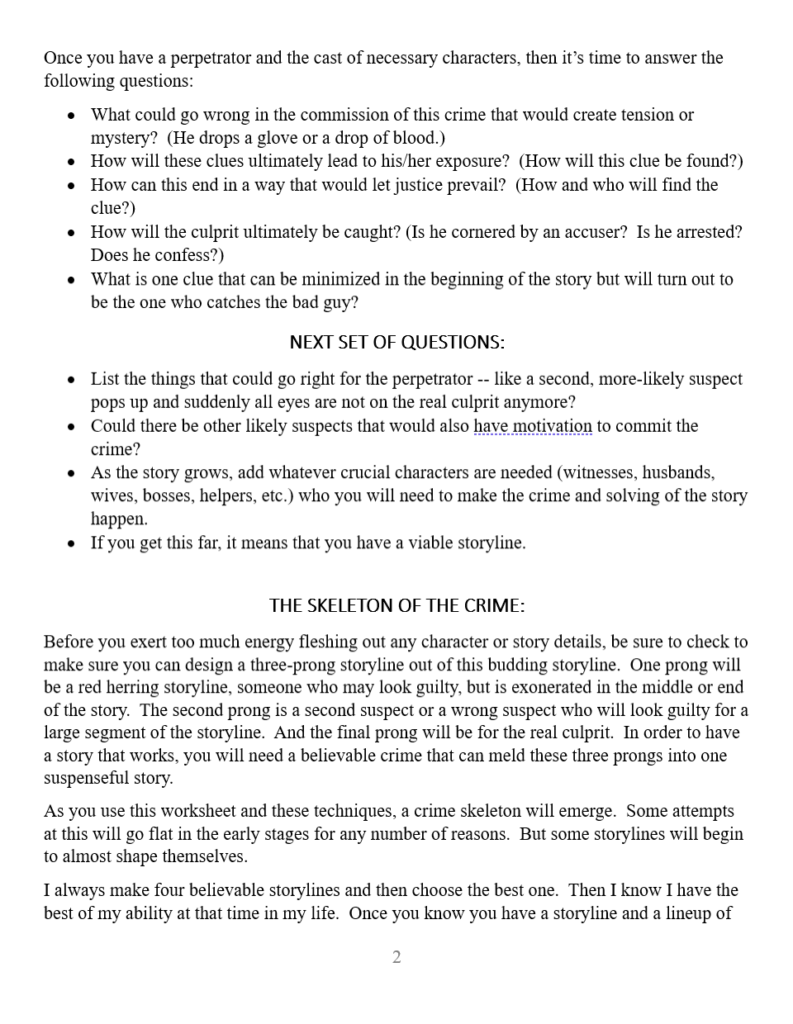
Once you have a perpetrator and the cast of necessary characters, then it’s time to answer the following questions:
  • What could go wrong in the commission of this crime that would create tension or mystery? (He drops a glove or a drop of blood.)
  • How will these clues ultimately lead to his/her exposure? (How will this clue be found?)
  • How can this end in a way that would let justice prevail? (How and who will find the clue?)
  • How will the culprit ultimately be caught? (Is he cornered by an accuser? Is he arrested?  Does he confess?)
  • What is one clue that can be minimized in the beginning of the story but will turn out to be the one who catches the bad guy?

NEXT SET OF QUESTIONS:

  • List the things that could go right for the perpetrator -- like a second, more-likely suspect pops up and suddenly all eyes are not on the real culprit anymore?
  • Could there be other likely suspects that would also have motivation to commit the crime?
  • As the story grows, add whatever crucial characters are needed (witnesses, husbands, wives, bosses, helpers, etc.) who you will need to make the crime and solving of the story happen.
  • If you get this far, it means that you have a viable storyline.

THE SKELETON OF THE CRIME:

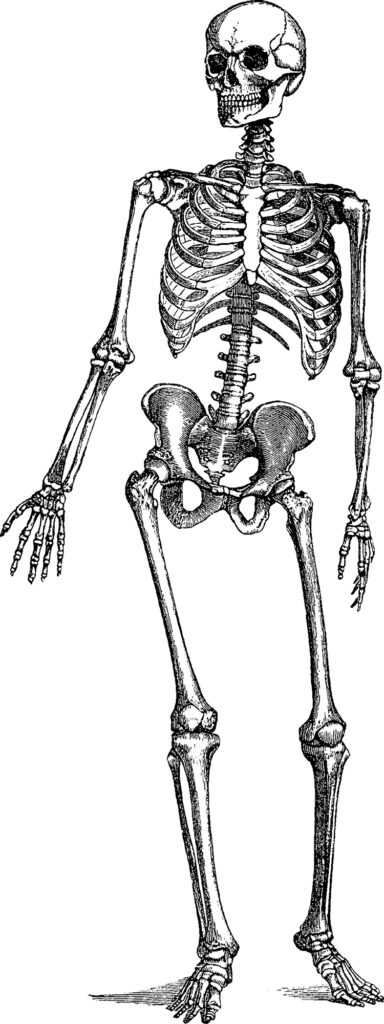
skeleton of a crimeBefore you exert too much energy fleshing out any character or story details, be sure to check to make sure you can design a three-prong storyline out of this budding storyline.  One prong will be a red herring storyline, someone who may look guilty, but is exonerated in the middle or end of the story.  The second prong is a second suspect or a wrong suspect who will look guilty for a large segment of the storyline.  And the final prong will be for the real culprit.  In order to have a story that works, you will need a believable crime that can meld these three prongs into one suspenseful story.
As you use this worksheet and these techniques, a crime skeleton will emerge.  Some attempts at this will go flat in the early stages for any number of reasons.  But some storylines will begin to almost shape themselves.I always make four believable storylines and then choose the best one.  Then I know I have the best of my ability at that time in my life.  Once you know you have a storyline and a lineup of stick figures and character roles that can technically pull off the mystery, so to speak, then you can begin to build real characters and an actual story.

THE CHARACTERS BUILD THEMSELVES:

Once you know what will be needed for the three-pronged storyline and what traits the lead characters will need to play out their parts, the characters will start building themselves into two-dimensional characters.  You can take the characters up to deeper, three-dimensional characters as you flesh out your main story and subplots.

LIST OF MYSTERIES, CRIMES & GENRES

I hope this is helpful.  Once you know you have a workable storyline, then it’s time to take a look at my Ultimate Character Development Worksheet.  This will help you bring the stick figures to three-dimensional with a full character arc.

Sign Up Below to Download the Brainstorming Form

LIKE WHAT YOU SEE?  WANT TO SIGN UP FOR MY NEWSLETTER?


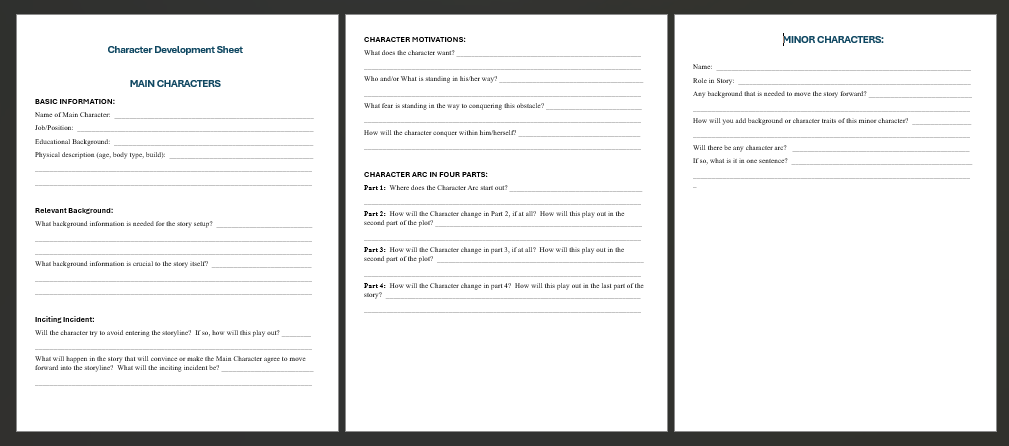
Character Development Worksheet

THE ULTIMATE CHARACTER DEVELOPMENT WORKSHEET

MAIN CHARACTER WORKSHEET:

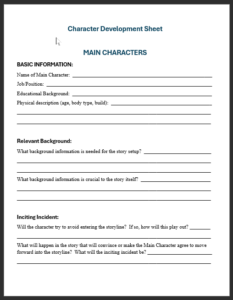
When I started writing several years ago, I came across the standard character worksheet and it focused mostly on physical attributes, occupation but there was a disconnect regarding their role in the storyline, which is the most important part.
My purpose in this blog post is share a more in depth character development worksheet.   I'll go over the different parts of the worksheet with a brief explanation of the parts that need a little explanation.  Most of the worksheet is self-explanatory.

The first question is:  Is this a Main Character you are developing?  Or  Minor Character?  There is a separate Minor Character Development List on the third page of the checklist.  We'll begin with the Main Character development.

The following aspects of the worksheet are self-explanatory.  The only prompt I will give to beginning writers is that you want to keep your writing lean.  So think in terms of what background, educational and job information is crucial for the plotline of the story?  That's the most important part.

THE BASICS:

  • Name of Main Character
  • Job/Position
  • Educational Background
  • Physical description - (age, body type, build)
  • Relevant Background:
    • What background information is needed for the story setup?
    • What background information is crucial to the story itself?


THE INCITING INCIDENT:

Most plotlines need an inciting incident.  This is the occurrence that happens to take the main character out of his/her normal life and into the storyline.  What will this be?

Sometimes it is an incident that happens but sometimes, like in a police procedural, it's as simple as being assigned to a case.  Either way, the inciting incident is what begins the actual story arc and the character arc.

TWO MAIN QUESTIONS:  

  • Will the character try to avoid entering the storyline?  If so, how will this play out?
  • What will happen in the story that will convince or make the Character agree to move forward into the storyline?  What will be the inciting incident?

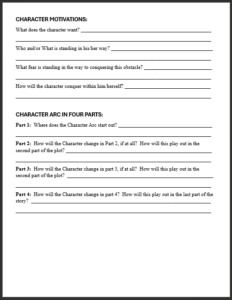
CHARACTER MOTIVATIONS:

As a newbie, it took me awhile to remember that a character needs to have an arc over the storyline.  So it's important -- and time saving -- to know what that arc will be before you even begin the draft.  This character sheet can help you find this so you know where you are starting from and where you want to end up.  The following questions should help you focus on what this character arc will be:
  • What does the character want?
  • Who and/or What is standing in his/her way?
  • What fear is in the way to conquering this obstacle?
  • How will the character conquer him/herself
  • How will this play out over the four parts of the story?


CHARACTER ARC IN FOUR PARTS:

I write in a four-part story line as opposed to the 3 part storyline.  So I break the character arc into these specific parts:

Part 1:  Where does the Character Arc start out?

Part 2:  How will the Character change in part 2, if at all?  How will this play out in the second part of the plot?

Part 3:  How will the Character change in part 3, if at all?  How will this play out in the second part of the plot?

Part 4:  How will the Character change in part 4?  How will this play out in the last part of the story?

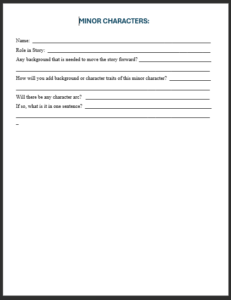
MINOR CHARACTER:

For minor characters, you only need to answer a few questions.  It helps to know what role these minor characters will play and what, if any, background information is needed to support them in the storyline:

  • Name
  • Role in Story
  • Any background that is needed to move the story forward?
  • How will you add background or character traits of this minor character?
  • Will there be any character arc?
  • If so, what is it in one sentence?

Download -Character Development Form

Sign Up for Newsletter

Writers Research – Tax Liens

ARE TAX LIENS PUBLIC INFORMATION?

tax lien informationYes, a tax lien on a company is a public record. This means that anyone can search for and view the lien, including potential creditors, investors, and the general public. The lien will typically be filed with the county recorder's office in the county where the company is located.

WHAT IS THE PURPOSE OF A TAX LIEN?

purpose of tax lienThe purpose of a tax lien is to give the government a legal claim on the company's assets if the company fails to pay its taxes. The lien will remain in effect until the taxes are paid in full.

There are a few exceptions to the rule that tax liens are public records. For example, if the lien is filed against a company that is in bankruptcy, the lien may be sealed. This means that the lien will not be available to the public.
Cops & Detectives can use this readily-available information to find out if a suspect is having money problems, or if he has suspicious business practices.

HOW TO FIND TAX LIEN INFORMATION:

how to find tax lien infoIf you are interested in finding out if a company has a tax lien, you can search the public records for the county where the company is located. You can also contact the Internal Revenue Service (IRS) to see if they have a lien on the company.

Since this is writer's information, you can see what information a detective can get and where he can get it.

WHY WOULD THE POLICE WANT TO KNOW ABOUT TAX LIENS?

cops-lien-infoHere are some of the reasons why someone (or a detective) might want to know if a company has a tax lien:
  • To determine if the company is financially stable.
  • To assess the company's risk as a potential creditor or investor.
  • To protect their own assets from being seized to satisfy the tax lien.When writing a plot line, you may also want to know:
  • What is the suspect's or his/her company's financial situation? Is this part of the motive?
  • What are the company's assets? Is a suspect's money all tied up in business assets?
  • Who are the company's creditors and investors? Could one of them be a suspect?


HERE IS A LIST OF SOME OTHER TERMINOLOGY SURROUNDING A TAX LIEN:

tax lien terminology for writersSometimes just having an overview of how things work can help you thicken the plot or add some details that will enrich the story.  Below are some words and definitions that surround the subject of Tax Liens:
  • Tax lien: A legal claim against a taxpayer's property for unpaid taxes. A tax lien gives the government the right to seize and sell the property to satisfy the debt.
  • Levy: The act of seizing property to satisfy a debt. In the case of a tax lien, the government can levy on any property owned by the taxpayer, including real estate, personal property, and bank accounts.
  • Notice of lien: A document that is filed with the public records to notify creditors and other interested parties that a tax lien has been filed against a taxpayer's property.
  • Lienholder: The person or entity that holds a lien on property. In the case of a tax lien, the lienholder is the government.
  • Redemption: The right of a taxpayer to pay off a tax lien and regain ownership of the property that was seized.
  • Statutory redemption: A type of redemption that is available to taxpayers under state law. Statutory redemption typically allows taxpayers to redeem property within a certain period of time after the lien was filed.
  • Judgment lien: A lien that is placed on property to satisfy a court judgment. Judgment liens can be filed by creditors who have won a lawsuit against a debtor.
  • Encumbrance: A legal claim against property that affects its ownership or use. Encumbrances can include tax liens, mortgages, and easements.
  • Lien priority: The order in which liens are satisfied when property is sold. Tax liens typically have the highest lien priority, meaning that they are paid off first.


The Top 10 Obstacles to Finishing a Novel

PEEK BEHIND THE NOVEL

I'm in the weeds!

scrivener-peek-behind-the-novelI am knee-deep in Level 4 of writing the next book in the Jack Nolan Detective Series.  I thought this would be a good time for me to take a break and reflect on what happens when I'm 'in the weeds' writing a novel.

Even though all writers have a different writing routine, I would venture a guess that most of us feel some of the same fears and face some of the same obstacles.

STARTING A NOVEL IS EASY:

DP-drawing-woman-and-computerWhen you first sit down to write a novel, everyone is filled with enthusiasm and creative energy.  It's exciting.  It's new.  But as the manuscript begins to grow, before it feels finished -- or even ready to be polished, it feels cumbersome, heavy, and overwhelming.  At least for me it does.

FEAR OF FAILURE:

Even though the story and plotline felt great at the beginning, there comes a point where a fear of failure sets in.  Am I going to be able to finish this?  Does this plotline even make sense?  What happens if this storyline is not that great?  Maybe this mystery isn't enough.  Maybe the dots are not going to all connect.

woman-fearfulIt's possible to get paralyzed by a fear of failure at any point during the writing of a novel.  It's not a one-and-done operation.  No one sits down, starts writing, finishes writing and ta-da, there's a book.   Writing a novel doesn't work that way.  It's a long process.  It's a multi-layer process.

When these fears pop up, and they will, it's important to remember that many writers feel these doubts and fears.  It's important to remember that everyone of us fails at something at some point in our lives.  The good news is any novel can be redone, re-written, revamped, added to, or massaged in any number to go from mediocre to great.  It's a work of art in progress until it's handed over to the publisher.  Knowing this is empowering.


WRITERS BLOCK:

DP-writers-block-womanWriters block is another common problem among authors.  This often sets in after that initial period of excitement about the novel wears off.  At some point the writing of the novel shifts into a project requiring some heavy lifting.  There's always a phase or two where the author has to tough it out.  We have to keep at it.


It's important to know ahead of time that writer's block may set in at any time while you're writing.  I find that deciding to just sit down and go over what I've written 'to get my place' or to 'get into the flow of it' is enough to get over any writer's block.  Just by sitting down and starting to read through it, the project recaptures me.  Even on days I feel I have nothing in me, I can suddenly be pulled into writing before I even know it's happening.  If you can commit to look at your project for fifteen minutes, this can be enough to recapture your enthusiasm.

LACK OF TIME:

Many wannabe authors have busy lives and don't have a lot of time to devote to writing.  There are certain years -- especially in a parents' lives --where raising kids is more than a full-time job.  But where there is a will, there is a way.

There are ways to steal away an hour or two in any given day.  It does, however, always require some level of planning.  Don't be afraid to plan writing time into your day and give it a higher priority than 'the back burner'.   Even if you are a parent or a caretaker, pursuing your own dreams is important.  It keeps you engaged in life.  It makes you a better parent.  It can even make you a better day worker.  Think of your writing as your own personal mission in life.

PERFECTIONISM:

Perfectionism can be another stumbling block for authors.  Everyone wants to write a masterpiece.  But at some point, you need to also know that nothing in life is perfect.  Don't let your ideas of perfect get all wired into your ideas of excellence.  They are two different things..  If you looked close enough, you could find a few imperfect brush strokes in the Mona Lisa.  If you read Harry Potter enough times, you may catch a plot hole or two.  It's important to know the difference between excellence and perfection.  One is doable and one is not doable by human beings.

FEAR OF REJECTION:

tension in story graphicWill my readers like the book?  Will the book be good enough to get a literary agent?  What happens if my book gets bad reviews?  There are any number of fears of rejection that can cause us to stop writing.  Decide ahead of time you won't allow these fears to stop you.  Like I said earlier, think of your writing as a mission God has given you.   This is your life's work, along with your other worldly responsibilities.  Your writing could be an opportunity to pass on things you have come to learn in your life.  That's a purpose.  Or maybe writing is a way for you to share the gift of storytelling that you know you were born with.  That's a God-given purpose.  Whatever the reason, it's important to not allow fear of rejection to get in the way.



SELF-DOUBT:

Self-doubt is a tool of the devil.  It's easy for any human to start thinking they aren't perfect, so maybe they aren't good enough to pull off writing a novel.  And the reason I call it a tool of the devil is because it can start with just a tiny little insignificant thought of self-doubt.  But it can snowball and get bigger and bigger and bigger.

During these times when I feel self-doubt, I think of my writing as therapeutic for myself.  It's something I'm doing for me, not for anyone else.  Any fear of rejection that occurs, thinking I'm doing it for myself, it takes away any sting self-doubt may have.  It removes any power it has over me.  It turns the tables on this.

DISTRACTIONS:

woman-multitasking-distractionsDistractions are one of the biggest obstacles to completing a novel.  One reason is because life does serve up constant small and big emergencies that have to take first priorities in our lives.  So an emergency distraction can throw a whole well-planned writing schedule up into the air in a heartbeat.

One of the weapons against distractions is get clear on what a real emergency is verses a situation that can take its place in your daily routine.  You don't always have to sacrifice your writing time just because someone else doesn't have to wait or suffer a small inconvenience.  Always ask yourself whether you have the right to protect your free time or whether you are dealing with a true emergency, a situation that requires you to replan in that moment.

Parents with kids can fall into a trap of giving up all their free time based on a constant stream of kid demands.  Giving in to every child whim is not the definition of a good parent.  Protecting your free time and expecting your child to work within your schedule is not bad parenting.  It's the sign of someone who is good at balancing their lives.

I learned a long time ago that I have to protect my free time as there are armies of people in the world who would harness me as a free resource in their lives.  They would demand and expect that I do all the things they don't want to do if I allowed it.  We're responsible to set our own boundaries with people, and that includes kids.

RESEARCH:

too-much-researchMost novels require at least some research.   The internet can be a blessing with research but it can also be a curse.  It's a blessing because the days of having to travel to a public library are over.  It can be a curse because the research can suck you in and you can use up all your valuable writing time doing too much research.

The tip I would pass on to any new writer would be to not do the research until you have already laid down your plotline.  This will avoid research for things that wind up on the editing floor, so to speak.  Subjects or issues you you think may come up in the story may get cut as you firm up a plotline to fit within the space of a novel.  There's nothing more frustrating than looking back and seeing hours and hours of wasted research time.

Too much research can also lead to another problem and that is 'information dumping'.  That means that many authors can't resist the opportunity to write into the story things they learned from their research that are not really relevant to the plotline.  This may be fascinating to us as authors but it's boring to readers if it doesn't move the story line along.

EDITING THE BOOK TO DEATH:

editing-a-novel-to-deathAnother trap to finishing a novel is to get caught up in a never-ending edit of the book.  This usually hooks in with perfectionism problem in some way.
I break up my editing into stages so that each time I go through the book, I focus on only one thing.  For example:  The first edit is to check to make sure I have put my descriptions of locations and people in.  The second time I go through it, I look at sentence structure and make sure the chapters flow without any time gaps.  The third time I pass through, I look for verb tenses.  The next level is looking for the words I like to use too much like okay and just.

By having a solo focus, it prevents you as the author from getting caught in changing everything all at once.  This prevents you from being able to focus on anything.

THE PSYCHOLOGICAL TRAP OF FINISHING THE NOVEL:

finishing-a-novelOnce you complete a novel, there is a little sadness that sets in.  This book is no longer your baby.  It's no longer your little pet project.  Once you hand it off to an editor, it becomes a shared work, so to speak.
Very often, authors who have abandonment issues or fears of depression, they don't like to end anything and that includes writing a book.  When I hear people saying they took seven or ten years to finish a book, I'm astounded at what could have taken them so long.  They kept the book as their little baby for an entire childhood.

My Peek Behind the Novel series is about writing in layers.  I feel that writing in layers is a way filled with techniques that keep me writing, keep me on track, keep me on schedule, and allow me to complete the novel, no matter how much research it requires.

These are just a few of the obstacles that we, as writers, face when undertaking the writing and completion of a novel.  If your goal is to write a novel, don't give up on your dream.  Keep writing, keep pushing yourself, and eventually you will complete your novel.


Peek Behind the Novel – Layer 2 – How to Break the Crime Skeleton into Four Acts or Parts

FITTING THE CRIME SKELETON OUTLINE INTO THE FOUR ACT STRUCTURE:

For anyone who is new here, I use a Four Act Structure as opposed to the more-popular three-act structure.  I find that middle section in the three-act structure too confusing.  Over the writing of 12 novels, I gravitated to a four-part structure as it is more symmetrical and makes more sense to me.  I also believe, for whatever it's worth to anyone, that this three-act structure is responsible for the 'lagging' that often occurs in the middle of a story.

If you are following my A Peek Behind the Novel Series, you have learned about creating the crime or mystery skeleton outline in past blog posts and videos.  I won't go over those again here.

This is the point where you will break the crime/mystery skeleton into the four parts.  I'll enumerate below the items that should be in each part.  I hope this is helpful to newbies.  I'm not an expert on any of this, by the way, but my purpose here is to provide help that I wish I had when I was first starting out.

Part One:

The inciting incident.  In a murder, crime or police procedural story, this will be the crime itself and how the detectives show up in it.  When the detectives are pushed into going on a quest to solve it, that's the inciting incident.  This begins the journey of the story.

Also in Section 1, I drop some information about where my characters arcs will begin.  Because I write in series, the question I ask myself is:  What do my characters want at this time of their lives?   What do they want to happen right now?  I determine in this initial phase where the character arcs will begin, and where they will end.

Now, in the creative process, the character arcs get deeper and more elaborate, so don't worry if you don't have a clear idea of exactly how they will change.  I make sure Part 1 contains information about where their arc begins.

Also in Part 1 will be a slow drip of background information.  When I was new, I tended to do these big info drops in the beginning, but thankfully, editors and advance readers were good enough to point this out to me.  The readers don't need to know everything about the background of the main characters within the first five pages.  This information is best 'slowly dripped', just like the clues.

PART TWO:

Part Two is where I introduce all the suspects and their possible motivations -- as the detectives are quite often guessing at this early stage of an investigation.  The motivation of each of the suspects will be uncovered in some way later in Part two or even in Part 3.

Part Two is about following clues and uncovering suspects, evidence and motivation.  The readers are collecting information and they are doing their own thinking and speculating too.  This is where their enjoyment comes from, hearing about the clues and trying to out think the detectives and the suspects -- and even the author!

Section two is also where the subplots begin to move forward.  Whether the subplot is a specific conflict that gets worse or a general stubbornness that is exhibited, I begin to move the subplots along in part two.

The end of Part Two usually marks the midpoint of the book.  I like to end this section with a .big reveal of some kind.  Or maybe a clue that turns the investigation into another direction.  There could even be a new murder, or the surfacing of an unusual suspect, or someone gets caught in a big lie that changes the direction of the investigation.
If you are using time or some other way to apply pressure to solve the crime, you also want to take it up one or two notches in Part 2.

Part Three:

Now the investigation gets a little stressful.  The detectives may not agree on who the guilty party is, or maybe they know who it is but can't find the legal evidence to prove it.  Maybe they are operating only on gut feeling and speculation at this point.  They are rushing against the clock or against other forces working against them to solve it, catch the guilty party or find compelling and irrefutable evidence.

Part 3 is where the suspects' lies and half-truths are exposed and this all sheds light on the actual crime or mystery.  The title of "most likely suspect" may also go back and forth between one or two of the suspects in Part 3.

The subplots need to also move along into their stage 3.  They may need to be set up for a final resolution of the subplot, which is often very different than the main story.

Part Four:

Part four is broken down into two parts.  In the first half of Section 4, the crime or mystery is solved.  There will be whatever drama you want to add about the solving of this crime.  Whether your detectives are battling physically with someone, bullets are being fired back and forth, or entrapping the guilty party, or just uncovering that last piece of evidence that will legally prove guilt, this is where this is revealed.

I personally also like to do a very quick sum up of the entire theory of the mystery.  In my opinion, readers are very busy and sometimes they are reading carefully, but other times, they are reading with one eye open right before they fall asleep for the night.  So I like to do a quick sum up just in case they missed anything.  But I do it very quickly because there are the avid readers who never miss anything and you don't want to bore them!

The second half of Part 4 is the 'wrap up'.  This is where you will show the new normal, everyone's life 'in resolution'.  This is where you will also explain the full growth of your characters.  Many author's don't do this, but I don't like to read books where things end where the reader is left to decide what it all means.  I may have my own opinions, but I like to know what the author meant by the story.  So I make sure I explain, again very quickly, how things are ending in a narrator voice.
If You Are Writing in a Series:

If you are writing a series, it's important to also let the reader know the back story continues.  I always include a link to a signup list for readers to be notified of any new books that I am releasing.

Check Out My Video Below:

I have a video on this crime mystery technique below.  For your convenience, I have the timestamps below if you want to jump to a specific section:

00:15 - Snapshot from a Crime Scene Clues List from another storyline
00:45 - Part 1 - Elements needed
01:29 - Part 1 - Dripping background information
01:45 - Part 2 - Adding additional suspects and motivations
02:24 - Part 2 - The Midpoint of the Story
03:00 - Part 3 - The Plot thickens - Secrets and revelations
03:30 - Part 3 - The Dark Night of the Soul
03:52 - Part 4 - First section is the big reveal
04:23 - Part 4 - Second half - Wrap up of the crime or mystery, show the growth of the characters and the new normal.
04:53 - Part 4 - Series clue that the story continues with a new adventure

Here is the Actual Video:

Brainstorming Stories

Download a Reading Chart


Peek Behind the Novel – Layer 3 – Writing Scene Outlines

WHERE WE ARE BEGINNING IN THIS BLOG POST:

I left off writing about how I divide the crime skeleton, after adding in the subplots, into the Four-Part Structure.  I am now entering the third layer of writing.  This blog post and video below are about sketching in the plot outlines.

WHERE WE ARE GOING:

Most new writers want to get to the writing already.  But in this layer of writing, all plot holes or inconsistencies will show up.  Any clues that won't work when adding more suspects and motivations will show up in this layer.

So this layer is like an insurance policy that you won't be writing for the trash can.

USING THE SHORT TEMPLATE:

My template is short but it keeps me on track.  I'll break it down below.  This small template I use keeps my writing on point and tight.  It prevents me from meandering, dawdling, going off on an irrelevant tangent or writing myself into a corner.

POINT OF VIEW

n order to prevent head-hopping, which is very common among new writers, you need to be constantly reminded that each scene is in one perspective.  Some writers write in first person and that's easy.

However, I write in third person - one persons perspective.  This prevents the reader hopping from head to head.  It's too confusing for a reader to do that.

However, I don't choose my point of view this early on in the process.  I wait until I am actually writing the scene before I choose.  In my experience, as you write the scene, the first draft, one character will sort of 'claim the scene as their own'.  That's when I choose the point of view and then make sure the entire scene is in that persons perspective.

Now, I must confess, since I write in third person narrator style, I do allow myself one tiny head-hop at the end of a scene if I think it serves the plot well.  I think any reader can handle one tiny head hop.

I'm a self-published author at this time, and one of the benefits of self-publishing is you can do what you want.  The professional publishers may be horrified by allowing one head hop at the end of a scene, but as a self-publisher, I can do what I want.  (Hee hee)

KEEPING TRACK OF TIME

I don't know whether I am an author who is obsessed with time, or whether I use time as an element to put pressure to solve on my characters, but I have always tracked time.  I find this helps me balance the story and make the story more realistic.

What I mean by that is often times there is so much that is happening in a book on one particular day, that it becomes unrealistic that all of this could happen in one day.  Maybe it's just me.

Keeping track of time allows me to also know when the workday is over and the subplots can enter the scene as most subplots happen at least in part in a character's off time.

CHOOSING A SCENE LOCATION:

Location is important for two reasons.  One reason is casts the scene in cement.  You have chosen a stage for the scene to take place.  I don't write any scene or location descriptions in this layer of writing.  But I can write the action of the scene in context of a location.

Secondly, adding the location in this layer allow me to go off and find photographs that I can use in the layers down the road where I will add descriptions into the story.

PURPOSE - MOVING THE STORY ALONG

Every experienced author who I listened to when I was first writing fiction said the same thing:  Everything in the manuscript is there to move the story along.  If it doesn't move the story, it doesn't belong there.    So this Purpose in my template helps me keep my writing tight and on point.

CLUES - KEEP TRACK OF CLUES

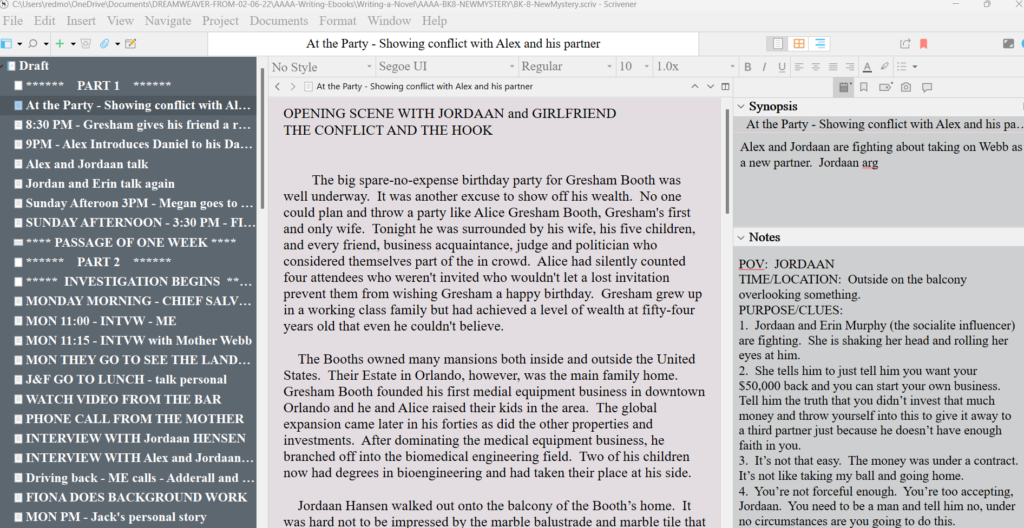
vector magnifying glass

This one is self-evident.  A crime novel, murder mystery or police procedural is about solving a crime or mystery.  So uncovering clues, following them to the next clue is the vehicle for the story.  So it's important to keep track of clues.

In the first stage of writing, it's easy to remember if you put clues into the story.  In the first draft, it's easy to rely on your memory.  But after you've read through the story a bit and begin to add more to it, you won't be able to remember whether you saw that clue in the last chapter or the last time you read through the entire layer.

So it's important to keep track of clues.

DIVIDING AND CONQUERING THE MANUSCRIPT:

By dividing the story into four parts, and then writing scene outlines, you can divide a huge manuscript down into bite-size pieces.  It is less overwhelming and easier to organize, write and keep track of.

HOW SCENE OUTLINING WORKS IN SCRIVENER:

You can watch the video below for a full explanation, but each scene begins with the template.  I leave the POV blank for now.  I choose the time and location.  And then under Purpose/Clues, I add everything I want to happen in this scene.  I am thinking about the main plot, the dripping of background info, the dripping of clues, and the subplots.

I use numbers but using bullet points would probably be best as I have to change the numbers a lot.  Although when I show you the rest of my technique, you will see that the number themselves don't matter.

ABOUT THE VIDEO:

In this video, I talk about and lay out how to use a simple template and write the individual scene outlines. By sketching in the individual novel scenes, I can be sure that the clues and mystery scenarios will all work before I waste any time writing any scenes. I go into my strategy and work flow in this video and the benefits of outlining the scenes first. Once you have a scene outline, the actual writing of the scenes becomes only creative and fun.

Time Stamps of this video:
00:01 - Laying out the plotline into scenes
00:58 - The benefits of writing scene outlines
02:46 - The scene template
03:03 - Summary of the process up to this point. Showing a scrolling outline.
04:22 - The template in action - an example of how the template works 04:45 - Point of View
05:26 - Keeping track of time in the manuscript
06:26 - The importance of Locations
07:10 - Purpose - Moving the story along
08:20 - Keeping track of clues
09:20 - Dividing and conquering the manuscript
10:05 - Live in Scrivener with present novel - How the scene outlines work. 11:45 - Sneak Peek of the Synopsis
12:05 - Looking at Scrivener Binders a new one vs. a fully written book
13:13 - Knowing the story through the outline


Writing a Novel in Layers:

First - A Little About the Chronology of a Crime

Writing a Novel - Layer 1
Writing a Novel - Layer 2
Writing a Novel - Layer 3
Writing a Novel - Layer 4
Writing a Novel - Layer 5
Writing a Novel - Layer 6
Writing a Novel - Layer 7
Writing a Novel - Layer 8