
PEEK BEHIND THE NOVEL
I'm in the weeds!
 I am knee-deep in Level 4 of writing the next book in the Jack Nolan Detective Series. I thought this would be a good time for me to take a break and reflect on what happens when I'm 'in the weeds' writing a novel.
Even though all writers have a different writing routine, I would venture a guess that most of us feel some of the same fears and face some of the same obstacles.
STARTING A NOVEL IS EASY:
 When you first sit down to write a novel, everyone is filled with enthusiasm and creative energy. It's exciting. It's new. But as the manuscript begins to grow, before it feels finished -- or even ready to be polished, it feels cumbersome, heavy, and overwhelming. At least for me it does.
FEAR OF FAILURE:
Even though the story and plotline felt great at the beginning, there comes a point where a fear of failure sets in. Am I going to be able to finish this? Does this plotline even make sense? What happens if this storyline is not that great? Maybe this mystery isn't enough. Maybe the dots are not going to all connect.
 It's possible to get paralyzed by a fear of failure at any point during the writing of a novel. It's not a one-and-done operation. No one sits down, starts writing, finishes writing and ta-da, there's a book. Writing a novel doesn't work that way. It's a long process. It's a multi-layer process.
When these fears pop up, and they will, it's important to remember that many writers feel these doubts and fears. It's important to remember that everyone of us fails at something at some point in our lives. The good news is any novel can be redone, re-written, revamped, added to, or massaged in any number to go from mediocre to great. It's a work of art in progress until it's handed over to the publisher. Knowing this is empowering.
WRITERS BLOCK:
 Writers block is another common problem among authors. This often sets in after that initial period of excitement about the novel wears off. At some point the writing of the novel shifts into a project requiring some heavy lifting. There's always a phase or two where the author has to tough it out. We have to keep at it.
It's important to know ahead of time that writer's block may set in at any time while you're writing. I find that deciding to just sit down and go over what I've written 'to get my place' or to 'get into the flow of it' is enough to get over any writer's block. Just by sitting down and starting to read through it, the project recaptures me. Even on days I feel I have nothing in me, I can suddenly be pulled into writing before I even know it's happening. If you can commit to look at your project for fifteen minutes, this can be enough to recapture your enthusiasm.
LACK OF TIME:

Many wannabe authors have busy lives and don't have a lot of time to devote to writing. There are certain years -- especially in a parents' lives --where raising kids is more than a full-time job. But where there is a will, there is a way.
There are ways to steal away an hour or two in any given day. It does, however, always require some level of planning. Don't be afraid to plan writing time into your day and give it a higher priority than 'the back burner'. Even if you are a parent or a caretaker, pursuing your own dreams is important. It keeps you engaged in life. It makes you a better parent. It can even make you a better day worker. Think of your writing as your own personal mission in life.
PERFECTIONISM:
Perfectionism can be another stumbling block for authors. Everyone wants to write a masterpiece. But at some point, you need to also know that nothing in life is perfect. Don't let your ideas of perfect get all wired into your ideas of excellence. They are two different things.. If you looked close enough, you could find a few imperfect brush strokes in the Mona Lisa. If you read Harry Potter enough times, you may catch a plot hole or two. It's important to know the difference between excellence and perfection. One is doable and one is not doable by human beings.
FEAR OF REJECTION:
 Will my readers like the book? Will the book be good enough to get a literary agent? What happens if my book gets bad reviews? There are any number of fears of rejection that can cause us to stop writing. Decide ahead of time you won't allow these fears to stop you. Like I said earlier, think of your writing as a mission God has given you. This is your life's work, along with your other worldly responsibilities. Your writing could be an opportunity to pass on things you have come to learn in your life. That's a purpose. Or maybe writing is a way for you to share the gift of storytelling that you know you were born with. That's a God-given purpose. Whatever the reason, it's important to not allow fear of rejection to get in the way.
SELF-DOUBT:
Self-doubt is a tool of the devil. It's easy for any human to start thinking they aren't perfect, so maybe they aren't good enough to pull off writing a novel. And the reason I call it a tool of the devil is because it can start with just a tiny little insignificant thought of self-doubt. But it can snowball and get bigger and bigger and bigger.
During these times when I feel self-doubt, I think of my writing as therapeutic for myself. It's something I'm doing for me, not for anyone else. Any fear of rejection that occurs, thinking I'm doing it for myself, it takes away any sting self-doubt may have. It removes any power it has over me. It turns the tables on this.
DISTRACTIONS:
 Distractions are one of the biggest obstacles to completing a novel. One reason is because life does serve up constant small and big emergencies that have to take first priorities in our lives. So an emergency distraction can throw a whole well-planned writing schedule up into the air in a heartbeat.
One of the weapons against distractions is get clear on what a real emergency is verses a situation that can take its place in your daily routine. You don't always have to sacrifice your writing time just because someone else doesn't have to wait or suffer a small inconvenience. Always ask yourself whether you have the right to protect your free time or whether you are dealing with a true emergency, a situation that requires you to replan in that moment.
Parents with kids can fall into a trap of giving up all their free time based on a constant stream of kid demands. Giving in to every child whim is not the definition of a good parent. Protecting your free time and expecting your child to work within your schedule is not bad parenting. It's the sign of someone who is good at balancing their lives.
I learned a long time ago that I have to protect my free time as there are armies of people in the world who would harness me as a free resource in their lives. They would demand and expect that I do all the things they don't want to do if I allowed it. We're responsible to set our own boundaries with people, and that includes kids.
RESEARCH:
 Most novels require at least some research. The internet can be a blessing with research but it can also be a curse. It's a blessing because the days of having to travel to a public library are over. It can be a curse because the research can suck you in and you can use up all your valuable writing time doing too much research.
The tip I would pass on to any new writer would be to not do the research until you have already laid down your plotline. This will avoid research for things that wind up on the editing floor, so to speak. Subjects or issues you you think may come up in the story may get cut as you firm up a plotline to fit within the space of a novel. There's nothing more frustrating than looking back and seeing hours and hours of wasted research time.
Too much research can also lead to another problem and that is 'information dumping'. That means that many authors can't resist the opportunity to write into the story things they learned from their research that are not really relevant to the plotline. This may be fascinating to us as authors but it's boring to readers if it doesn't move the story line along.
EDITING THE BOOK TO DEATH:
 Another trap to finishing a novel is to get caught up in a never-ending edit of the book. This usually hooks in with perfectionism problem in some way.
I break up my editing into stages so that each time I go through the book, I focus on only one thing. For example: The first edit is to check to make sure I have put my descriptions of locations and people in. The second time I go through it, I look at sentence structure and make sure the chapters flow without any time gaps. The third time I pass through, I look for verb tenses. The next level is looking for the words I like to use too much like okay and just.
By having a solo focus, it prevents you as the author from getting caught in changing everything all at once. This prevents you from being able to focus on anything.
THE PSYCHOLOGICAL TRAP OF FINISHING THE NOVEL:
 Once you complete a novel, there is a little sadness that sets in. This book is no longer your baby. It's no longer your little pet project. Once you hand it off to an editor, it becomes a shared work, so to speak.
Very often, authors who have abandonment issues or fears of depression, they don't like to end anything and that includes writing a book. When I hear people saying they took seven or ten years to finish a book, I'm astounded at what could have taken them so long. They kept the book as their little baby for an entire childhood.
My Peek Behind the Novel series is about writing in layers. I feel that writing in layers is a way filled with techniques that keep me writing, keep me on track, keep me on schedule, and allow me to complete the novel, no matter how much research it requires.
These are just a few of the obstacles that we, as writers, face when undertaking the writing and completion of a novel. If your goal is to write a novel, don't give up on your dream. Keep writing, keep pushing yourself, and eventually you will complete your novel.
 In my last blog post, I went over how to find the right genre for your ebook. I also suggested you choose one or two book cover 'templates' from the ebooks you see during this journey. That's our starting point for this blog post. Now that you know where you want to go, it's time to learn about the technicalities: the sizes, resolutions, etc. It's all here on one page.
 Often the ultimate colors of your cover will come from the pictures you choose. But there are techniques to wash a scene in a very subtle color in order to cast a certain mood into an image. You may want to take a look at a website or two where you can find some great colors. Here are two:
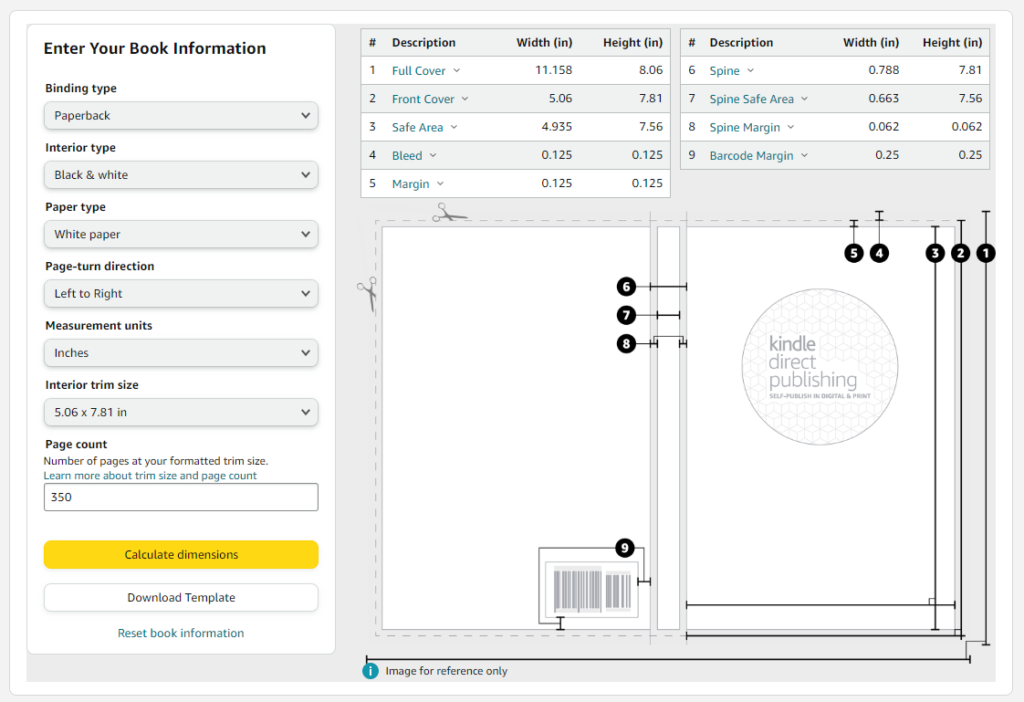
 When you create the eBook front cover, you can design the back cover at the same time. I suggest this because when your manuscript goes out to the editor, there will be about a month of 'free time' and if you want to get a jump on getting your back cover done, this is a good time but it is before you will know the exact page count.
 When writing your book, especially if you are writing in a management system like Scrivener, it's easy enough to keep track of your manuscript.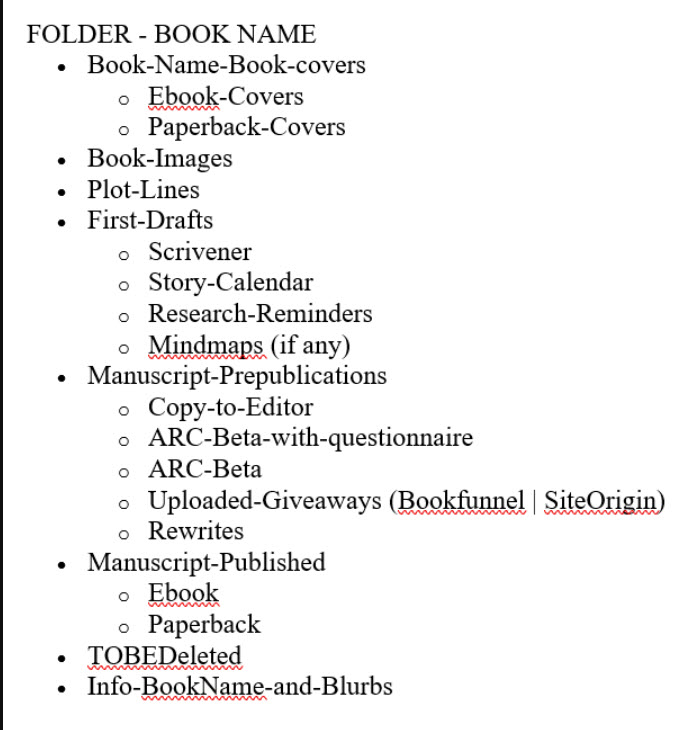




 When I wrote my first novel, I worried about grammar, spelling, sentence structure in the first draft. I didn't even know what a draft was. I sat down and started writing 'a manuscript'.
 First there's the mystery outline of a novel. It's important to know where the mystery begins, the names of all suspects, everyone's motivation for murder or kidnapping, theft, etc. But once you have your crime and mystery outline, what then?
 The subplots should not detract from the main plot, but should instead enhance it. They should add depth and complexity to the story, and they should help to drive the main plot forward. In a mystery, it's easy to mirror a main character's personality trait in a witness and create some inner dialogue. This ties it in nicely.
 If you're writing a first-person novel, try using a different POV for your subplots. This can help to add variety to your story and to give readers a different perspective on the events. This is not a technique that I would suggest to beginner novelists, but for authors who are more seasoned, yes, this is a way to shake things up a bit.
 Subplots can be used to ramp up the tension in your story. It's a great way to add a little more pressure onto your main character or characters! Not only do they have to catch the bad guy, but their landlord is threatening them, or their wife is threatening to leave them, etc. If the main mystery plot is getting a little slow as you drip in clues, you can spice up the subplot that will add some excitement and suspense.
 Subplots need to be interesting, yes, but it's easy to go overboard with them too. So the arc needs to be short but concise. They should be short and sweet, so to speak. They should be short enough to keep the reader's interest, but not so short that they feel underdeveloped.
 I'm assuming all writers have doubts as they are writing the first draft. I know I do. Something happens between the feeling of knowing I have a good plotline and writing out the first draft.
 So the antidote to self-doubt is to keep writing. Trust your plotline. Know too that you can always add clues, rearrange some scenes, add a bit more intrigue into your subplots. Eight layers of writing leaves a lot of room for beefing up a story, deepening a story and polishing a story.
 For anyone who is new here, I use a Four Act Structure as opposed to the more-popular three-act structure. I find that middle section in the three-act structure too confusing. Over the writing of 12 novels, I gravitated to a four-part structure as it is more symmetrical and makes more sense to me. I also believe, for whatever it's worth to anyone, that this three-act structure is responsible for the 'lagging' that often occurs in the middle of a story.

 The end of Part Two usually marks the midpoint of the book. I like to end this section with a .big reveal of some kind. Or maybe a clue that turns the investigation into another direction. There could even be a new murder, or the surfacing of an unusual suspect, or someone gets caught in a big lie that changes the direction of the investigation.
 Now the investigation gets a little stressful. The detectives may not agree on who the guilty party is, or maybe they know who it is but can't find the legal evidence to prove it. Maybe they are operating only on gut feeling and speculation at this point. They are rushing against the clock or against other forces working against them to solve it, catch the guilty party or find compelling and irrefutable evidence.
 Part four is broken down into two parts. In the first half of Section 4, the crime or mystery is solved. There will be whatever drama you want to add about the solving of this crime. Whether your detectives are battling physically with someone, bullets are being fired back and forth, or entrapping the guilty party, or just uncovering that last piece of evidence that will legally prove guilt, this is where this is revealed.
 The second half of Part 4 is the 'wrap up'. This is where you will show the new normal, everyone's life 'in resolution'. This is where you will also explain the full growth of your characters. Many author's don't do this, but I don't like to read books where things end where the reader is left to decide what it all means. I may have my own opinions, but I like to know what the author meant by the story. So I make sure I explain, again very quickly, how things are ending in a narrator voice.

 Most new writers want to get to the writing already. But in this layer of writing, all plot holes or inconsistencies will show up. Any clues that won't work when adding more suspects and motivations will show up in this layer.
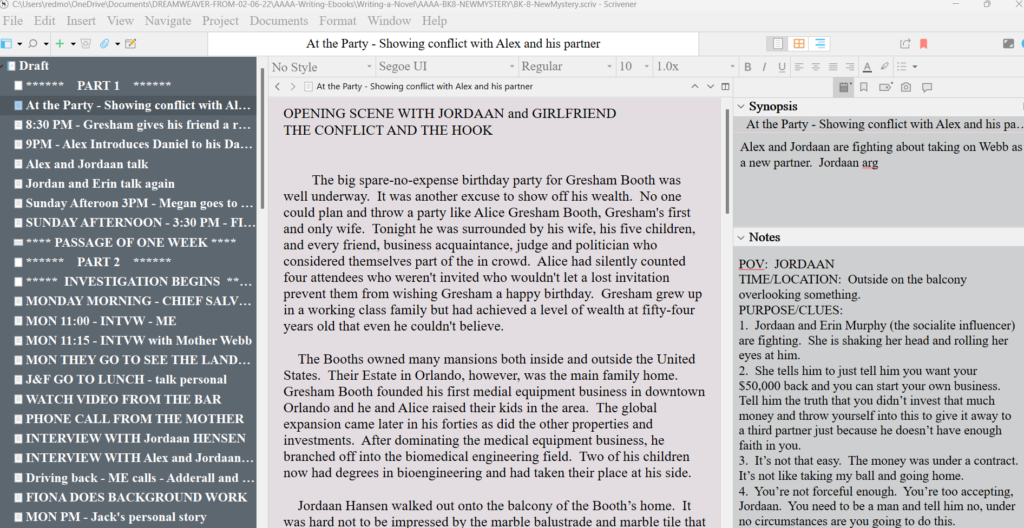
 My template is short but it keeps me on track. I'll break it down below. This small template I use keeps my writing on point and tight. It prevents me from meandering, dawdling, going off on an irrelevant tangent or writing myself into a corner.
 n order to prevent head-hopping, which is very common among new writers, you need to be constantly reminded that each scene is in one perspective. Some writers write in first person and that's easy.
 I don't know whether I am an author who is obsessed with time, or whether I use time as an element to put pressure to solve on my characters, but I have always tracked time. I find this helps me balance the story and make the story more realistic.
 Location is important for two reasons. One reason is casts the scene in cement. You have chosen a stage for the scene to take place. I don't write any scene or location descriptions in this layer of writing. But I can write the action of the scene in context of a location.

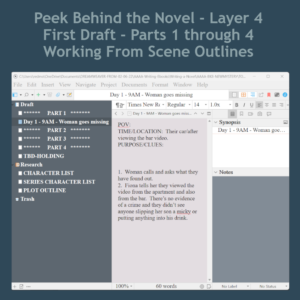


 Write forward only. Don't look back.
 This is the second step in writing a new fiction novel. In the first step, I start out with writing four potential storylines in FreeMind, which is a mind mapping software.
  Most new writers want to start writing scenes and dialogue. They want to just get on with it. But the dark side of working this way is that when you find out your clues won't work when you need to add a new suspect, you will have written two chapters already. My process will save you from writing for the trashcan.