I have advertised with Freebooksy and have had a good experience. The cost to advertise runs approximately $100 to 110. Occasionally, they do have a special, but generally, it is a $100.00 cost. I’ve had over 2,000 downloads with them, so I consider them the best that I have tried.
I have also used The Fussy Librarian and I’ve also had a good result. Their prices range from $49 to $80. They have less of a reach, but I have had 300 or 400 downloads and I still consider that a good result.
THE NEW KID ON THE BLOCK:
I decided to try some of the newer kids on the block to see what kind of results I would get for less of an investment. The first one I’m trying is Manybooks.net.
You can see a snapshot of their website to the left. The website is for readers, of course, and they have a search where the readers can browse through all the books or by genre.
AUTHOR SERVICES:
In order to find the author services, you need to scroll all the way to the bottom and look for a link for Author Services. I took a snapshot of it above.
THE REQUIREMENTS TO ADVERTISE:
Above you will see the conditions that I took a snapshot of from their website. The book has to be marked down at least 50%. You need a minimum of 5 reviews on Amazon and you need to have a 4-star rating or higher. More on this below.
MY OWN PERSONAL EXPERIENCE:
I tried the $29 package, shown abaove, to see what kind of results I would get. Because they required a 4-star rating, I had to choose Book 4 from my Newport Vampire Series. It’s always harder to market for a Book 4, so I had pretty realistic expectations going into this.
The first book in this series, Darius, A Vampire Story, is permafree on Amazon.
Besides the two permafree books I have, all my other books are in Kindle Select. So I set Distrust to be free on February 26th and February 27th. I only purchased the one promotion on 02/26/24. I signed up and these were my results:
02/26/24 – Distrust – 135 downloads and Darius (Book 1) had 21 downloads
02/27/24 – Distrust – 132 downloads and Darius (Book 1) had 19 downloads
I was very happy with the results. First of all, having 135 downloads for a Book 4 in a series is good. Darius also received 21 downloads. Now, Darius gets downloads everyday on its own, but I attributed all the downloads to the promotion just for ease of keeping the records.
The bigger surprise was that I had the same amount of downloads on the 27th. I only paid for one promotion but I count all of these downloads as results of the paid promotion.
Next time I will try Murder in the Sanctuary which is a Book 1 in a series but not permafree and see what kind of results I get. I will do a follow-up blog and video.
I am also planning to try another book, Groomed for Marriage which is permafree with the second $39 package. I’ll write about that one when I do it. The third package had to do with more of an editorial package. It seemed a little bit involved, an author interview, and working with their staff. I wasn’t interested in that one at this time, but for anyone who is looking for something like that, their price seems very reasonable and their staff, pictured below, seems friendly enough!
Below is a video I made going over the website and showing you where everything is. Sometimes it’s helpful to see it live.
This is the third and last segment to the Personalized Workflow Series. In this post, I'll share my best strategies to find, make and claw back time to make room to write that book you want to write.
Although I'm in retirement now, I wrote the first six of my fiction books while self employed full time. So I know the following strategies work.
HOW DO YOU FIND TIME?
In order to find time, you need to analyze your life to find the wasted time and the dripping faucets of time. The last two segments of this series are all about looking at your duties and obligations from a bird's eye view in order to do a proper analyzation. By seeing everything on paper before your own eyes, you can more easily see where the time leaks and losses are happening.
Look for the obvious ways you're losing time. Are you sleeping too late and not getting an early enough start? Are you getting lost in social media or talking too long on personal phone calls? We tend to do this kind of thing when we're not in a time-management frame of mind. We assume we have all the time in the world. First look for obvious wasted time. With two ounces of discipline and a tighter but realistic schedule, you can reclaim all wasted time and direct it to your actual goals.
Learn to break down projects into bite-sized pieces. Instead of scheduling yourself to write for five hours for two days in a row, try scheduling three two-hour writing sessions over the course of a week.
Once you have made the list of obligations and the realistic time frames to complete them, you can more easily juggle a calendar to make time for everything. It's easier to swap out a 2 hour time-frame than a four-hour time frame.
ANALYZE YOUR LIFE FOR WAYS TO MAKE THINGS MORE EFFICIENT:
Once you have found all the time leaks and fixed those, now it's time to look at the ways in which we can more efficiently use our time. Most of us develop the bad habit of keeping a mental list of the things we need to accomplish. Then we move from one thing to another based on what we think we should do now or next. This leads to squandering both time and energy.
By looking at all of your weekly or monthly obligations from above, you can be much more efficient with your time. It's possible to categorize tasks and assignments in order to get them done together. With a little foresight, multi-tasking happens naturally. I'll give some examples below.
Multi-task Example 1: If you go to Church once a week, schedule a grocery pickup afterwards. Use Instacart to order the groceries and then simply swing by and pick up the groceries on your way home. That's a two to three hour savings right there.
If you need to pick up mail at a post office or a central location, add that small errand onto the grocery haul. I'm sure you are getting the idea that by grouping errands done with the car together, multi-tasking allows you to clear them all away on one trip. This saves both time, energy -- and gas. This is another huge time savings that can be put towards making time to write or do whatever else you want to do.
Multi-Task Example 2: Schedule doctor appointments on the same day, one in the morning and one in the afternoon. Schedule research to be done in the waiting room in both doctor offices. Most doctor offices allow you to use at least a general Wi-Fi. Then add lunch with a friend between the visits and keep up friendships as part of your new lifestyle.
I always have a cellphone and ear buds with me. Any time I have to wait, no matter where it is, I watch marketing or writing videos to improve my skills. This is a strategy to squeeze every available minute in a day and make it work for you. Multi-Task Example 3: Get any Saturday chores out of the way by doing the chores one bite at a time during the week. Washing a floor takes about ten minutes. Dusting one room? Fifteen minutes -- depending upon how many dust-collectors you have displayed! You can get up twenty minutes earlier in the mornings to make time for one housekeeping or bookkeeping chore to clear a full Saturday.
At the end of your day, when you're ready to sit back and relax, put in a load of laundry first. Set an alarm to put it into the dryer. Be sure to transfer it to the dryer and then you're done. If you have enough energy to fold and hang the clothing when done, great. Otherwise, the folding can go on to tomorrow's list of things to do. Just tumble dry the clothes for five minutes before folding. You have just found two more hours to write.
Reduce All House Cleaning Down to Bite-Sized Pieces: Many people save all the cleaning for Saturday or Sunday. By doing mini-cleanings, as I've described above, you won't need a cleaning day. I haven't set aside a full day to clean in years. My cleaning is all done in little bite-sized pieces and my house is always neat.
The Kitchen: To sweep up the kitchen floor and do a quick mop -- that takes about 10 minutes. Do this ten minutes before going to bed.
Pick up the living room: If your living room is a mess -- and if you have kids it probably will be -- do the following: Before sitting down for the night or before leaving for work in the morning, put four things away. Then put another four things away. By about the fourth run of putting four things away, the living room will be tidied up. You will be amazed at how this four-things technique can clean up a room in no time!
Analyze the rest of your home-cleaning and house-maintenance routines and see how many of them you can reduce down to a five to ten minute quick routine before leaving for work or leaving for an appointment. My home is orderly as I do these 10 minute clean ups about twice a day. That's enough to keep it neat. I literally don't have a cleaning day. It's all done in these 10 to 15 minute sessions that I sneak into my days.
LET'S TALK ABOUT MAKING TIME TO WRITE:
So now that you have the strategies to find at least a full day to write, let's talk about making it a more formal endeavor. This requires an announcement to the people around you. Creating an actual workspace will also formalize this goal.
Tell your family and close friends that you are setting aside a few hours on Saturday or whatever day works for you where you will need them to allow you to have this time uninterrupted. Tell them straight out you will need their cooperation. Children often think parents' only job in the world is to wait on them. Be sure to explain to your children that you are adding a personal goal into your life and you need their help and cooperation.
This formal announcement will let them all know you're not taking time away from anyone. You're not abandoning them. You have simply cleaned up your life in order to put the found time towards meeting your new writing goals.
Infants: If you have small babies, this announcement won't work, of course, but you can make good use of their nap time. That can be your time to write. Toddlers can be a handful and you may need to schedule your free time to write after their bedtime. If that is your only time, let your spouse know you want to set aside a few hours to write and you need his or her cooperation.
CLAWING BACK TIME & ENERGY FROM WORK?
Clawing back time and energy from your job is a different strategy. This can only be done in some jobs. Realigning and redistributing your energy, however, can be done in any job or career. Let's talk about the differences below.
First of all, not all jobs are careers. Sometimes we have jobs because we're in a phase of life where we can't devote ourselves wholeheartedly to an outside career. Women raising children or caretaking a parent are perfect examples of needing a paycheck with not too much responsibility. Sometimes it's more beneficial to have a job with kids because your life changes every five years based on how their lives change. Being able to redesign a job or get a different job based on your needs can be worth more than a career during the years you raise children or caretake a loved one. Remember, after you're 45 years old, you still have time for a career that can span 25 years or more.
IF YOU HAVE A GOOD CAREER POSITION:
Some jobs are career tracks. If you are pursuing a career and are in a good position where there is growth built into the company you're with, that's great. You may not be able to claw back too much time, but you will be able to claw back some energy with the efficiency I cover later in this blog post. Keep reading.
IF YOU HAVE A JOB THAT IS DRESSED UP TO LOOK LIKE A CAREER BUT IT ISN'T:
For those of you who have a job that is disguised as a career path, the first order of business is to decide if this is the type of job you really have. If there are no supervisory positions to move into, you have a job. If there are no corporate positions available, you have a job. If everyone in management is from the same family or closely-knit cultural group, and you're not one of them, then you have a job. You can claw back both time and energy from a position like this.
If there's no career growth in a business, people generally max out salary-wise and it's only a matter of time before the bosses are too tempted to hire a younger person for less money. There is no loyalty from employers today. So just know that.
GOOD JOBS vs. DEAD-END JOBS:
There are still what I would call good jobs that are not career paths. If you are pursuing a greater goal and have a good job with no career path, it's fine. If you are raising kids or pursuing a masters or a doctorate, a good job without a career path is okay. Even a dead-end job can work as long as you are being paid fairly.
During the years you are pursuing other higher goals, going from good job to dead-end job to an okay job works well because your need at this time is only a paycheck. You can recover both time and energy from all of these jobs.
Once you know you are not in a career tract, you can recalibrate both time and energy output on your job. First of all, good people tend to give too much to these jobs because they tend to give a lot of themselves all the time. You must realign your energy output according to the following rule: You agreed to work a full shift with certain responsibilities in exchange for a specific amount of money. Shift into that mindset. Don't volunteer to do extras. Don't arrive twenty minutes early -- take care of some chore at home if you're ready earlier. Don't feel it's your job to entertain the people at work. You want to shift into a state of mind where you are doing the job you agreed to do but with a slightly reduced amount of energy output. Your goal is to hold up your end of the bargain. Do the shift you agreed upon, but don't exhaust yourself in the process.
You will be shocked how a shift in your mindset will allow you to leave the job after a shift with a reserve of energy that you can put towards your writing goals.
TOXIC CAREERS & JOBS:
If you have a great job but it's in a toxic environment, the amount of energy that you are expending psychically, mentally and emotionally is very high. Working with horrid people and/or in a toxic environment is very draining. A good job is better than a toxic career, especially if you have a goal to write or pursue a different occupation. So just be aware of this. You may want to employ some of the strategies for taking back time and energy from a dead-end job so you can gather your energies for other pursuits.
STRATEGIES TO SAVE ENERGY:
Shift into a lower energy output in these dead-end jobs. Continue to hold up your end of the deal. Do an honest day's work in exchange for your paycheck. That doesn't mean working to the point of exhaustion. It means a fair day's labor.
Make checklists and cheat sheets for most of the things you do at your job. If you are following a boss' list of how to do things, just lower your pace and energy output. This will allow you to continue to work, but stay away from exhaustion.
Analyze all of your job duties and using web flow charts, checklists, procedure lists and information sheets, which we learned about in parts 1 and 2 of this series, you can reduce the amount of mental energy applied to all of these tasks. This will enable you to save a huge amount of mental energy at work too.
All jobs, no matter what it is, can be robotized. Example: Think of all the doctors' offices you've been to where they have it set up like an assembly line. They move you along the conveyor belt from one waiting area to the next, all preparing you for a four-minute visit with the doctor. They have robotized even that profession to be an assembly line job. This is for efficiency.
A WORD ABOUT LUNCHTIME:
Claw back lunchtime for yourself. Too many employees wind up eating lunch with co-workers that they barely have anything in common with. Because we now live in a global society, we barely have anything in common with each other -- except knowing the other people we work with. So very often the conversations at work descend into gossip. And there is NOTHING more energy robbing than making idle gossip.
So if this is how you are spending your lunch hour making idle chitchat or gossiping with coworkers, you need to start leaving your job to sit in your car and write, do research, run errands, or whatever. Just use the lunch hour constructively.
Try to limit the mindless chit chat that also goes on in most workplaces. Co-workers are not friends. You won't know most of them five years from today. Don't allow them to talk and talk and talk until you're punch drunk. Under the best of circumstances, they can be an occasional lunch buddy.
Lunch buddies are people in the third circle of influence in your life. Our spouses and families are in our first circle of influence. Church or private club friends, lifelong friends, more distant relatives, and neighborhood friends are in our second circle of influence. The third circle of influence is for co-workers, doctors, business connections, old acquaintances, etc. So don't allow co-workers to drain your mental, emotional or psychic energy during the day by making idle, mindless chatter.
By applying all of these strategies, you will recover a lot of time and energy from each day. Now you have everything you need to set up your new goal of writing that book!
In the last installment, I described how to start your duties and obligations list with realistic times associated with each one. The list will prove itself over a week or so. Then you will be ready to expand on that list and make a series of workflows, templates, and procedure lists or diagrams. I have posted my own above to jog your memory as to where we left off.
HOW TO RECLAIM TIME:
First let's talk about strategies for finding, making and clawing back time from your days that may be wasted right now.
Looking at your list, are there any obligations that you can take care of while waiting for other things in your life? For example: Can you make some calls as you wait in line to pick up kids at school?
Can you save yourself a trip out of the house by hooking two or three errands together on the same day?
If you are spending your lunch breaks listening to coworkers blathering on and on about inane things, can you write during your lunch hour? Or can you run an errand to clear a Saturday for a greater goal?
Can you listen to an instructional video while driving home from work or some other obligation to make better use of time in traffic?
Go through the list and see how you can mop up wasted time out of your days and reclaim that time for more or better things.
If you have 10 minutes here and 20 minutes there, don't waste it. Clean out your purse with the 10 minute time slot. Do online research for that 20 minutes.
Every minute that you make better use of will free your schedule for the higher goals you want to pursue. Will your life suffer if you miss out on office gossip at lunchtime? I doubt it.
A SPECIAL NOTE ABOUT GETTING LOST IN SOCIAL MEDIA:
Social media can be wonderful or it can be a time-wasting trap like none other. Be particularly careful with short videos or reels. This can be mindless and mind-numbing. One short video can lead to the next almost without willing it. We've all been there. Think of the times the internet, in whatever form, has stolen an entire morning or afternoon. In order to reach higher levels of accomplishment, this has to stop.
Assign yourself some mind-numbing social media time at night. You will have already met your daily accomplishment goals. By checking social media in the evenings, the news of the day has had time to ferment. You'll be reading news instead of 'breaking gossip' or hours of speculation. You can see what your favorite social media people have said all day instead of in the last hour.
If you must go on social media during the day, set an alarm to sound in fifteen minutes. Then get back into accomplishment mode.
START THE WORK FLOW FROM THE TOP:
As a self-publisher, all of the hats I wear in writing and publishing books are noted in the chart above. Analyze and translate your business and make a similar chart. As we move along, we'll drill down into each section and make work-flow diagrams, procedural lists, or informational sheets for just about everything that has to be done.
EVERY BUSINESS OR WORKFLOW NEEDS A FILING SYSTEM:
As you begin, it's important to know how you will organize and file the work product you are about to produce. For example: How will you file your book manuscripts so you can put your fingers on them in two seconds? How will you file all the marketing graphics you produce once you create a social media presence? How will you file and store video files that may be too big to store on a laptop or a desktop?
It's a good idea to think about this in your analyzing phase. Below, I'll go into details about how I set up my book files to keep everything orderly and consistent.
STARTING AT THE TOP OF THE HIERARCHY:
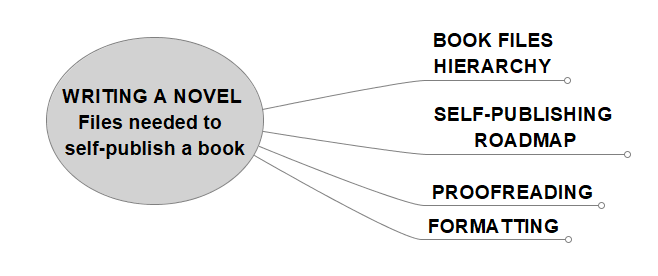
Below is a snapshot of the top layer of my Self-Publishing Business. Each area represents another hat I wear in publishing my novels -- or any other books I may decide to publish. I created this mindmap on a free tool called Freemind. What I like about this mindmapping software is that I can close each of the sections and only focus on what I need depending upon which segment of the self-publishing process I am in.
ORGANIZING MY BOOK FILES | MANUSCRIPTS & COVERS:
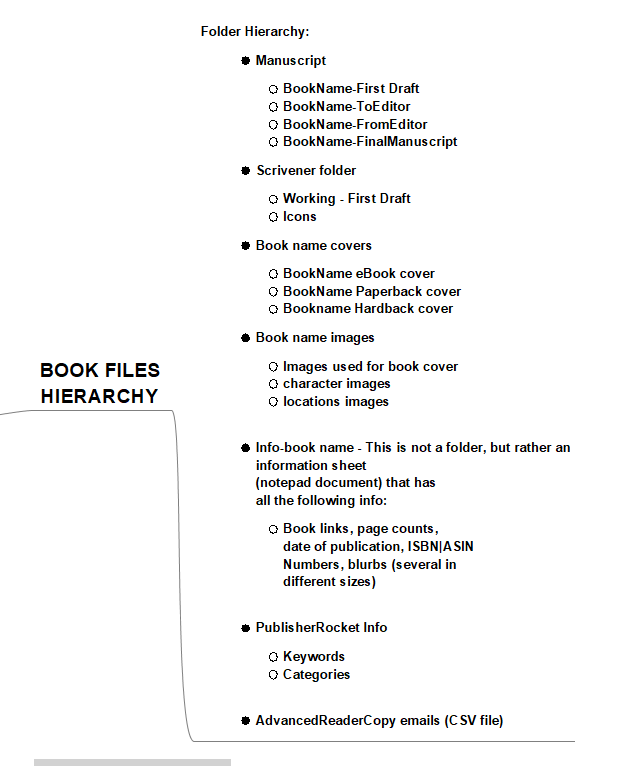
Above is the Book Files Hierarchy opened. It contains a list of all of the folders, sub-folders and files I need for each of my books. By having this visual, I can be consistent in the names of the folders, It's even possible to set up the folders before you even finish a first draft.
When I wrote my first novel, I can't tell you how many "drafts" I had and how mixed up I got with it all. This system makes everything clear and self-explanatory.
SELF-PUBLISHING ROADMAP:
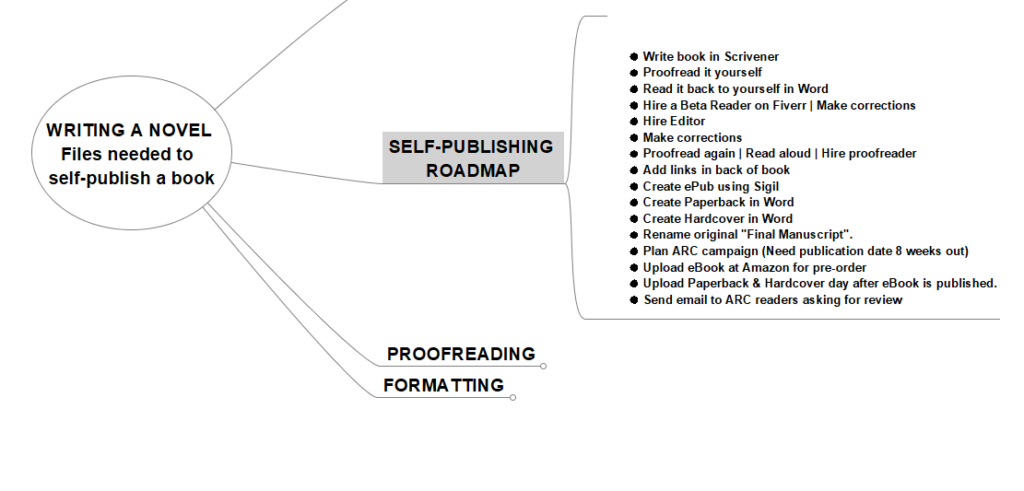
Above is the Self-Publishing Roadmap section opened. This is more of a chronological list of everything that has to be done. I have Procedural Lists and/or Informational Sheets with more detailed instructions for each of these steps. It seems a bit excessive, right? Not really. By using organizational tools, diagrams, and lists, it prevents me from having to reinvent the wheel each time I have to do something. I also don't have to use valuable mental energy 'figuring things out'.
There are many things I do on autopilot and I don't use a list for those things. Anything I do everyday or once a week, I don't need a list for. The lists come in handy when I'm doing something I only do occasionally. I believe by having these lists, I cut through any confusion or a bad memory. I have more energy to write!
LET'S LOOK AT THE PROOFREADING LIST:
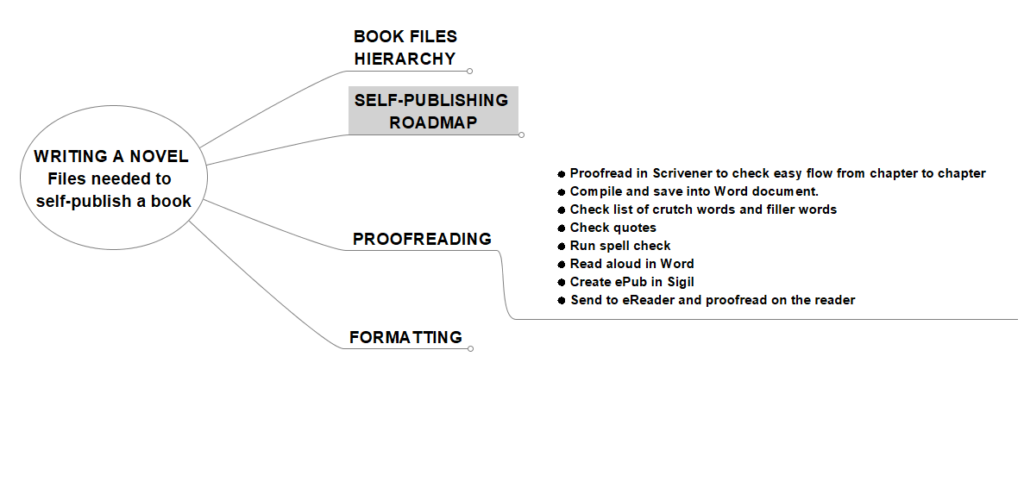
Above is a snapshot of the Proofreading tab opened. It has a chronological list of how I proofread. I proofread in layers because it makes it easier and less taxing.
LET'S OPEN THE FORMATTING TAB:
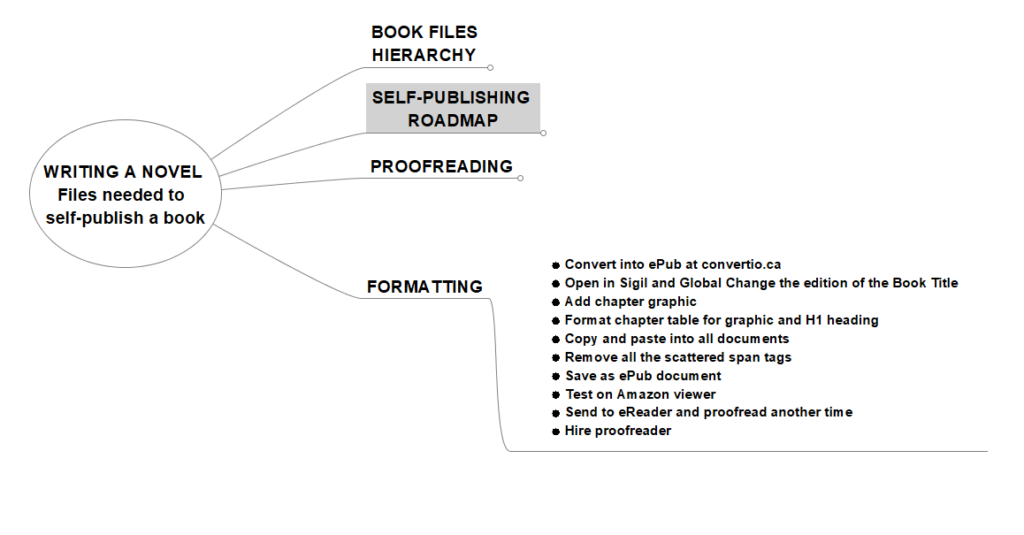
Above is the Formatting Tab opened up. It too has a chronological list of how I take my books from formatting the eBook, making the ePub for best upload on Amazon, to the paperback and Hardcover.
If ever I'm at a loss as to what comes next, no matter where I am in the self-publishing process, I just have to go to my list, and the next step will become as clear as day.
Below I have a short snippet where I open all of the sub categories and you can see the chronological lists that serve as guides and reminders of what every facet of the process requires.
In creating workflow information for the entire self-publishing process, I use a series of Informational Sheets, Procedure Lists, and Diagrams. They all serve the same purpose: To make sure I know what is needed, it functions as a memory jogger, and gives me a sense of knowing I'm not forgetting anything.
Below is a Video Snippet showing one my Informational Sheet on Formatting. I have been adding information and specific notes about experiences I've had with formatting for the last several years. I check this list before beginning any formatting so I refresh my memory about any little snags that happened in the past. This is a great time saver.
Below is a video snippet scrolling through the Formatting Info Sheet.
In the next installment, I will cover my Blog and Video Procedural List. This allows me to easily write a blog, convert it to a video script, and make blog graphics and video overlay panels at the same time. Multitasking supercharged! See you in the next installment!
There comes a time when any author or creator starts to accumulate a lot of documents. Manuscript files, first drafts, editor drafts, book cover files, social media images, how-to information, checklists, not to mention a work calendar of some kind. You can see that it can get overwhelming very quickly.
The trick to getting and staying organized is to analyze what type of work flow you have and what solutions and systems you need to cover all your bases. That’s what this blog post is all about.
There are lots of videos where people show you their work-flow setups, or their personal filing system. But every single person — even those producing the same type of work — will have different needs, different goals and even different outcomes.
Why not learn how to create your own system and workflow by analyzing what goals you have now and what needs to be done to achieve them?
WHAT HAPPENS WHEN WE GET SCATTERED AND OVERWHELMED?
What happens? You lose momentum. Without enough organization and a defined mission, most of us fall into a state of chaos. Some worse than others. You can’t see the forest for the trees because you can’t envision how to get from point A to point B. Your energy scatters. You lose your stride. The next thing you know. an invisible white flag goes up and you find yourself watching mindless videos as a distraction. Don’t let this happen to you anymore.
Before we start into mapping out any specific business strategies or personal goals, it’s important to get a handle of your everyday obligations as they stand today. Make a list of all you need to accomplish on a regular basis, plus your everyday must-dos, plus setting up your location, having your supplies and tools handy — this creates the perfect setup. This will lead to your personal work-flow. Once you know your unique workflow, then organizing a calendar and a filing system to match it will be easy.
BENEFITS TO ORGANIZING A WORKFLOW
Once you implement this system, you will eliminate all of the time eaters and time wasters. You can reacclimate yourself at any moment of the day. You can find your place in an instance. No more lost days or lost weekends. Most of the stress and worry about getting everything done will disappear. You will rely on your proven plan and proven system. You’ll accomplish almost double of what you’re accomplishing now.
IT ALL BEGINS WITH A LIST OF THE THINGS YOU NEED TO DO ON A WEEKLY BASIS.
Most people are balancing a personal life and a work life. Thinking about what you need to accomplish at work without taking into account all that is required in your personal life is a recipe for disaster. Your goals will be unrealistic and it will be a setup to fail.. It’s important to plan around realistic personal and business goals.
I am a self-published author writing in retirement right now. I own a home and live alone. So taking care of and maintaining myself as well as my home is my responsibility. Going to church, keeping up with friends and family, and even leaving time for a hobby or two, these are all sketched into my work flow plan. Everything you do requires time and energy. So having a realistic over-arching monthly plan of accomplishment will be the basis of your own personal workflow and system.
IT ALL STARTS FROM YOUR ROUTINE AND A REALISTIC LIST OF THINGS TO ACCOMPLISH:
Make a list of what a week in your life looks like. For me, I write novels, do book marketing, write blog posts and make videos (for marketing reasons as well as sharing my experience and knowledge with others).
On the personal side, I do freezer cooking once every three to four weeks where I spend the greater part of a day cooking for the month. I go to the gym three days a week with my cousin. And I organize a lunch with my neighborhood friends once a month as well. My workflow is knitted around these events, activities and goals. This is where my workflow starts. Your workflow design will start with your week-in-the-life information about yourself.
ASSIGN REALISTIC TIME SLOTS TO THE VARIOUS TASKS:
I can’t stress it enough how important being realistic about how much time things normally take is. For example: When I set aside time to write on a novel, I use two to 3 hour spaces in a day. If I can schedule one or two of these spots a week, I can continue writing at least two novels a year. If I can afford more time in some weeks, all the better. I choose quiet days without doctor appointments or other family or friend obligations where I will have quiet time to write.
I save some general research to do when I do my freezer cooking. During this time, I play writing videos in the background, so I can learn from other authors. Sometimes I play marketing videos. But I use the cooking time efficiently. I’m still moving forward with my goals, even when I’m cooking! Multi-tasking works!
Go through the entire list of things to do and put down realistic time slots for everything.
LOCATION | LOCATION | LOCATION:
Alongside the time allotment, add the location you need to be in to do this work. Also list what supplies, trinkets or tools you need to accomplish each. Plus, add whatever you like to have on hand like coffee.
Here’s a personal example: To write, sit in corner of my bedroom in a chair, with my laptop, with a table set up next to it. I like to drink coffee when I write, so I make sure I have a pot ready and on hand. I also place a pad and pen on the table so I can down any new names I choose during the writing process. I write in Scrivener which is loaded onto my laptop, so that’s all I need for the entire writing session. By recreating your perfect environment you can design a setup or gathering list so you won’t keep interrupting yourself with forgotten items.
When I am videotaping, I need my laptop, Snagit tool, printed video script, ideas for the YouTube thumbnail, a pen, ideas for text overlays, ideas for video graphic elements, and a ring light. To shoot a video, I also use a two to three hour workspace. I’m new at making videos so younger people may be able to work faster than this.
BUT I DON’T HAVE THAT MUCH TIME:
If you are someone who has a limited amount of time to achieve the goal of writing a novel, it’s okay. You can convert an hour a day into a book as long as you are organized and can protect your writing time. I published my first five books while still working full time. So I know it can be done.
Go through your life — at least those parts you are attempting to organize for efficiency — and analyze them as I suggested below. That list will become the basis of your personalized work flow and your ultimate work calendar.
MAKE A WEEKLY CALENDAR:
Add on your church and family obligations, school obligations, and you can then see realistically how much time you will have to write or do whatever your passion is.
It’s a good idea to make your list and live with it for the first few days or a week. A couple of things may happen. First, the time slots you gave each item may be much shorter than you thought or much longer than you thought. So adjust them as you go along.
Another thing that will happen is other obligations will arise that you didn’t remember when making the list. So before you write the list in stone and start planning around it, give yourself time to make the necessary and realistic adjustments. By the end of a week or two, you will be clear on what you need to do to set up a winning and successful plan to take you to where you want to be.
WHAT COMES NEXT?
In the next installment of this series, I’ll talk about getting more efficient. How to rid yourself and your life of time eaters, energy zappers, and other dead-end roads to nothing but time loss with zero accomplishments.
We’ll also talk about how to reclaim time and energy from your life to better apply it to your personal goals.
Here is a video I recorded covering most of the above material:
Everyone writes for a reason. Knowing why you write is important, especially as a beginner writer. Writing a book is not hard, but it can be a long process. If your purpose for writing is clear, this will give you the energy and inspiration to spur you on if and/or when the going gets a little tough.
Are you writing for pleasure? Are you an avid reader and you want to write the books you never found? Do you want to write around some social commentary you have a desire to share? Writing is a form of sharing. What is it that you want to share? Your wit? Maybe Satire? Have you always been told that you're funny? Do you have a unique take on society that you think people would like?
I love stories and movies that have a backdrop of Catholicism in them, like The Godfather saga, or The Supranos, or even Ray Donovan. The Catholicism in these stories felt familiar to me and I believe it gave the story a layer of depth as it tapped into religion and culture which tends to anchor a group or family. So I write novels that have either a backdrop of Catholicism or a ribbon of Catholic sensibility passing through it. Of course, I leave out the blasphemy that Hollywood loves to toss in there on occasion!
I also write as part of my legacy. I began to write in 2018 when I moved to Central Florida, which I considered my pre-retirement. Now I have retired and I write full time. I feel that my books will be part of my legacy. I'm clear on my purpose for writing.
ARE STORIES JUST BURSTING TO COME OUT OF YOUR HEAD?
Some people are what I call natural-born writers. They do have stories bursting out of their hearts and heads. Often, these people fell in love with reading as children. Reading was an adventure. It took them up, up and away. Some people have always had a desire to author their own stories. If this sounds like you, you are a natural-born author.
This is usually a sign that you have been given the gift of authoring. These gifts are Heaven-sent, and predate schooling and other influences in your life. If this is the case, embracing your fate is probably the next best step to take.
DO YOU WANT TO WRITE AS PART OF YOUR LEGACY?
There are trades and arts that seem to fall by the wayside in each generation. But often, how to do certain things is lost to history. Do you know how to do something that you feel you need to leave behind? Do you want to write about how you did something that is now fading from the world?
There are young people who don't know how to write a check anymore. They don't know how to address an envelope for the mail. Some don't even read cursive writing anymore.
Listening to a lecture by the learned intellectual and researcher Thomas Sowell, he stated that when Rome fell, the western world lost the art of making bricks. Then when the western world got back on its feet, they had to import brings from England because the art of making bricks died with the civilization. Cement was invented in Rome. They made all of those brick arches -- but the art was lost. What is it that you know how to do that you feel compelled to record for prosperity's sake?
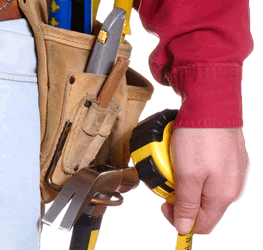
I'm old enough to remember 'phone guys' that worked for Bell South or whatever the phone company was called back then. These men -- they didn't have phone women back then -- would show up with big toolbelts and gaffs or lineworker boots on. These boots had cleats or little metal spikes in them that was a safety feature. These men know everything about the phone system. They would climb the wooden telephone poles and they could fix phones outside on the pole or inside in the houses. They were familiar with the entire system. That is one group of technical workers that have fallen away.
Is there something about an art form or a job that you knew that you want to pass on for prosperity sake? You can write a novel around it and it will serve two purposes: It will be a way for you to tell the story of your industry or job and you will be documenting how life was at a certain time in history.
DO YOU HAVE A BURNING DESIRE TO SHARE A UNIQUE EXPERIENCE?
Very often life dishes out some hard times to some of us. Did you experience, survive and prosper through some difficult times that you feel compelled to write a memoir about? You don't have to have been a famous celebrity or someone with a Moses-like mission. You may have fell on hard times and you want to share your experience, strength or faith that kept you going. People love inspirational stories.
Writing a memoir can also be part of your legacy. Someone three generations down the road may be curious about how the family was back in your times. By having a published memoir, you can share your perspective on things during the times you lived.
Today people no longer write letters. Most photos live on phones that may be lost or stolen. Even photos in the cloud could easily be lost to history without the right username and password. By writing a memoir, you may be someone who is documenting the present in a way that historians in the future may be very grateful for.
SO WHY DO YOU WANT TO WRITE A BOOK?
What do you think? Do any of these reasons resonate with you? Make your first writing assignment to list the reason or reasons why you choose to write.
Here is a video where I had a few more words to say about finding your reason to write!
John Walsh is a successful funeral director with a loving family but he has a weakness for other women. The modern world thinks cheating is a victimless crime, but is it?
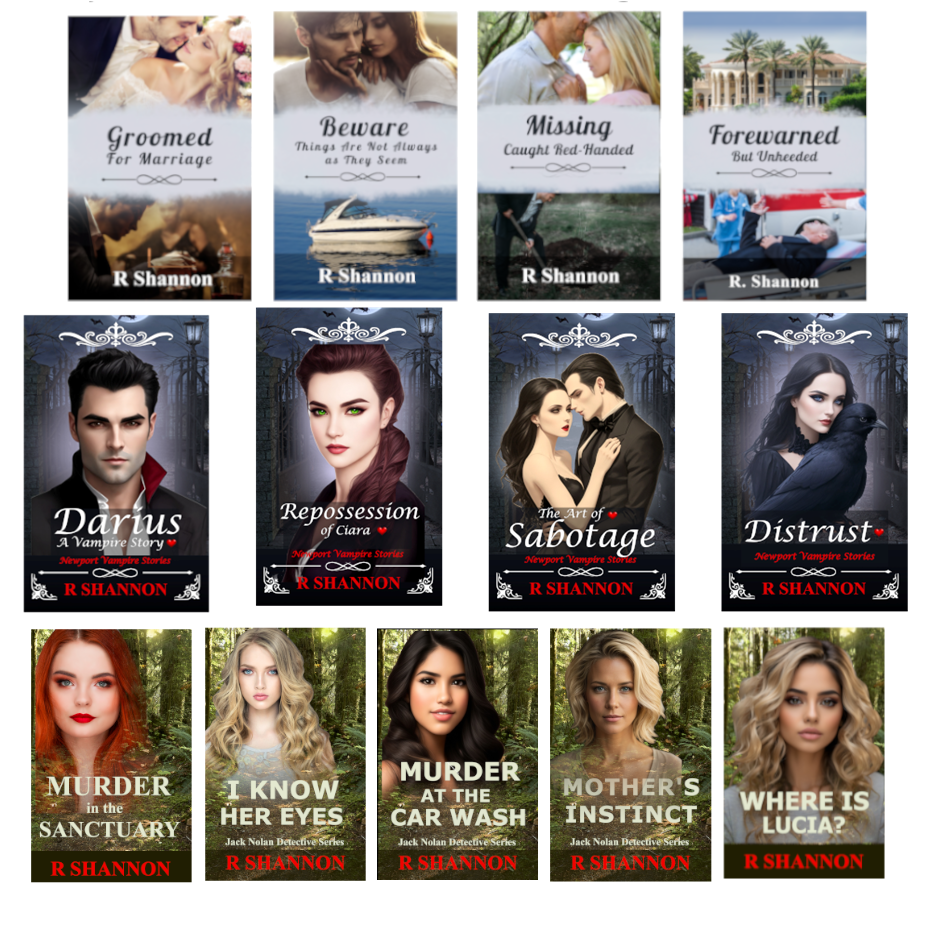
I didn’t set off to write a book series. How did it happen? My first novel turned out to be way too long and there was way too much going on. So I broke it down and wrote two separate stories.
Once I finished the first two novels, I realized that because my main character was a private investigator, it was possible to continue to solve crimes in new books, so that's what I did. The series is now four books, but I could easily add more in the future.
During the process of writing my first, second and third series, I learned a lot of tips to make it easier. There were so many things I didn't know I didn't know in the beginning. My purpose in this blog post is to pass on my best tips in writing a book series.
I found out later that more experienced authors even suggested that newer authors consider writing in series because it's easier to market the books. But my venture into writing book series was a happy accident.
TIP NUMBER 1: KEEP A LONG RUNNING INFORMATION LIST
Keep a long running names list. I call mine an Information Sheet. I put down every character I ever name. I learned the hard way to only trust my memory. It doesn't work!
By having a long list of every character, street names, crime locations, neighbor names, job titles, etc., you will have all of this information at your fingertips.
Example Number 1: In my first novel in the Jack Nolan Detective Series, I needed an immediate boss' name. So I chose Lieutenant Duane White. But then when I needed to refer to him in Book 3 but I forgot what I named him! I had to hunt him down in the manuscript of the first book. This can take hours, especially if you don't have any clue what you may have called him.
Now I keep the all proper names and other information that I may need again on a long list that travels with me through each book. No matter how insignificant the character seems, I write it down on my information list.
Example Number 2: I referred to Jack Nolan's wife, one of the characters, as having left him eight month's previous to the start of the series. By having this information recorded, I was able to track how many months passed and how this time increased over the time of the series.
Example Number 3: Town names, Plaza names, Mall names, etc. All of these seem insignificant when you are pulling the names out of the air during the drafting of the book. But with cops working in the same town, you may need to reference that same mall again.
Special Note to Fantasy Writers: They use what they sometimes call a World Bible, and this is a more extended information list. It's important to keep track of everything I've just mentioned, as well as the world rules and the rules regarding whatever supernatural power you may write about.
TIP NUMBER 2: KEEP A SHARED MARKETING LIST FOR THE ENTIRE SERIES:
Shared Marketing List
Keep all of information about the books on one shared marketing sheet. I keep the names, publication dates, book links, categories, and keywords for the books all on one page.
Once you begin to market the books, you will need to use this information over and over again.
You may also want to keep a few short blurbs because when uploading to advertise on Bookfunnel, Bookbub, FussyLibrarian, or Freebooksy, you will need all of this information handy.
At the time of the writing of this blog post, Amazon only allow an author to put their book in 3 genres. If you have 4 books in a series, you can put the last three books in different genres thereby extending your marketing reach.
It goes without saying that you should have a link in the back of each eBook so the reader can click on the link and go to purchase the next book inthe series.
Amazon only allows seven keywords for each book. Use the best keywords for the first book or two. Then use longer-tail keywords and different keywords to broaden your reach for new readers. By having them handy, especially if you do keyword research, it will make all of this much easier.
Let me give you an example: In my Jack Nolan Detective Series, I put the first book into Police Procedurals, Mystery Romance, and Mystery Suspense. But Books 2 to 5, I can add into general mystery categories and women's fiction, literature and fiction, etc. You can imagine how much broader your reach for new readers will be.
TIP NUMBER 3: USE A BROAD STROKE CHARACTER ARC OVER THE ENTIRE SERIES:
I use broad-stroke character arc for the main characters that extends over all the books in the series. Each individual book, however, the character grows and changes a little bit. So each book contains its own arc, but there is a longer series arc for the main characters. It helps to know this before you start writing the series.
Each book has a crime or mystery that plays out and is solved. The characters grow during the subplot of each book. Once the mystery is solved, a new normal is shown with the characters embracing their new-found growth. In the next book, the same template will be followed. The mystery or crime will play out or be solved, and characters will grow, and there will be a new normal that reflects that growth.
TIP NUMBER 4: I WRITE THE BOOKS AS STAND-ALONE BOOKS
This tip is about writing the books in the series as 'stand-alone books'. This allows me to market the books as a series, but also as stand-alone books. As stated above, each book has a full plot that completes but I put in enough background information in order to fill in stand-alone readers on what is going on with the characters in case they haven't read the initial books.
I write in Scrivener and I set up a meta tag so I can keep track of what background information I need to drop into the story for those stand-alone readers. This makes marketing the books much easier.
John Walsh is a successful funeral director with a loving family but he has a weakness for other women. The modern world thinks cheating is a victimless crime, but is it?
Some writers have no-to-little money to work with and they will take one route. Other writers have no time but have some money to work with. Where you are on this road will determine what your choices are.
I HAVE TIME BUT NO MONEY:
This could be a person who works full time, lives alone, or has a few kids and there is just not enough extra money around to fund all the things necessary to do when self-publishing a book. Not to worry. There are a few choices for you.
Goodreads.com is an active website for readers and authors and is filled with other authors who are also looking for help to publish their books. The trick is to find them.
If you search "Beta Readers" in the search box on Goodreads, it will bring up all of the beta reader groups that are available to you at that time. You can access this under the community tab on the navigation menu. Be sure to read the rules and regulations for the specific group because the last time I looked, there were a few Gestapo-like warnings and instructionals about how people should post.
If you happen to be extraverted or bubbly, good with people, you will have no trouble finding someone in one of these groups or forums to help you. I'm introverted and don't do well in these large groups because I always feel like I'm bothering people. But not everyone is like this, so if you are good at making acquaintances and friends, give Goodreads a try.
Try to google "beta readers" as well and you will find other forums that claim to have people willing to read your book. I never gave this much patience because I chose to just pay someone.
TRY A FAMILY MEMBER AS A BETA READER:
If you have a family member who you can trust to give you honest feedback and gentle criticism, this is probably the best choice. Make sure it's someone who will want to do a good job for you and they will know you are counting on them. That's what I did. My Aunt Gen offered to read my books and I jumped at the chance. She read them and kept a notepad by her book and jotted down everything she thought about.
I also had a friend who needed computer help and I bartered with her for beta reading. That was also a great experience.
The trick to making working with amateurs, so to speak, work is knowing two things. (1) Your readers will feel that they have to give you some level of criticism so you have to be ready to make that work for you. I'll go into that below. (2) The second thing is that sometimes people will give you advice about writing books that come out of left field. They will not know what they are talking about, so it's important to be prepared for this. Just be ready to thank them for their ideas.
Once you have chosen a family member or friend to beat read for you, you need to direct their attention to what it is you are interested in having them do. Tell them that after they read the book, you will want to know the following 5 things:
Do you like the characters?
Is the plot easy enough to follow or was it confusing at any point?
Were there any plot holes or anything about the plot that felt unfinished?
How were the character and location descriptions?
Did my prose read easily or did you find yourself having to re-read sentences sometimes?
That's it. Let them have the book with those questions. Then after they're done, you can ask them other questions. By guiding them as to what you want to know, you will get feedback and criticism that is helpful.
I HAVE MONEY BUT NOT TIME:
If you are working, raising kids, or just working 60 hours a week, you probably have a few extra dollars and will need to get someone two help you for a reasonable price. There are full industries that have sprung up around the entire self-publishing industry, but it's important to know how not to be ripped off!
I used Fiverr.com for my beta readers. I found someone who was willing to read my book and give me feedback. The person I chose read the book in Microsoft Word and she used commenting in the Track Changes feature. I hadn't thought of this myself at that point. She commented all throughout the book. This was so valuable because it was like being in the reader's head when she read the book.
I gave her my list of 5 questions above and between her answering the questions and commenting throughout the book, she did a great job. She charged me $80. This was back in 2022 so it may have gone up to $100, but I believe it's still worth it.
I have become a repeat Fiverr user as I have had nothing but good experiences on their website.
Here is a video you may like where I go over pretty much the same material I just explained in the blog post.
What's the Difference Between a
Beta Reader and an ARC Reader?
A Beta Reader is someone who reads the book to give you feedback as to whether people will even like the story. A beta reader knows they are reading a book that is not ready to be released. They are aware or should be made aware that they will be asked for feedback as part of the final crafting of the book process.
An Advanced Copy Reader is a different animal. They are readers who are also expected to give feedback, but many are not quite aware that the book is not yet "finished". They also don't look at giving feedback an obligation.
WHICH ONE IS BETTER? A BETA OR AN ARC READER?
In my humble opinion, they are different readers for different reasons. But I will share how releasing my book as an ARC copy came back to bite me once or twice.
I chose to use Bookfunnel or SiteOrigin to release my ARC copies so that I could get the readers' emails to be able to contact them with a gentle reminder to review the book when it was released. Sounds innocent enough, right?
Well, what I found out later was that often readers will volunteer to be an ARC reader but they just want a free eBook. I don't necessarily have a problem with that. However, then some don't read the book for up to a year or more. And when they do, they forget they are reading "an early copy" or an "imperfect copy" of the book.
I can point to several snarky remarks about spelling and/or punctuation in a few Goodreads and/or Amazon Reviews. I learned the hard way to never send out any ARC copies to any eReaders unless or until it has been beta-read, professionally edited and it's just waiting to be listed for a pre-order.
MORE ABOUT BETA READERS:
The other thing I learned about beta readers is that they were hard for me to find. I went to innumerable forums or groups asking for someone, but no one ever responded. I do believe authors who are more extraverted and more actively socially have an easier time asking for help. For me, I tried, but I didn't find anyone.
I decided to go to Fiverr.com and hire a beta reader for $80.00. Go to Fiverr.com and type in "Beta Reader" in the search box. Look specifically for those who have done it a few times and have a 4 to 5 star rating. It's that easy.
Once I chose somethin, I gave the woman a copy of the book in Word and she make comments throughout the entire book. Not just corrections, but actual feedback and suggestions as she read. This was so000000 helpful! It was worth every penny and more.
The other thing I liked about using Fiverr is that it made it easy and instantaneous. When I was ready to pass the book off, I wanted someone right away. In the forums, I didn't get the impression anyone was home when I was there. I also have a problem asking people to do things for free. Most people I know are working so I consider their time valuable. I always have. So by paying the woman for her time, she made a little extra money on the side and I found a great beta reader. It was a win-win for both of us.
I STILL USE ARC READERS BUT FOR A SLIGHTLY DIFFERENT PURPOSE:
I will continue to request ARC readers and I include a questionnaire in the back of the ARC copies. Several readers do take the time to fill them out for me. It's so valuable. Each one has a different take on things.
Going forward, I may also put a statement at the end of the ARC book copies reminding the reader that they are reading an ARC copy of the book and to forgive any last minute errors that are still uncorrected. Many of my past ARC readers did take the time to alert me to a typo or two on top of filling out the questionnaire and I can't tell you how valuable someone like this is. I now also put my ARC readers on my Acknowledgments page. They have no idea how grateful I am for them. I usually offer them a small gift or a free eBook for their trouble.
After release, I only send onegentle-reminder email asking for a review after the book is released. Not everyone posts a review, but that's okay. If I get a few, again, I'm thankful. If they are members of my newsletter list, I usually put an announcement that the book has been released and this serves as a second gentle reminder.
If you are interested in seeing more about my ARC reader procedure, click here.
WHAT'S THE TAKE AWAY?
The take away is -- at least in my humble opinion -- you don't need a whole team of 10 or 20 people to release a book. If you have one beta reader, a professional editor that you trust, and get feedback questionnaires from a few readers, that's enough. After all, at the end of the day, some people will love your work and some may hate it. You're writing for your own readership -- not for those people who don't like your work.
ONE FURTHER NOTE ON WRITING IN BOOK SERIES:
I write in series of four to five books. In the first book in any series, when the characters are new, this is when I may hire two beta readers. You want more than one or two opinions when main characters are new. When I released Murder in the Sanctuary, I had no idea if people would like the main characters -- Jack and Fiona. But it turned out most of the readers really liked them. What a relief! The additional beta readers gave me the confidence I needed as I went forward into releasing the book.
Now, you know I love to have checklists, worksheets and cheat sheets. So of course I have one for this blog post and video.
The most important lesson I ever learned about Beta Readers and ARC readers -- in releasing a book in general -- is that it takes time. I need at least eight weeks to do a full ARC campaign, and two weeks for a beta extra for the beta readers and editor. When I was new, I had no idea of needing to do so many things before release.
This Checklist will lay out everything that has to be done, how much time you will comfortably need, and it will give any newbies the added confidence that you're not forgetting something!
BOOK MARKETING FOR THE SHY AND INTROVERTED:
Every self-published author -- and even some who have literary agents and publishers -- have to learn basic marketing skills today. I have developed many marketing skills that work for the introverted and camera-shy. If you can relate to that, subscribe to my YouTube channel and follow me on social media as I post about book marketing strategies all the time.
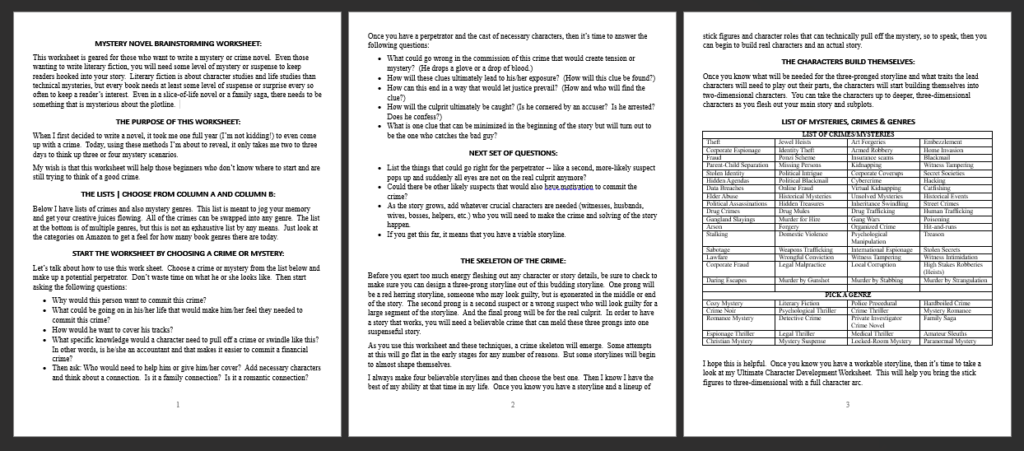
This worksheet is geared for those who want to write a mystery or crime novel. Even those wanting to write literary fiction, you will need some level of mystery or suspense to keep readers hooked into your story. Literary fiction is about character studies and life studies than technical mysteries, but every book needs at least some level of suspense or surprise every so often to keep a reader’s interest. Even in a slice-of-life novel or a family saga, there needs to be something that is mysterious about the plotline.
THE PURPOSE OF THIS WORKSHEET:
When I first decided to write a novel, it took me one full year (I’m not kidding!) to even come up with a crime. Today, using these methods I’m about to reveal, it only takes me two to three days to think up three or four mystery scenarios.
My wish is that this worksheet will help those beginners who don’t know where to start and are still trying to think of a good crime.
THE LISTS | CHOOSE FROM COLUMN A AND COLUMN B:
Below I have lists of crimes and also mystery genres. This list is meant to jog your memory and get your creative juices flowing. All of the crimes can be swapped into any genre. The list at the bottom is of multiple genres, but this is not an exhaustive list by any means. Just look at the categories on Amazon to get a feel for how many book genres there are today.
START THE WORKSHEET BY CHOOSING A CRIME OR MYSTERY:
Let’s talk about how to use this work sheet. Choose a crime or mystery from the list below and make up a potential perpetrator. Don’t waste time on what he or she looks like. Then start asking the following questions:
Why would this person want to commit this crime?
What could be going on in his/her life that would make him/her feel they needed to commit this crime?
How would he want to cover his tracks?
What specific knowledge would a character need to pull off a crime or swindle like this? In other words, is he/she an accountant and that makes it easier to commit a financial crime?
Then ask: Who would need to help him or give him/her cover? Add necessary characters and think about a connection. Is it a family connection? Is it a romantic connection?
THE NEXT SET OF QUESTIONS TO ASK:
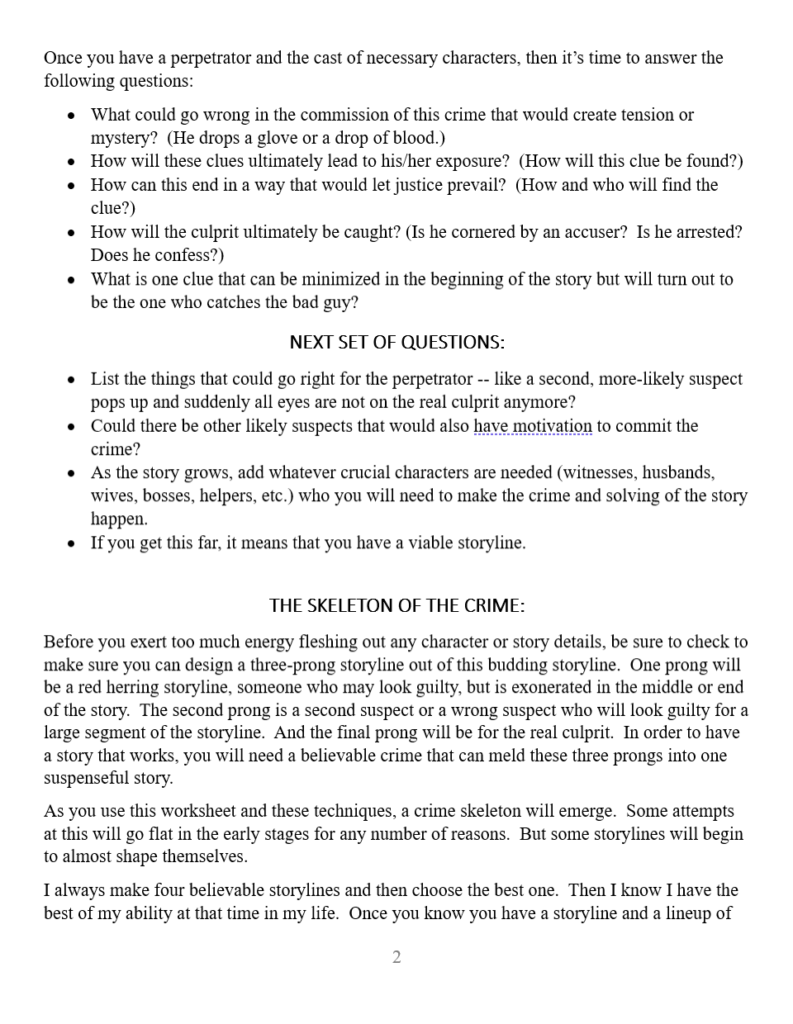
Once you have a perpetrator and the cast of necessary characters, then it’s time to answer the following questions:
What could go wrong in the commission of this crime that would create tension or mystery? (He drops a glove or a drop of blood.)
How will these clues ultimately lead to his/her exposure? (How will this clue be found?)
How can this end in a way that would let justice prevail? (How and who will find the clue?)
How will the culprit ultimately be caught? (Is he cornered by an accuser? Is he arrested? Does he confess?)
What is one clue that can be minimized in the beginning of the story but will turn out to be the one who catches the bad guy?
NEXT SET OF QUESTIONS:
List the things that could go right for the perpetrator -- like a second, more-likely suspect pops up and suddenly all eyes are not on the real culprit anymore?
Could there be other likely suspects that would also have motivation to commit the crime?
As the story grows, add whatever crucial characters are needed (witnesses, husbands, wives, bosses, helpers, etc.) who you will need to make the crime and solving of the story happen.
If you get this far, it means that you have a viable storyline.
THE SKELETON OF THE CRIME:
Before you exert too much energy fleshing out any character or story details, be sure to check to make sure you can design a three-prong storyline out of this budding storyline. One prong will be a red herring storyline, someone who may look guilty, but is exonerated in the middle or end of the story. The second prong is a second suspect or a wrong suspect who will look guilty for a large segment of the storyline. And the final prong will be for the real culprit. In order to have a story that works, you will need a believable crime that can meld these three prongs into one suspenseful story.
As you use this worksheet and these techniques, a crime skeleton will emerge. Some attempts at this will go flat in the early stages for any number of reasons. But some storylines will begin to almost shape themselves.I always make four believable storylines and then choose the best one. Then I know I have the best of my ability at that time in my life. Once you know you have a storyline and a lineup of stick figures and character roles that can technically pull off the mystery, so to speak, then you can begin to build real characters and an actual story.
THE CHARACTERS BUILD THEMSELVES:
Once you know what will be needed for the three-pronged storyline and what traits the lead characters will need to play out their parts, the characters will start building themselves into two-dimensional characters. You can take the characters up to deeper, three-dimensional characters as you flesh out your main story and subplots.
LIST OF MYSTERIES, CRIMES & GENRES
I hope this is helpful. Once you know you have a workable storyline, then it’s time to take a look at my Ultimate Character Development Worksheet. This will help you bring the stick figures to three-dimensional with a full character arc.
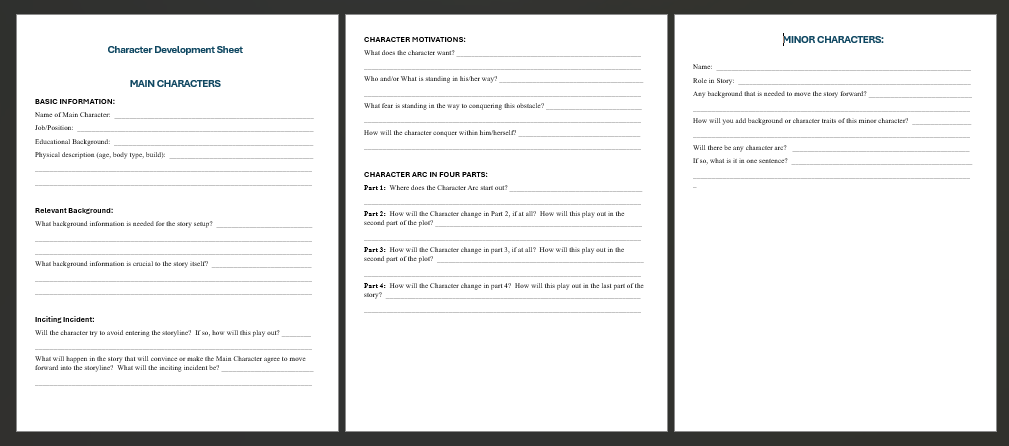
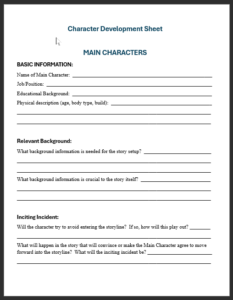
When I started writing several years ago, I came across the standard character worksheet and it focused mostly on physical attributes, occupation but there was a disconnect regarding their role in the storyline, which is the most important part.
My purpose in this blog post is share a more in depth character development worksheet. I'll go over the different parts of the worksheet with a brief explanation of the parts that need a little explanation. Most of the worksheet is self-explanatory.
The first question is: Is this a Main Character you are developing? Or Minor Character? There is a separate Minor Character Development List on the third page of the checklist. We'll begin with the Main Character development.
The following aspects of the worksheet are self-explanatory. The only prompt I will give to beginning writers is that you want to keep your writing lean. So think in terms of what background, educational and job information is crucial for the plotline of the story? That's the most important part.
THE BASICS:
Name of Main Character
Job/Position
Educational Background
Physical description - (age, body type, build)
Relevant Background:
What background information is needed for the story setup?
What background information is crucial to the story itself?
THE INCITING INCIDENT:
Most plotlines need an inciting incident. This is the occurrence that happens to take the main character out of his/her normal life and into the storyline. What will this be?
Sometimes it is an incident that happens but sometimes, like in a police procedural, it's as simple as being assigned to a case. Either way, the inciting incident is what begins the actual story arc and the character arc.
TWO MAIN QUESTIONS:
Will the character try to avoid entering the storyline? If so, how will this play out?
What will happen in the story that will convince or make the Character agree to move forward into the storyline? What will be the inciting incident?
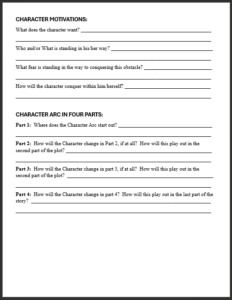
CHARACTER MOTIVATIONS:
As a newbie, it took me awhile to remember that a character needs to have an arc over the storyline. So it's important -- and time saving -- to know what that arc will be before you even begin the draft. This character sheet can help you find this so you know where you are starting from and where you want to end up. The following questions should help you focus on what this character arc will be:
What does the character want?
Who and/or What is standing in his/her way?
What fear is in the way to conquering this obstacle?
How will the character conquer him/herself
How will this play out over the four parts of the story?
CHARACTER ARC IN FOUR PARTS:
I write in a four-part story line as opposed to the 3 part storyline. So I break the character arc into these specific parts:
Part 1: Where does the Character Arc start out?
Part 2: How will the Character change in part 2, if at all? How will this play out in the second part of the plot?
Part 3: How will the Character change in part 3, if at all? How will this play out in the second part of the plot?
Part 4: How will the Character change in part 4? How will this play out in the last part of the story?
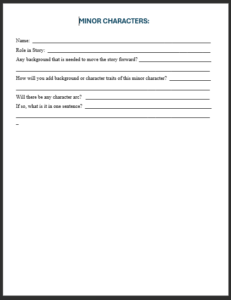
MINOR CHARACTER:
For minor characters, you only need to answer a few questions. It helps to know what role these minor characters will play and what, if any, background information is needed to support them in the storyline:
Name
Role in Story
Any background that is needed to move the story forward?
How will you add background or character traits of this minor character?





 I tried the $29 package, shown abaove, to see what kind of results I would get. Because they required a 4-star rating, I had to choose Book 4 from my Newport Vampire Series. It’s always harder to market for a Book 4, so I had pretty realistic expectations going into this.
 This is the third and last segment to the Personalized Workflow Series. In this post, I'll share my best strategies to find, make and claw back time to make room to write that book you want to write.
 In order to find time, you need to analyze your life to find the wasted time and the dripping faucets of time. The last two segments of this series are all about looking at your duties and obligations from a bird's eye view in order to do a proper analyzation. By seeing everything on paper before your own eyes, you can more easily see where the time leaks and losses are happening.
 Learn to break down projects into bite-sized pieces. Instead of scheduling yourself to write for five hours for two days in a row, try scheduling three two-hour writing sessions over the course of a week.
 Multi-task Example 1: If you go to Church once a week, schedule a grocery pickup afterwards. Use Instacart to order the groceries and then simply swing by and pick up the groceries on your way home. That's a two to three hour savings right there.
 Multi-Task Example 2: Schedule doctor appointments on the same day, one in the morning and one in the afternoon. Schedule research to be done in the waiting room in both doctor offices. Most doctor offices allow you to use at least a general Wi-Fi. Then add lunch with a friend between the visits and keep up friendships as part of your new lifestyle.
 At the end of your day, when you're ready to sit back and relax, put in a load of laundry first. Set an alarm to put it into the dryer. Be sure to transfer it to the dryer and then you're done. If you have enough energy to fold and hang the clothing when done, great. Otherwise, the folding can go on to tomorrow's list of things to do. Just tumble dry the clothes for five minutes before folding. You have just found two more hours to write.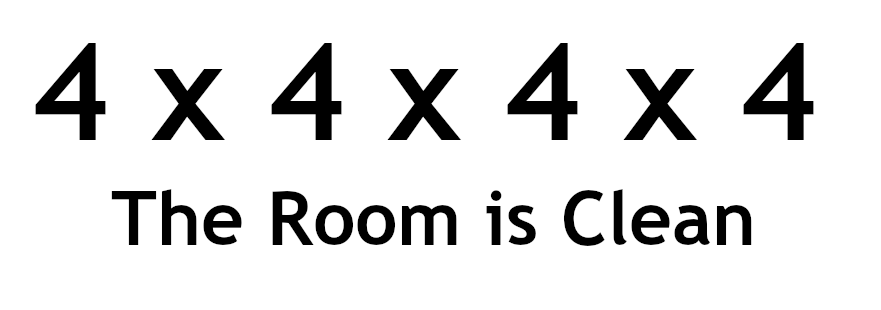
 Infants: If you have small babies, this announcement won't work, of course, but you can make good use of their nap time. That can be your time to write. Toddlers can be a handful and you may need to schedule your free time to write after their bedtime. If that is your only time, let your spouse know you want to set aside a few hours to write and you need his or her cooperation.
 Clawing back time and energy from your job is a different strategy. This can only be done in some jobs. Realigning and redistributing your energy, however, can be done in any job or career. Let's talk about the differences below.
 If you have a great job but it's in a toxic environment, the amount of energy that you are expending psychically, mentally and emotionally is very high. Working with horrid people and/or in a toxic environment is very draining. A good job is better than a toxic career, especially if you have a goal to write or pursue a different occupation. So just be aware of this. You may want to employ some of the strategies for taking back time and energy from a dead-end job so you can gather your energies for other pursuits.
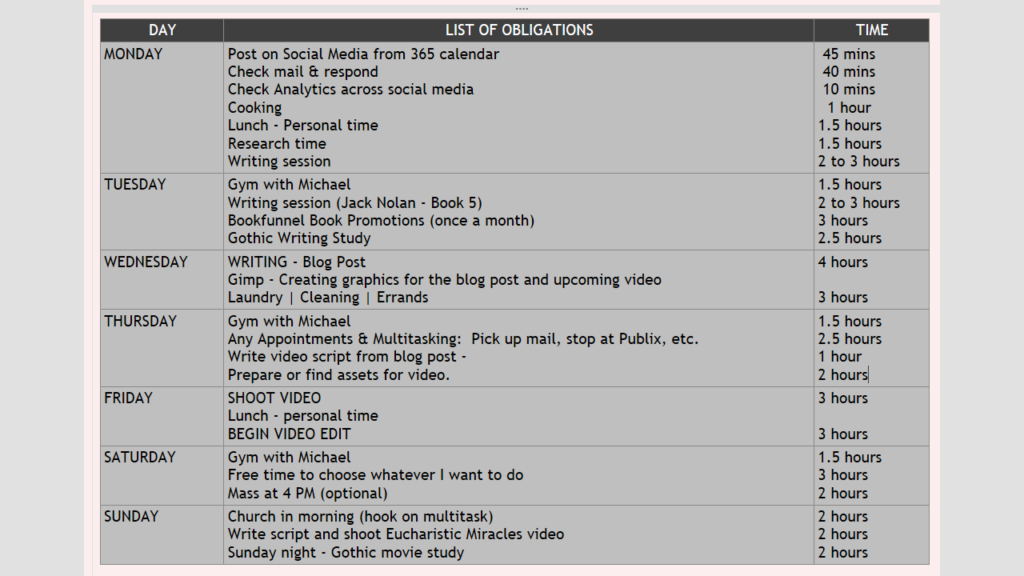 In the last installment, I described how to start your duties and obligations list with realistic times associated with each one. The list will prove itself over a week or so. Then you will be ready to expand on that list and make a series of workflows, templates, and procedure lists or diagrams. I have posted my own above to jog your memory as to where we left off.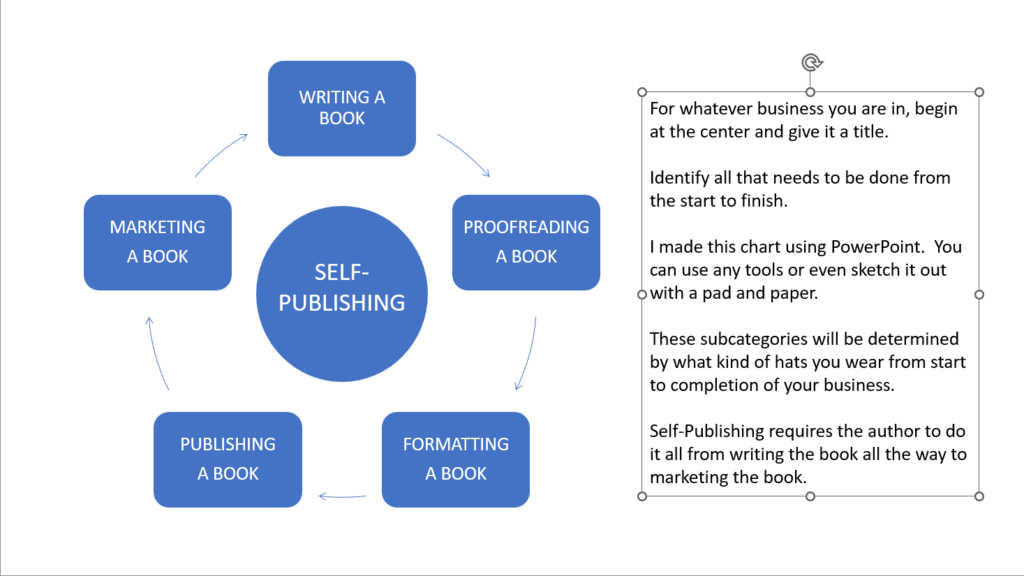
 There comes a time when any author or creator starts to accumulate a lot of documents. Manuscript files, first drafts, editor drafts, book cover files, social media images, how-to information, checklists, not to mention a work calendar of some kind. You can see that it can get overwhelming very quickly.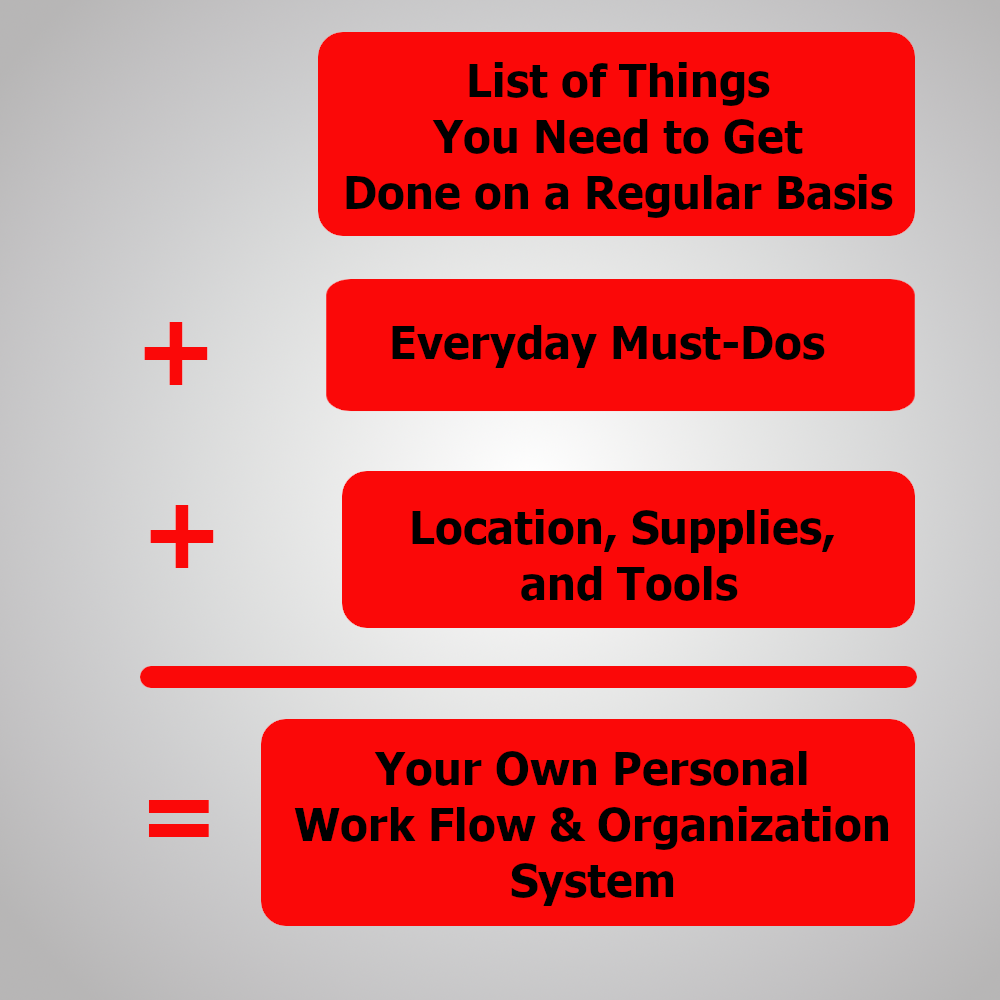
 Most people are balancing a personal life and a work life. Thinking about what you need to accomplish at work without taking into account all that is required in your personal life is a recipe for disaster. Your goals will be unrealistic and it will be a setup to fail.. It’s important to plan around realistic personal and business goals.
 Make a list of what a week in your life looks like. For me, I write novels, do book marketing, write blog posts and make videos (for marketing reasons as well as sharing my experience and knowledge with others).
 Here’s a personal example: To write, sit in corner of my bedroom in a chair, with my laptop, with a table set up next to it. I like to drink coffee when I write, so I make sure I have a pot ready and on hand. I also place a pad and pen on the table so I can down any new names I choose during the writing process. I write in Scrivener which is loaded onto my laptop, so that’s all I need for the entire writing session. By recreating your perfect environment you can design a setup or gathering list so you won’t keep interrupting yourself with forgotten items.
 In the next installment of this series, I’ll talk about getting more efficient. How to rid yourself and your life of time eaters, energy zappers, and other dead-end roads to nothing but time loss with zero accomplishments.
 veryone writes for a reason. Knowing why you write is important, especially as a beginner writer. Writing a book is not hard, but it can be a long process. If your purpose for writing is clear, this will give you the energy and inspiration to spur you on if and/or when the going gets a little tough.
 I'm old enough to remember 'phone guys' that worked for Bell South or whatever the phone company was called back then. These men -- they didn't have phone women back then -- would show up with big toolbelts and gaffs or lineworker boots on. These boots had cleats or little metal spikes in them that was a safety feature. These men know everything about the phone system. They would climb the wooden telephone poles and they could fix phones outside on the pole or inside in the houses. They were familiar with the entire system. That is one group of technical workers that have fallen away.
 Very often life dishes out some hard times to some of us. Did you experience, survive and prosper through some difficult times that you feel compelled to write a memoir about? You don't have to have been a famous celebrity or someone with a Moses-like mission. You may have fell on hard times and you want to share your experience, strength or faith that kept you going. People love inspirational stories.


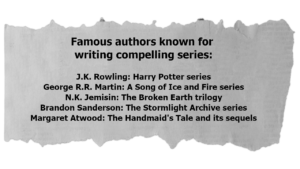 I found out later that more experienced authors even suggested that newer authors consider writing in series because it's easier to market the books. But my venture into writing book series was a happy accident.
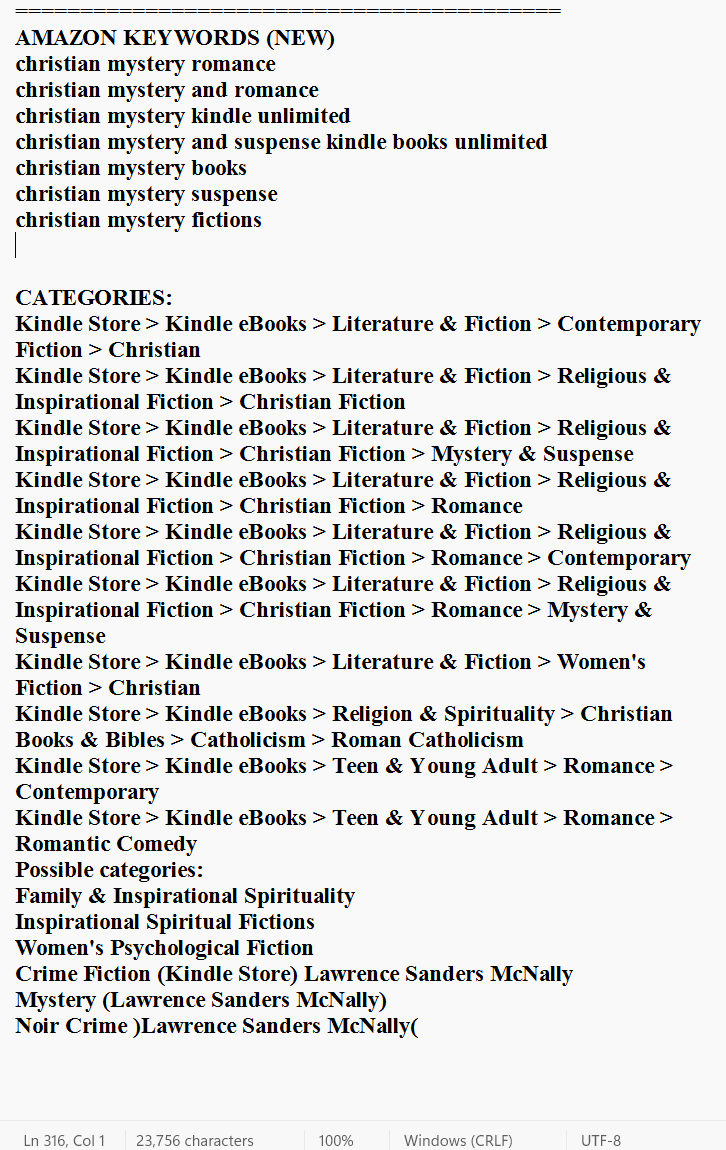
 I use broad-stroke character arc for the main characters that extends over all the books in the series. Each individual book, however, the character grows and changes a little bit. So each book contains its own arc, but there is a longer series arc for the main characters. It helps to know this before you start writing the series.



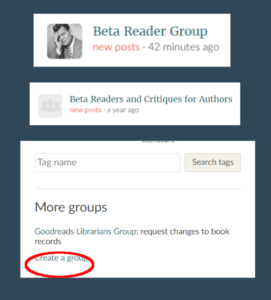 This could be a person who works full time, lives alone, or has a few kids and there is just not enough extra money around to fund all the things necessary to do when self-publishing a book. Not to worry. There are a few choices for you.
 A Beta Reader is someone who reads the book to give you feedback as to whether people will even like the story. A beta reader knows they are reading a book that is not ready to be released. They are aware or should be made aware that they will be asked for feedback as part of the final crafting of the book process.
 I chose to use Bookfunnel or SiteOrigin to release my ARC copies so that I could get the readers' emails to be able to contact them with a gentle reminder to review the book when it was released. Sounds innocent enough, right?
 I decided to go to Fiverr.com and hire a beta reader for $80.00. Go to Fiverr.com and type in "Beta Reader" in the search box. Look specifically for those who have done it a few times and have a 4 to 5 star rating. It's that easy.
 I will continue to request ARC readers and I include a questionnaire in the back of the ARC copies. Several readers do take the time to fill them out for me. It's so valuable. Each one has a different take on things.
 After release, I only send one gentle-reminder email asking for a review after the book is released. Not everyone posts a review, but that's okay. If I get a few, again, I'm thankful. If they are members of my newsletter list, I usually put an announcement that the book has been released and this serves as a second gentle reminder.
 The take away is -- at least in my humble opinion -- you don't need a whole team of 10 or 20 people to release a book. If you have one beta reader, a professional editor that you trust, and get feedback questionnaires from a few readers, that's enough. After all, at the end of the day, some people will love your work and some may hate it. You're writing for your own readership -- not for those people who don't like your work.
 The most important lesson I ever learned about Beta Readers and ARC readers -- in releasing a book in general -- is that it takes time. I need at least eight weeks to do a full ARC campaign, and two weeks for a beta extra for the beta readers and editor. When I was new, I had no idea of needing to do so many things before release.
 When I first decided to write a novel, it took me one full year (I’m not kidding!) to even come up with a crime. Today, using these methods I’m about to reveal, it only takes me two to three days to think up three or four mystery scenarios.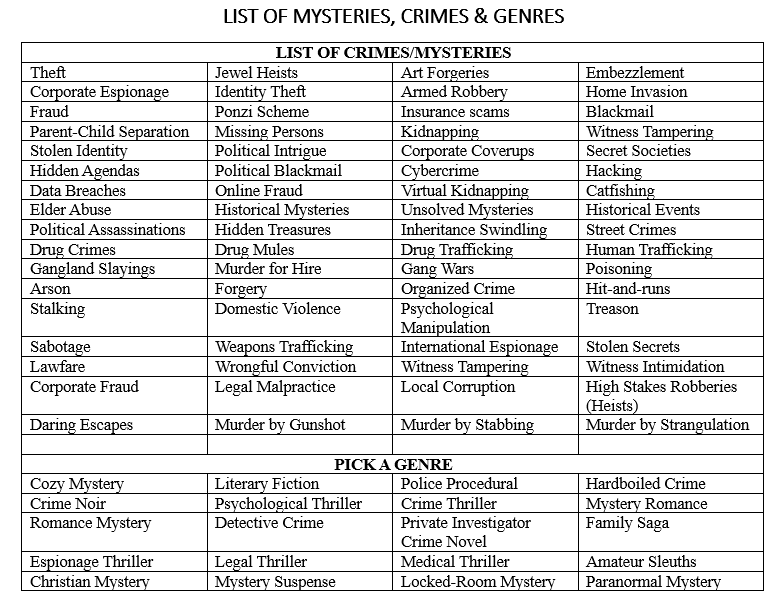
 Let’s talk about how to use this work sheet. Choose a crime or mystery from the list below and make up a potential perpetrator. Don’t waste time on what he or she looks like. Then start asking the following questions:
 Once you have a perpetrator and the cast of necessary characters, then it’s time to answer the following questions:
 Before you exert too much energy fleshing out any character or story details, be sure to check to make sure you can design a three-prong storyline out of this budding storyline. One prong will be a red herring storyline, someone who may look guilty, but is exonerated in the middle or end of the story. The second prong is a second suspect or a wrong suspect who will look guilty for a large segment of the storyline. And the final prong will be for the real culprit. In order to have a story that works, you will need a believable crime that can meld these three prongs into one suspenseful story.
 When I started writing several years ago, I came across the standard character worksheet and it focused mostly on physical attributes, occupation but there was a disconnect regarding their role in the storyline, which is the most important part.
 As a newbie, it took me awhile to remember that a character needs to have an arc over the storyline. So it's important -- and time saving -- to know what that arc will be before you even begin the draft. This character sheet can help you find this so you know where you are starting from and where you want to end up. The following questions should help you focus on what this character arc will be:
 For minor characters, you only need to answer a few questions. It helps to know what role these minor characters will play and what, if any, background information is needed to support them in the storyline: