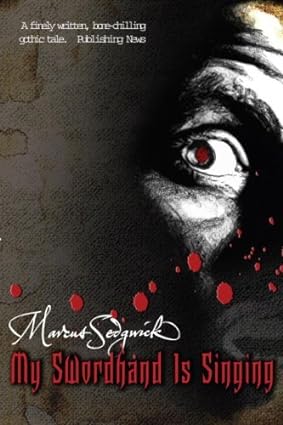
 Book Title: My Swordhand is Singing
Author: Marcus Sedgwick
AMAZON DESCRIPTION:
WHEN TOMAS AND HIS SON, Peter, settle in Chust as woodcutters, Tomas digs a channel of fast-flowing waters around their hut, so they have their own little island kingdom. Peter doesn't understand why his father has done this, nor why his father carries a long, battered box, whose mysterious contents he is forbidden to know.But Tomas is a man with a past: a past that is tracking him with deadly intent, and when the dead of Chust begin to rise from their graves, both father and son must face a soulless enemy and a terrifying destiny.
WHY I CHOSE THIS BOOK: I'm always interested in why book reviewers choose the books they do, so I'll reveal the reason behind my own choice. This book came up in a "Best Vampire Books" video I watched. I expected a "classic vampire book" as I started the book, but it wasn't that at all.

MY REVIEW AS A READER: The story unfolded as more of a old-lore fairytale, a moral tale, that had a twist of vampire-like happenings in it. Vampires were barely mentioned by name. I like books that are written in a fairytale style so I kept reading. I especially like books that have some kind of moral ribbon running through it or at least a reference to a spiritual dimension. This book had all of the above.
I enjoyed the book and it was a fairly easy read. There was an unexplained box that was referenced and this held my interest and kept me reading. I won't give anything away about the box, but it served as the ribbon of suspense that did run through the entire book.
It's hard for me to comment on the writing as I'm still studying "fairytale writing" itself. The prose held the storybook style the entire way through so I give the author an A+ for that.

REVIEW AS AN AUTHOR: As I read, I paid particular attention to see how this fairytale style is done but I can't yet put my finger on it. I did notice that the characters were only two-dimensional. They had their role to play in the plotline plus one thin layer of history that conjured up sympathy, compassion or empathy. I did notice that. There was distance between the reader and the soul of the character. I would love to discuss this with other authors, so if anyone else is interested in this style of writing, email me and let's discuss it!
The author did a great job in recreating the lifestyle of woodcutters in the ancient world. The scenes were vivid and had a bit of a Charles Dickens feel to them. As an author, I think this is hard to do and I do take my hat off to Marcus Sedgwick for his writing style.
There was a band of gypsies in the story and their caravan and scenes were written very well. This too kept with the fairytale genre without seeming stereotypical. I can tell as an author that there was research done regarding "gypsies during ancient times".
I plan to look through the book again and reanalyze some of the writing style to see what else I can learn about writing in the fairytale style.
THE BAD REVIEWS:
I always like to check author's bad reviews after any book I read. I like to see if there there is any legitimate criticism. I find most bad reviews are just snotty comments made by readers in bad moods. But occasionally, I will find one with at least some critical value. The only 3-star review with a comment was that the reader was expecting a classic vampire story. I did have the same unmet expectation in this book. However, I was able to shift into this fairytale for what it had to offer.
I've also learned the hard way as an author myself that it's important to let the readers know ahead of time what the book will be like because not everyone is okay to go into a book with one set of expectations and be able to shift into enjoying the book anyway. This 3-star review confirmed it. It seemed that the only reason for the lackluster review was this disappointment.

SOME TURN OF PHRASES I NOTED:
- "She had eyebrows like a man's that seemed fixed perpetually in a scowl."
- "Do not trespass on my patience."
- "She was still dressed in mourning weeds."
- "The trunk where he's been chopping gave a deafening crack, as if lightening had struck nearby."






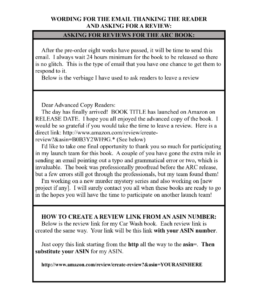

 Now that you have a generic marketing calendar, it's time to assemble your toolbox. These are the things you will want to have close by when it's time to dedicate an hour or two to marketing.
 First into the toolbox is a graphics program. I used to use Photoshop, but since I retired from work, I now use Gimp because it's free. I try to do everything as free as I can because I devote all monies spent on producing my books on an editor and paid book ads that work. I say 'ads that work' because many of them don't. More on that in the next few blog posts.
 I used to use Hootsuite, but it got too expensive and I couldn't see enough in their desktop area. I switched to using a Microsoft Excel sheet. This allows me to continue to just Right-click and add a row above, so it is easy to build out the calendar. Within 6 months, I had about 4 to 6 daily marketing ads to post everyday. I find this the easiest.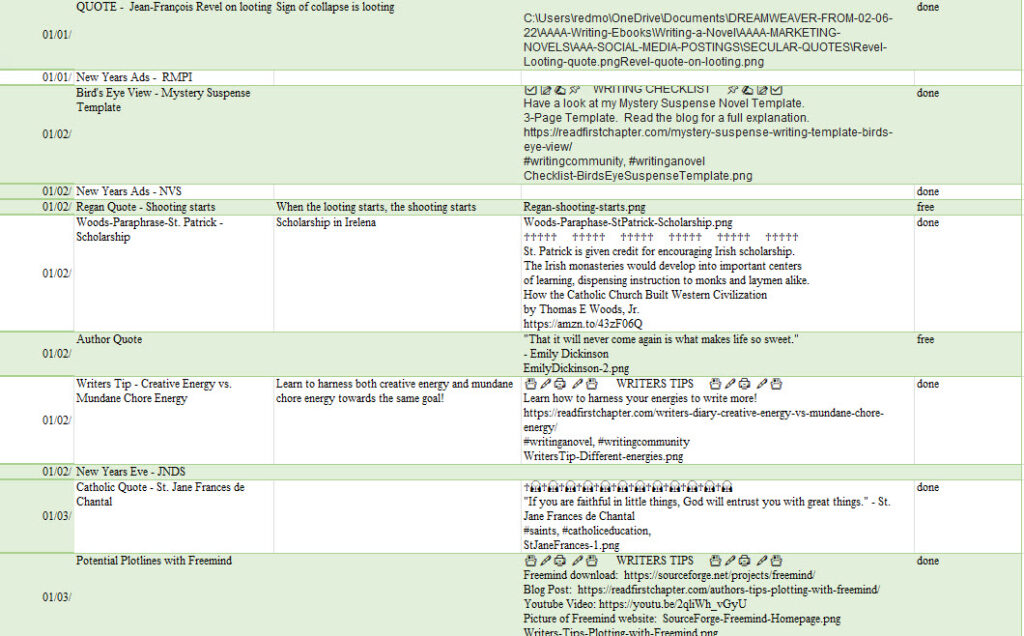
 Along with the 72 dpi book cover, you will need short blurbs about your book or books. Starting at about 150 words, keep whittling the blurb down until you have several blurbs with the last one being about one sentence (for Amazon ads).
 Copy and paste any and all purchase links for your book. Be sure to keep track of which merchant each link belongs to. Besides the purchase links, you may want to keep the paperback and hardcover links handy -- you never know!
 Most younger people know what hashtags are. If you're a boomer like me (hee hee), you may need to brush up on what hashtags are. Go to YouTube and search out videos explaining hashtags. Someone will explain them to you.

 Book Marketing is a huge undertaking, but it starts with baby steps. When I was brand new, the mere subject of book marketing was enough to make me feel completely overwhelmed. However, now looking back, I see that it started with baby steps and book marketing isn't something you do, it's something you build.
 This first installment is to set the framework of your marketing plan. The calendar list below is meant to be sort of a file box. Think of each holiday as a marketing opportunity. You will build your marketing plan by starting with this calendar.
 Earlier this year I started uploading YouTube videos targeting beginner writers and marketers who want to learn how to make their own book covers. Gimp is a free photo manipulation program -- completely free. Volunteer coders from around the world, unsung heroes, have worked on this computer program for the masses.
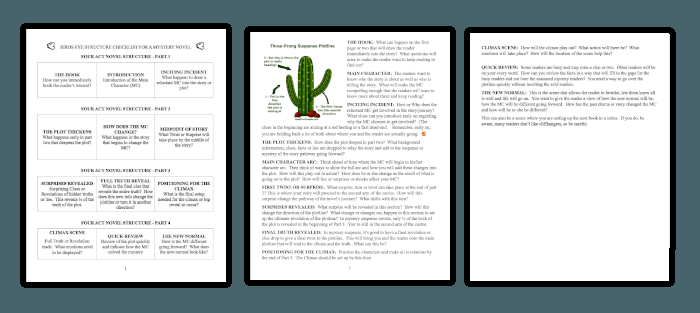
 This is a checklist I wish I had when I first started out as an author. With the internet and research being at our fingertips, anyone can figure out how to write a first draft. In the world I live in, a first draft is nothing more than blurting out the story onto paper so you have something to begin working on.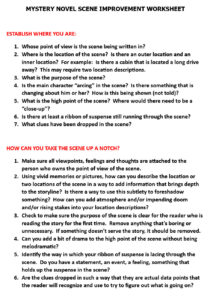
 By focusing on each element individually with these questions in mind, it will allow a new author to focus on only one element at a time. It prevents new authors from becoming overwhelmed by a general suggestion to take the whole novel up a notch.