
THERE ARE ALWAYS FIRST DRAFT DOUBTS:
 I'm assuming all writers have doubts as they are writing the first draft. I know I do. Something happens between the feeling of knowing I have a good plotline and writing out the first draft.
After analyzing it for a while, I believe what happens is that I cannot 'envision' the whole story coming together as I am just blurting out the first half of the first draft.
When writing a first draft, I'm in the nitty gritty now. It's no longer 'thinking about the plotline'. I'm now committing it to paper. A feeling of insecurity arises as I realize that I'm halfway through my scenes and I don't get a feeling of any suspense or mystery. It has absolutely no personality yet. It's dry. The characters are a bit like sticks yet.
THIS IS WHY I START WITH FOUR DIFFERENT PLOTLINES:
Battling against these doubts is one reason I started working on four separate plotlines before choosing the best one. This way, I know I picked the best of four before I even started.
Then I remind myself that a first draft has no details. I'm really more or less linking the scenes where the biggest clues are dropped to one another. In the book I'm writing now, I'm even skipping over most of the subplots until I can get a read on how much "space" I'll have to write them.
What does that mean? It means that as a newer author, I can't go over 80,000 to 100,000 words. So I try to create a first draft with about 45,000 to 60,000. This way, I have room to beef up my subplots, add the descriptions and any theme commentary, etc.
THE DOUBTS ARE MORE ABOUT LACK OF VISION:
The doubts seem to be a combination of an inability to see the final novel and being halfway through the first layer of a first draft. It's hard not to feel that this story is not "good enough". It's not good enough. It's not meant to be good enough. A good enough story needs 8 or 9 layers of writing.
JUST KEEP WRITING:
 So the antidote to self-doubt is to keep writing. Trust your plotline. Know too that you can always add clues, rearrange some scenes, add a bit more intrigue into your subplots. Eight layers of writing leaves a lot of room for beefing up a story, deepening a story and polishing a story.
REMIND MYSELF THAT THIS IS ONLY LAYER 3 OF A 7 TO 8 LAYER PROCESS:
I also remind myself that a first draft just has to be gotten through. It's the hardest layer to write because you are writing on faith alone really. You are trusting yourself as a storyteller.
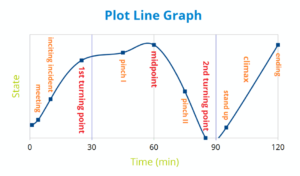
 For anyone who is new here, I use a Four Act Structure as opposed to the more-popular three-act structure. I find that middle section in the three-act structure too confusing. Over the writing of 12 novels, I gravitated to a four-part structure as it is more symmetrical and makes more sense to me. I also believe, for whatever it's worth to anyone, that this three-act structure is responsible for the 'lagging' that often occurs in the middle of a story.

 The end of Part Two usually marks the midpoint of the book. I like to end this section with a .big reveal of some kind. Or maybe a clue that turns the investigation into another direction. There could even be a new murder, or the surfacing of an unusual suspect, or someone gets caught in a big lie that changes the direction of the investigation.
 Now the investigation gets a little stressful. The detectives may not agree on who the guilty party is, or maybe they know who it is but can't find the legal evidence to prove it. Maybe they are operating only on gut feeling and speculation at this point. They are rushing against the clock or against other forces working against them to solve it, catch the guilty party or find compelling and irrefutable evidence.
 Part four is broken down into two parts. In the first half of Section 4, the crime or mystery is solved. There will be whatever drama you want to add about the solving of this crime. Whether your detectives are battling physically with someone, bullets are being fired back and forth, or entrapping the guilty party, or just uncovering that last piece of evidence that will legally prove guilt, this is where this is revealed.
 The second half of Part 4 is the 'wrap up'. This is where you will show the new normal, everyone's life 'in resolution'. This is where you will also explain the full growth of your characters. Many author's don't do this, but I don't like to read books where things end where the reader is left to decide what it all means. I may have my own opinions, but I like to know what the author meant by the story. So I make sure I explain, again very quickly, how things are ending in a narrator voice.

 Most new writers want to get to the writing already. But in this layer of writing, all plot holes or inconsistencies will show up. Any clues that won't work when adding more suspects and motivations will show up in this layer.
 My template is short but it keeps me on track. I'll break it down below. This small template I use keeps my writing on point and tight. It prevents me from meandering, dawdling, going off on an irrelevant tangent or writing myself into a corner.
 n order to prevent head-hopping, which is very common among new writers, you need to be constantly reminded that each scene is in one perspective. Some writers write in first person and that's easy.
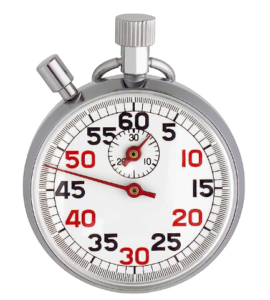 I don't know whether I am an author who is obsessed with time, or whether I use time as an element to put pressure to solve on my characters, but I have always tracked time. I find this helps me balance the story and make the story more realistic.
 Location is important for two reasons. One reason is casts the scene in cement. You have chosen a stage for the scene to take place. I don't write any scene or location descriptions in this layer of writing. But I can write the action of the scene in context of a location.
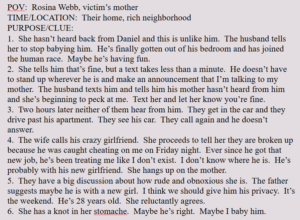
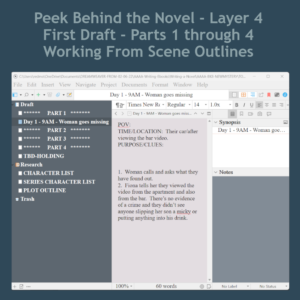


 Write forward only. Don't look back.
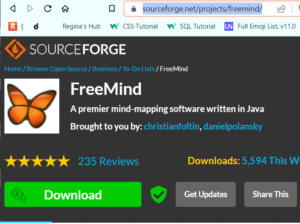 This is the second step in writing a new fiction novel. In the first step, I start out with writing four potential storylines in FreeMind, which is a mind mapping software.
  Most new writers want to start writing scenes and dialogue. They want to just get on with it. But the dark side of working this way is that when you find out your clues won't work when you need to add a new suspect, you will have written two chapters already. My process will save you from writing for the trashcan.

 Gimp is a free graphics program and it's fairly easy to use. But a lot of the program is not self-explanatory. So you can get lost really easily. A graphics designer needs to know how the entire program works. For authors, writers and other self-publishers, you only need to know a few of the tools to do pretty much everything you need to do.
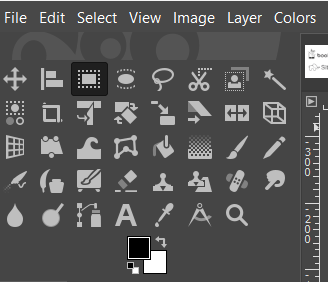 The graphic to the left is a closeup of the tools panel. Each tool is represented by an icon. Below the tools is a graphic representation of your foreground color (the color on top) and the background color (the color in the back).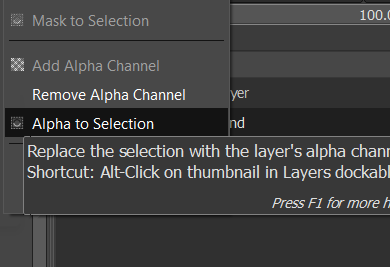
 However, if you just open the document and try to add something that needs a transparency, it will cause a lot of frustration because the transparency won't work. If you do this, open with a white or black background, then go over to the layers panel, right click on the layer and select "add alpha channel". When you do this, nothing will happen, no noise is heard. It feels like nothing happened. But it did.
 As a self-published author, all marketing for my books falls to me. I can outsource it, but that costs money too. I have figured out, after publishing 11 novels, where my money is best spent. The answer is on line-editing, which costs between $400 to $500 or more depending upon how long your book is.
 Two of the most popular websites to give away or sell your book is through bookfunnel.com and siteoriginapp.com. These two companies offer the opportunity to join other authors in featuring your book. Everyone has a 'share date' and they share the promotion with their newsletter list and also with their social media following. It's a win/win for everyone.
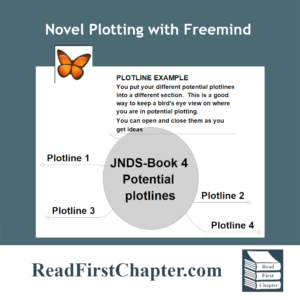 In the first installment of the Peek Behind the Novel Series, I wrote about working four different plotlines before choosing one. By working on four of them, it helps me 'improve' on some storylines and when I have four to choose from, I am able to go into the project knowing that I have chosen the best one. It's a technique that I use to build my author confidence.
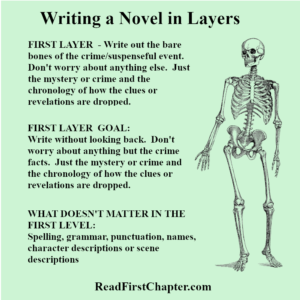 In the first layer of writing, I focus only on the crime or mystery. I make a list of the chronology of the crime. How it happens, who it happens to, how the detectives are assigned to the case. I focus only on the crime. I don't think of subplots, or dialogue or even the outcome. Only on the crime itself, almost like a Forensic Files show.




 I mentioned writing in layers above. This is a secondary technique that I will blog about as I move along in my present book. I'll also give you a sneak peek behind the novel to see what levels I write in.
 Each new book requires a new plotline. I used to come up with a plotline and go with it. But I noticed I had a lot of insecurities as to whether it was good enough or whether I was choosing a plotline too soon.
 So I could tell the four plotlines was a working strategy going forward. The first time I did this, I opened a new Notepad document, plotted a crime and a potential storyline. When I finished, I named it the first potential plotline and filed it. Rinse and repeat. Sounds pretty straight forward, right?
 Then in response to getting scattered, I just wrote all four plotlines in one document, but then I was overwhelmed by how long the document was and it wasn't easy to see which plotline I was in. The Notepad has a tendency to return to the top when you flip out of it to check a spelling or anything. Ugh, I again went upside down.