
I write novels in series and like there to be a personal subplot that takes place over each book, but another longer arc that takes place over the entire book series. In order to pull this off, I need to be very organized and deliberate in how I let the character arc play out not only over time but over the book series as well.
This blog post is about my process in doing that. Now, I don’t claim this to be the only way to go about it, but it is the way I do it and it works for me. This process is not how I started out working on character arcs! I learned the hard way that it’s important to know in the very beginning how you will allow the book arc and the series arc plays out.
I know there are long multi-book series where the main character is more of an action hero and he/she doesn’t change much. Legal thrillers and the Jack Reacher book series comes to mind. This does work as Lee Childs and other successful authors can attest to. They have sold millions of copies with these stock hard-boiled characters who remain generally the same over the entire series.
I prefer there to be more character growth in each book, plus, I like there to be a series arc as well. My series are shorter than Mr. Child’s but each writer has to find their own place. I like shorter series with the main characters participating in more of a family drama and/or a romantic subplot.
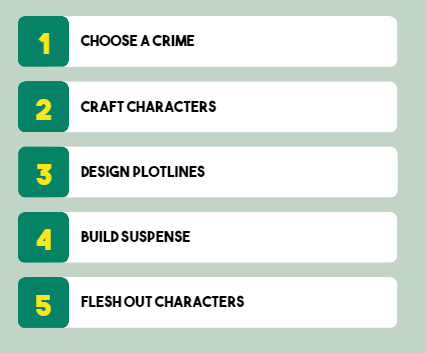
THE FIRST STEP IN SETTING UP A CHARACTER ARC IS TO ESTABLISH THE FOLLOWING:
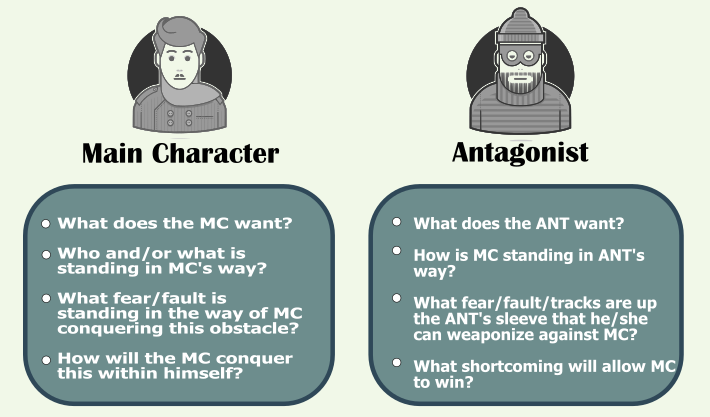
Sketch out on a mind map or even a piece of paper the answer to each of the above character development questions. MC stands for Main Character and ANT stands for Antagonist. By sketching them out at the same time in the beginning stages, it will give you a strong direction for your writing right from the get go. Of course, if you have more than one main character, you will want to repeat this process for every main character.
This also allows you to see and create a conflict between the main character and the antagonist. This is particularly helpful to new writers who lean towards making all characters “too nice”. Without some level of conflict, there won’t be enough conflict or drama to move forward in the story. It will simply be an “and-then-this-happened, and-then-this-happened” kind of story.
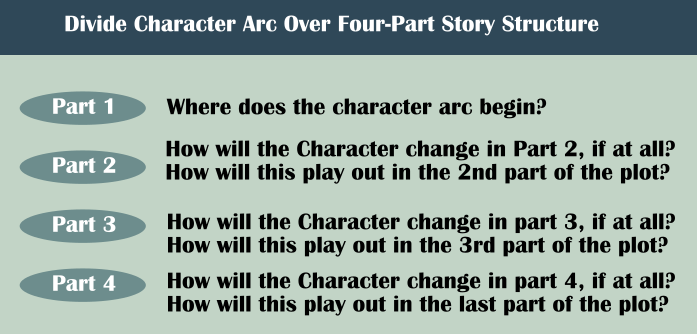
BREAK THE ENTIRE CHARACTER ARC INTO THREE OR FOUR PARTS:
 I use a four-part plot structure, so I break my character arc into four sections. This allows me to keep up with the character development and also don’t resolve the inner conflict too early.
I find this technique also gives me solid writing boundaries and/or writing guideposts. When I’m in Part 2, I know my goal for this section is to make sure the planned character arc for Part 2 is completed before I move to part 3.
A LITTLE ADVICE ABOUT WRITING IN SERIES:
Now that I’ve written my third book series, I think in terms of multiple-book character acts. As I start out with new characters in a new series, I make sure that I have many options of where these characters can go over the entire series.
A special note to pantsers: This technique gives guideposts and boundaries, but every story or novel takes on a creative life of it’s own. I find by having the character arc written down and sectioned, it makes it easier to change the story as this creative process takes over. I simply look over the character arc and alter it with the new “better idea” that has come up.
I find it gives me the best of both worlds. I have a strong direction when I am writing, but flexibility and ease are built into the process itself. It’s super easy to change mid-stream by just tweaking the character arc a bit.
I hope this helps new writers!
If you would like to download the Infographic referred to in this blog article, sign up below:
LIKE WHAT YOU SEE? WANT TO SIGN UP FOR MY NEWSLETTER?
I send out a weekly newsletter with eBook freebies, deals & steals, along with bits & pieces of other interesting things for book and reading lovers. Sign up below!

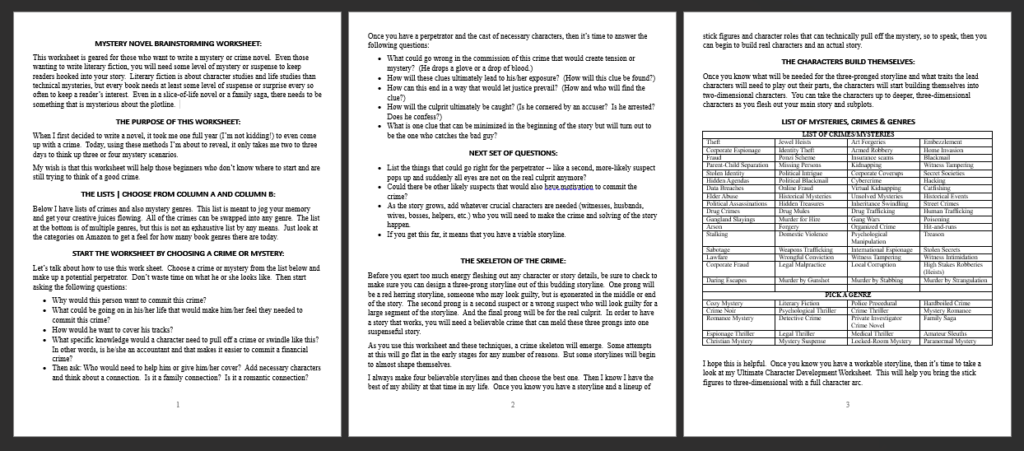
 If you are stumped for a main story, or if you are stumped for what happens now, or even if you have written yourself into a bit of a corner, this instructional will help, along with your own creativity and thinking, to bring about new possibilities.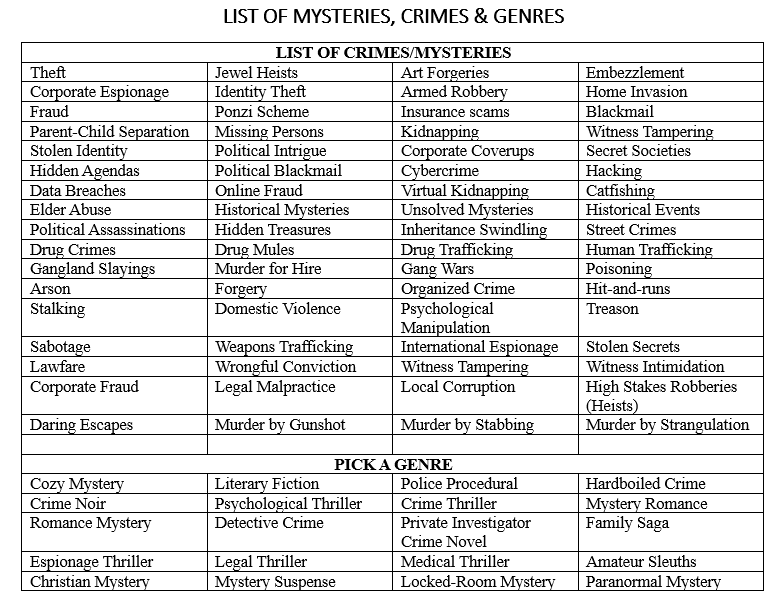

 Once you have a perpetrator and the cast of necessary characters, then it’s time to answer the following questions:
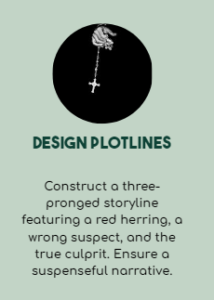
 Before you exert too much energy fleshing out any character or story details, be sure to check to make sure you can design a three-prong storyline out of this budding storyline. One prong will be a red herring storyline, someone who may look guilty, but is exonerated in the middle or end of the story. The second prong is a second suspect or a wrong suspect who will look guilty for a large segment of the storyline. And the final prong will be for the real culprit. In order to have a story that works, you will need a believable crime that can meld these three prongs into one suspenseful story.
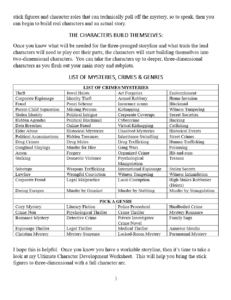 As you use this worksheet and these techniques, a crime skeleton will emerge. Some attempts at this will go flat in the early stages for any number of reasons. But some storylines will begin to almost shape themselves.
 Pulp Fiction become popular during the depression of the 1920s and 1930s. Publishers at the time used a very cheap “pulp” paper in order to produce these short stories and magazines that cost about a quarter. Yes, twenty-five cents!

 When I self-published my first novel, I finished it and uploaded it and waited. That’s when I learned how important marketing the book is. I also learned through the next several books how important it is to take advantage of each tiny phase of a book launch for marketing. That’s what this blog post is about.


 Writing a novel is a huge undertaking. There are many things that go into the writing of a fiction story. The best tip I can pass on is this: Break everything down into little bite-sized pieces. By doing this, you can reduce a huge project down to do-able portions that can be done whether you have 2 hours a week to write or two full days! It only requires a little planning and organization.
 It’s important to keep reading as your own journey as a writer continues. Each author has a different style and uses different storytelling techniques. The stories don’t even have to be great. You can learn from the good, the bad and the bland. Just analyzing what made a book bland is a great lesson in itself. Did the story need more action? Did the story get stuck somewhere?
  or other books you read. Reading other authors is crucial no matter where you are on the writing spectrum. However, when you’re new, you can learn a lot from watching mystery or crime noir movies. I like movies from the 1940s, 1950s, and 1960s. The movies in these decades didn’t have CGI and the directors had to use the stage to tell the story. They used wider shots and props to assist the storytelling. By watching these older movies, you can learn a lot regarding writing.
  It’s a good idea to read the synopsis before you view the movie. Knowing at least a basic outline of the story will allow you to absorb more as an author. If you go into the movie blindly, you will be “experiencing the movie” as a viewer only. By knowing ahead of time what story will be unfolding, it will allow you to watch specifically for certain scenes to unfold. You can watch what tools are used to move the story along.
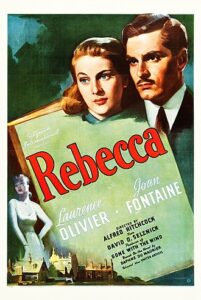 If you are looking for a suggestion, I would suggest Rebecca for the first movie. This movie was directed by Alfred Hitchcock and it has a lot of gothic atmosphere. There is also a psychological plotline in this story so it is a goldmine for learning storytelling tools.




 This is the third and last segment to the Personalized Workflow Series. In this post, I'll share my best strategies to find, make and claw back time to make room to write that book you want to write.
 In order to find time, you need to analyze your life to find the wasted time and the dripping faucets of time. The last two segments of this series are all about looking at your duties and obligations from a bird's eye view in order to do a proper analyzation. By seeing everything on paper before your own eyes, you can more easily see where the time leaks and losses are happening.
 Learn to break down projects into bite-sized pieces. Instead of scheduling yourself to write for five hours for two days in a row, try scheduling three two-hour writing sessions over the course of a week.
 Multi-task Example 1: If you go to Church once a week, schedule a grocery pickup afterwards. Use Instacart to order the groceries and then simply swing by and pick up the groceries on your way home. That's a two to three hour savings right there.
 Multi-Task Example 2: Schedule doctor appointments on the same day, one in the morning and one in the afternoon. Schedule research to be done in the waiting room in both doctor offices. Most doctor offices allow you to use at least a general Wi-Fi. Then add lunch with a friend between the visits and keep up friendships as part of your new lifestyle.
 At the end of your day, when you're ready to sit back and relax, put in a load of laundry first. Set an alarm to put it into the dryer. Be sure to transfer it to the dryer and then you're done. If you have enough energy to fold and hang the clothing when done, great. Otherwise, the folding can go on to tomorrow's list of things to do. Just tumble dry the clothes for five minutes before folding. You have just found two more hours to write.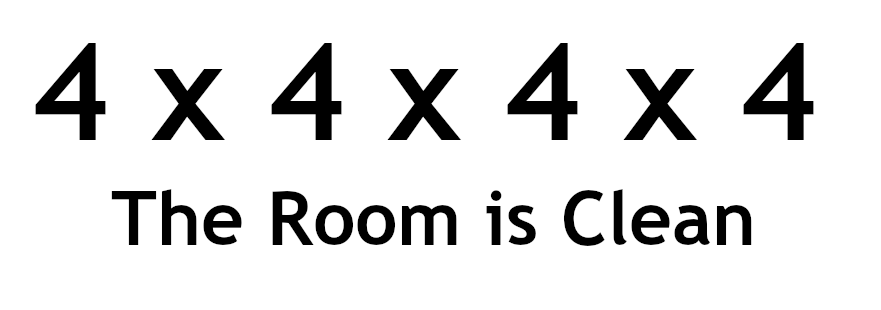
 Infants: If you have small babies, this announcement won't work, of course, but you can make good use of their nap time. That can be your time to write. Toddlers can be a handful and you may need to schedule your free time to write after their bedtime. If that is your only time, let your spouse know you want to set aside a few hours to write and you need his or her cooperation.
 Clawing back time and energy from your job is a different strategy. This can only be done in some jobs. Realigning and redistributing your energy, however, can be done in any job or career. Let's talk about the differences below.
 If you have a great job but it's in a toxic environment, the amount of energy that you are expending psychically, mentally and emotionally is very high. Working with horrid people and/or in a toxic environment is very draining. A good job is better than a toxic career, especially if you have a goal to write or pursue a different occupation. So just be aware of this. You may want to employ some of the strategies for taking back time and energy from a dead-end job so you can gather your energies for other pursuits.
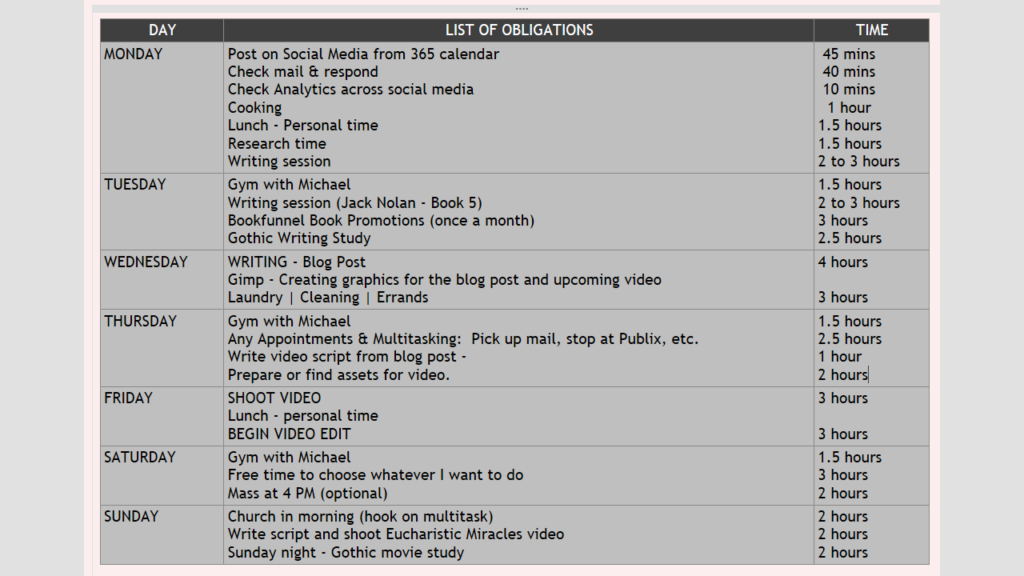 In the last installment, I described how to start your duties and obligations list with realistic times associated with each one. The list will prove itself over a week or so. Then you will be ready to expand on that list and make a series of workflows, templates, and procedure lists or diagrams. I have posted my own above to jog your memory as to where we left off.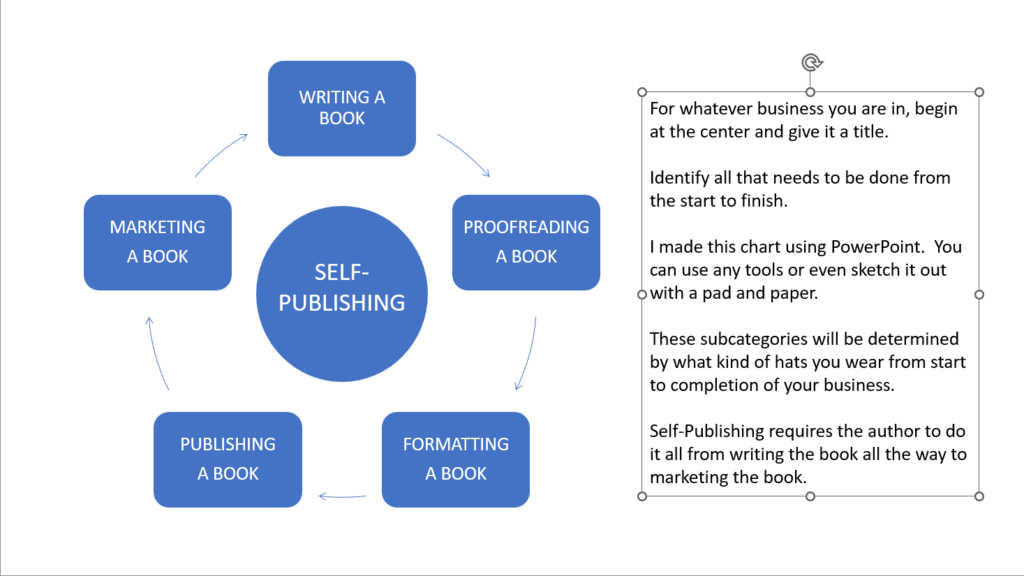
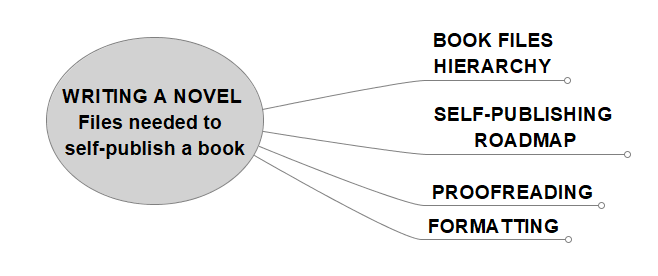
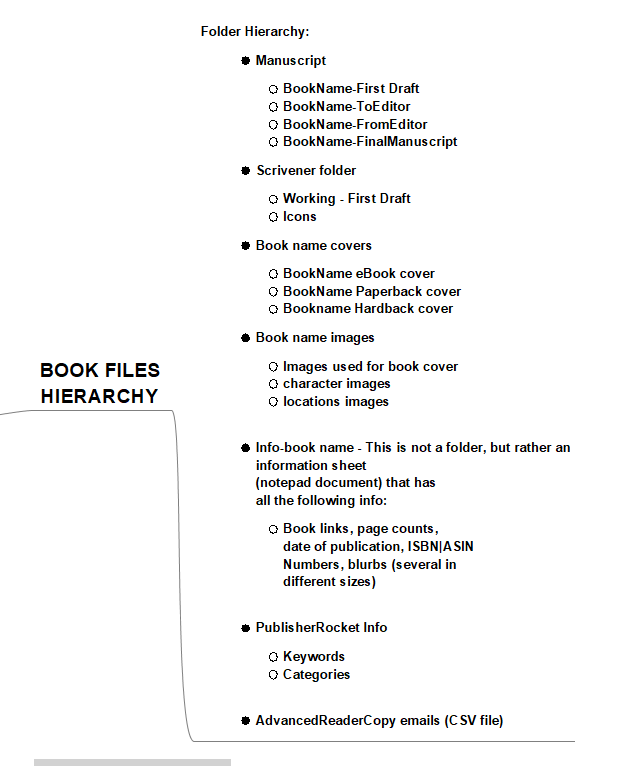
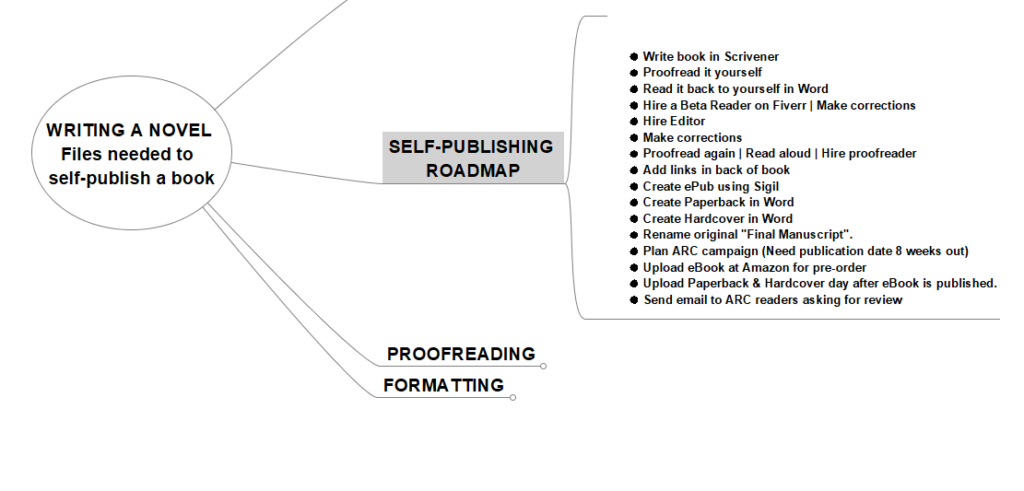
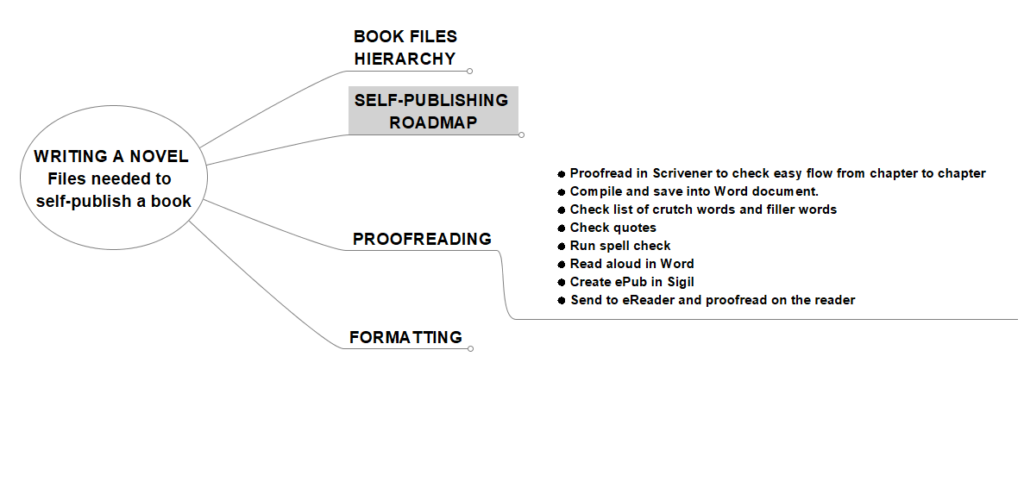
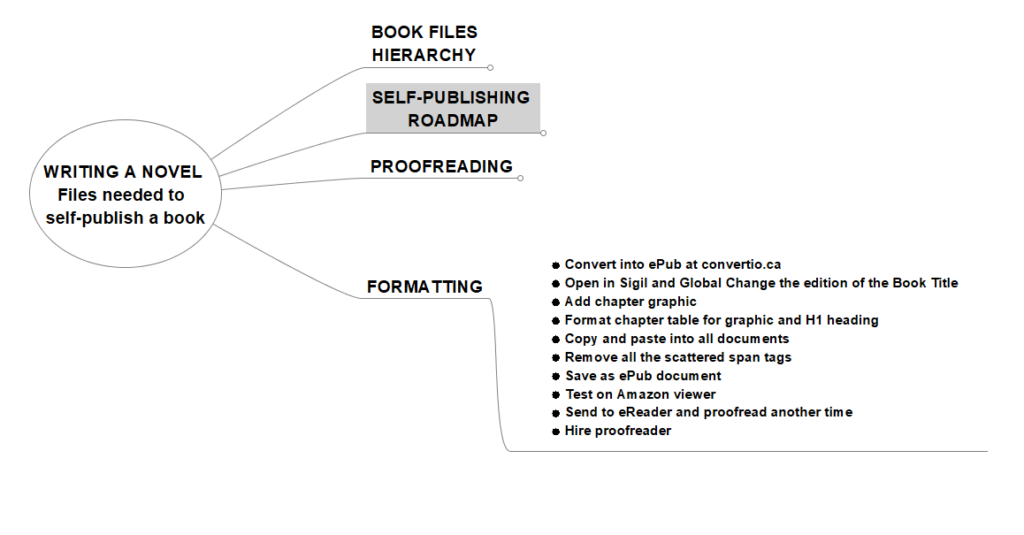
 There comes a time when any author or creator starts to accumulate a lot of documents. Manuscript files, first drafts, editor drafts, book cover files, social media images, how-to information, checklists, not to mention a work calendar of some kind. You can see that it can get overwhelming very quickly.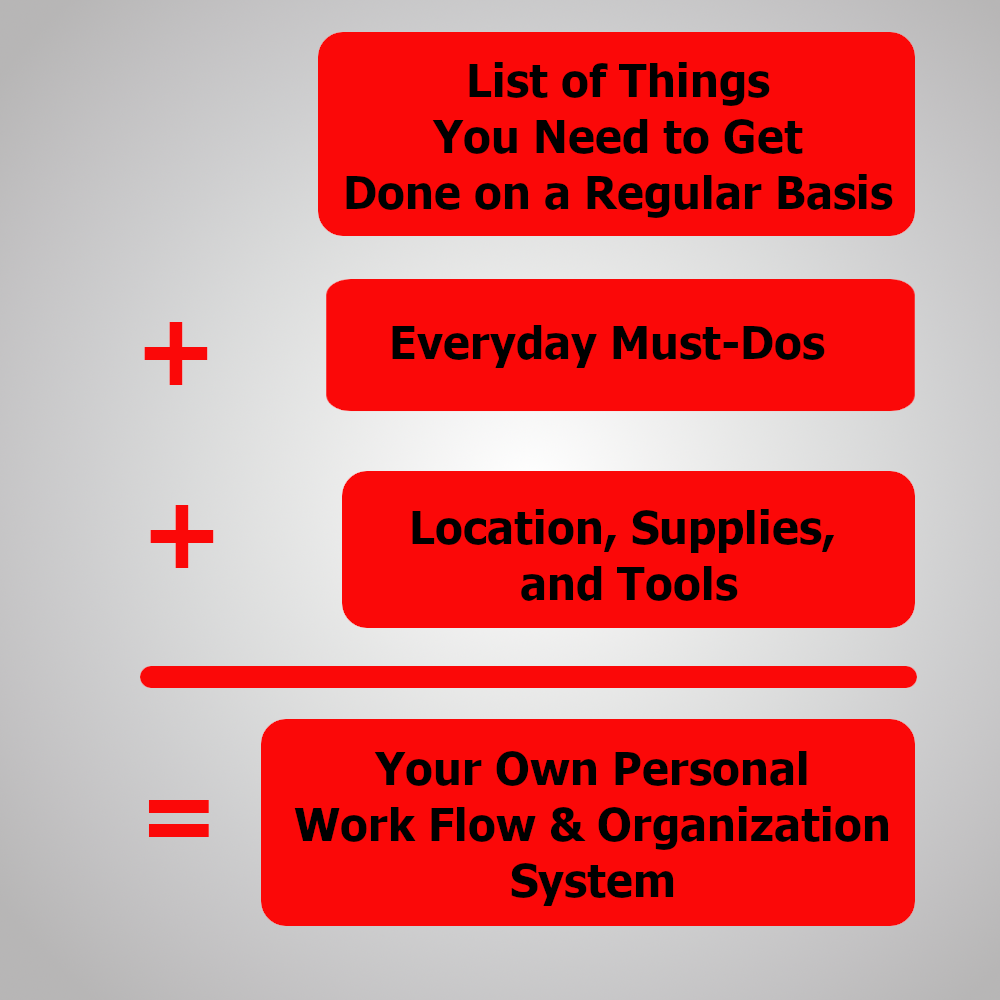
 Most people are balancing a personal life and a work life. Thinking about what you need to accomplish at work without taking into account all that is required in your personal life is a recipe for disaster. Your goals will be unrealistic and it will be a setup to fail.. It’s important to plan around realistic personal and business goals.
 Make a list of what a week in your life looks like. For me, I write novels, do book marketing, write blog posts and make videos (for marketing reasons as well as sharing my experience and knowledge with others).
 Here’s a personal example: To write, sit in corner of my bedroom in a chair, with my laptop, with a table set up next to it. I like to drink coffee when I write, so I make sure I have a pot ready and on hand. I also place a pad and pen on the table so I can down any new names I choose during the writing process. I write in Scrivener which is loaded onto my laptop, so that’s all I need for the entire writing session. By recreating your perfect environment you can design a setup or gathering list so you won’t keep interrupting yourself with forgotten items.
 In the next installment of this series, I’ll talk about getting more efficient. How to rid yourself and your life of time eaters, energy zappers, and other dead-end roads to nothing but time loss with zero accomplishments.