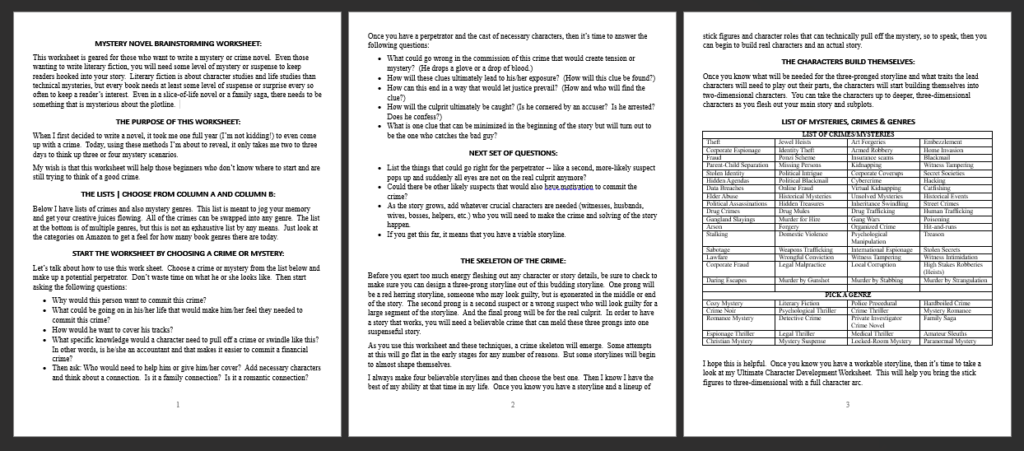
This worksheet is geared for those who want to write a mystery or crime novel. Even those wanting to write literary fiction, you will need some level of mystery or suspense to keep readers hooked into your story. Literary fiction is about character studies and life studies than technical mysteries, but every book needs at least some level of suspense or surprise every so often to keep a reader’s interest. Even in a slice-of-life novel or a family saga, there needs to be something that is mysterious about the plotline.
THE PURPOSE OF THIS WORKSHEET:
 When I first decided to write a novel, it took me one full year (I’m not kidding!) to even come up with a crime. Today, using these methods I’m about to reveal, it only takes me two to three days to think up three or four mystery scenarios.
My wish is that this worksheet will help those beginners who don’t know where to start and are still trying to think of a good crime.
THE LISTS | CHOOSE FROM COLUMN A AND COLUMN B:
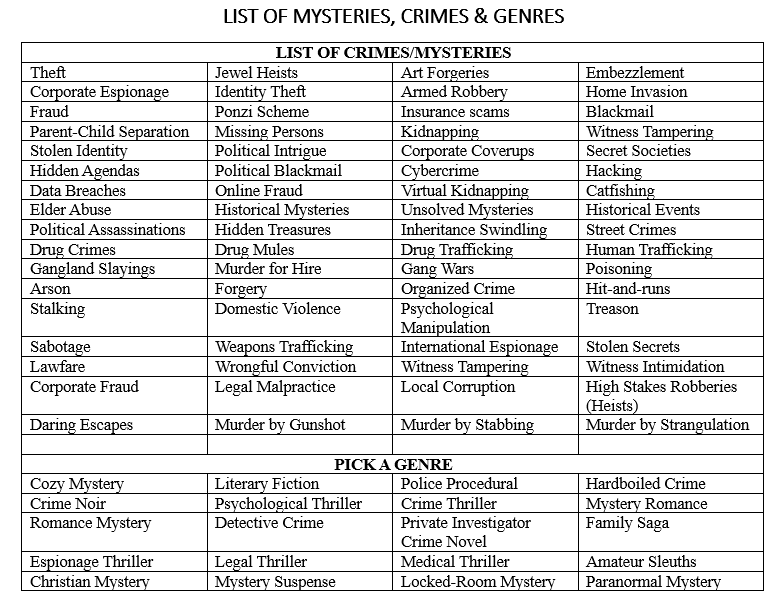
Below I have lists of crimes and also mystery genres. This list is meant to jog your memory and get your creative juices flowing. All of the crimes can be swapped into any genre. The list at the bottom is of multiple genres, but this is not an exhaustive list by any means. Just look at the categories on Amazon to get a feel for how many book genres there are today.
START THE WORKSHEET BY CHOOSING A CRIME OR MYSTERY:
 Let’s talk about how to use this work sheet. Choose a crime or mystery from the list below and make up a potential perpetrator. Don’t waste time on what he or she looks like. Then start asking the following questions:
- Why would this person want to commit this crime?
- What could be going on in his/her life that would make him/her feel they needed to commit this crime?
- How would he want to cover his tracks?
- What specific knowledge would a character need to pull off a crime or swindle like this? In other words, is he/she an accountant and that makes it easier to commit a financial crime?
- Then ask: Who would need to help him or give him/her cover? Add necessary characters and think about a connection. Is it a family connection? Is it a romantic connection?
THE NEXT SET OF QUESTIONS TO ASK:
 Once you have a perpetrator and the cast of necessary characters, then it’s time to answer the following questions:
- What could go wrong in the commission of this crime that would create tension or mystery? (He drops a glove or a drop of blood.)
- How will these clues ultimately lead to his/her exposure? (How will this clue be found?)
- How can this end in a way that would let justice prevail? (How and who will find the clue?)
- How will the culprit ultimately be caught? (Is he cornered by an accuser? Is he arrested? Does he confess?)
- What is one clue that can be minimized in the beginning of the story but will turn out to be the one who catches the bad guy?
NEXT SET OF QUESTIONS:
- List the things that could go right for the perpetrator -- like a second, more-likely suspect pops up and suddenly all eyes are not on the real culprit anymore?
- Could there be other likely suspects that would also have motivation to commit the crime?
- As the story grows, add whatever crucial characters are needed (witnesses, husbands, wives, bosses, helpers, etc.) who you will need to make the crime and solving of the story happen.
- If you get this far, it means that you have a viable storyline.
THE SKELETON OF THE CRIME:
 Before you exert too much energy fleshing out any character or story details, be sure to check to make sure you can design a three-prong storyline out of this budding storyline. One prong will be a red herring storyline, someone who may look guilty, but is exonerated in the middle or end of the story. The second prong is a second suspect or a wrong suspect who will look guilty for a large segment of the storyline. And the final prong will be for the real culprit. In order to have a story that works, you will need a believable crime that can meld these three prongs into one suspenseful story.
As you use this worksheet and these techniques, a crime skeleton will emerge. Some attempts at this will go flat in the early stages for any number of reasons. But some storylines will begin to almost shape themselves.I always make four believable storylines and then choose the best one. Then I know I have the best of my ability at that time in my life. Once you know you have a storyline and a lineup of stick figures and character roles that can technically pull off the mystery, so to speak, then you can begin to build real characters and an actual story.

 Now that you have a generic marketing calendar, it's time to assemble your toolbox. These are the things you will want to have close by when it's time to dedicate an hour or two to marketing.
 First into the toolbox is a graphics program. I used to use Photoshop, but since I retired from work, I now use Gimp because it's free. I try to do everything as free as I can because I devote all monies spent on producing my books on an editor and paid book ads that work. I say 'ads that work' because many of them don't. More on that in the next few blog posts.
 I used to use Hootsuite, but it got too expensive and I couldn't see enough in their desktop area. I switched to using a Microsoft Excel sheet. This allows me to continue to just Right-click and add a row above, so it is easy to build out the calendar. Within 6 months, I had about 4 to 6 daily marketing ads to post everyday. I find this the easiest.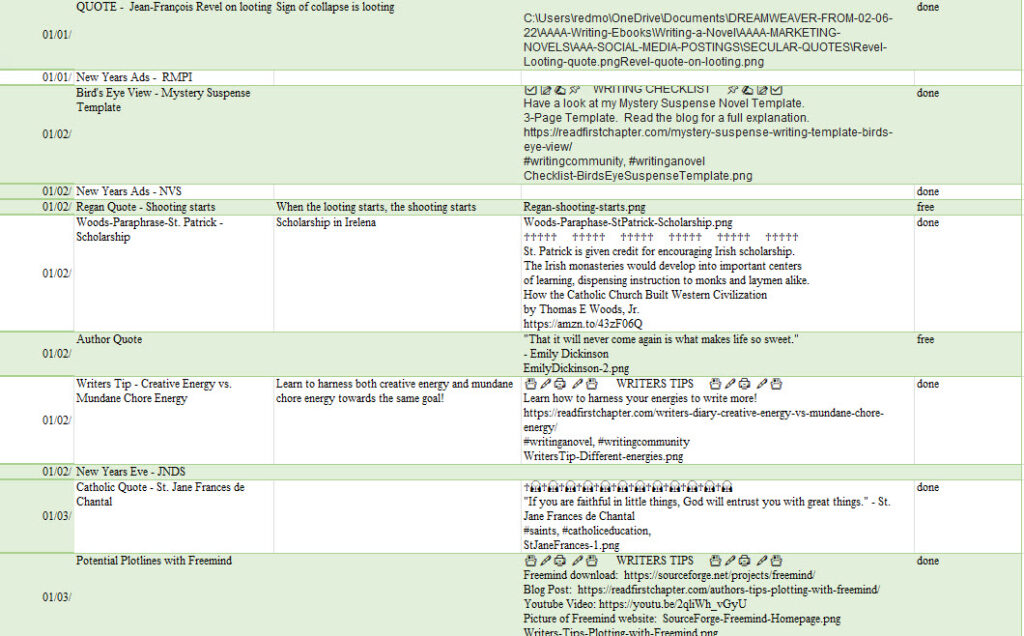
 Along with the 72 dpi book cover, you will need short blurbs about your book or books. Starting at about 150 words, keep whittling the blurb down until you have several blurbs with the last one being about one sentence (for Amazon ads).
 Copy and paste any and all purchase links for your book. Be sure to keep track of which merchant each link belongs to. Besides the purchase links, you may want to keep the paperback and hardcover links handy -- you never know!
 Most younger people know what hashtags are. If you're a boomer like me (hee hee), you may need to brush up on what hashtags are. Go to YouTube and search out videos explaining hashtags. Someone will explain them to you.

 Book Marketing is a huge undertaking, but it starts with baby steps. When I was brand new, the mere subject of book marketing was enough to make me feel completely overwhelmed. However, now looking back, I see that it started with baby steps and book marketing isn't something you do, it's something you build.
 This first installment is to set the framework of your marketing plan. The calendar list below is meant to be sort of a file box. Think of each holiday as a marketing opportunity. You will build your marketing plan by starting with this calendar.
 Earlier this year I started uploading YouTube videos targeting beginner writers and marketers who want to learn how to make their own book covers. Gimp is a free photo manipulation program -- completely free. Volunteer coders from around the world, unsung heroes, have worked on this computer program for the masses.
 This is a checklist I wish I had when I first started out as an author. With the internet and research being at our fingertips, anyone can figure out how to write a first draft. In the world I live in, a first draft is nothing more than blurting out the story onto paper so you have something to begin working on.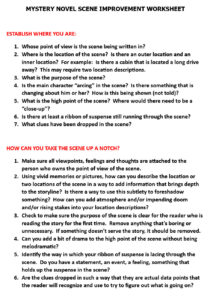
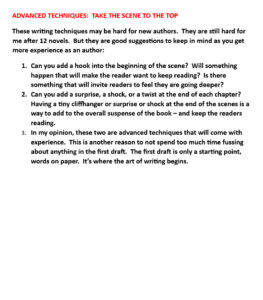 By focusing on each element individually with these questions in mind, it will allow a new author to focus on only one element at a time. It prevents new authors from becoming overwhelmed by a general suggestion to take the whole novel up a notch.










 When I self-published my first novel, I finished it and uploaded it and waited. That's when I learned how important marketing the book is. I also learned through the next several books how important it is to take advantage of each tiny phase of a book launch for marketing. That's what this blog post is about.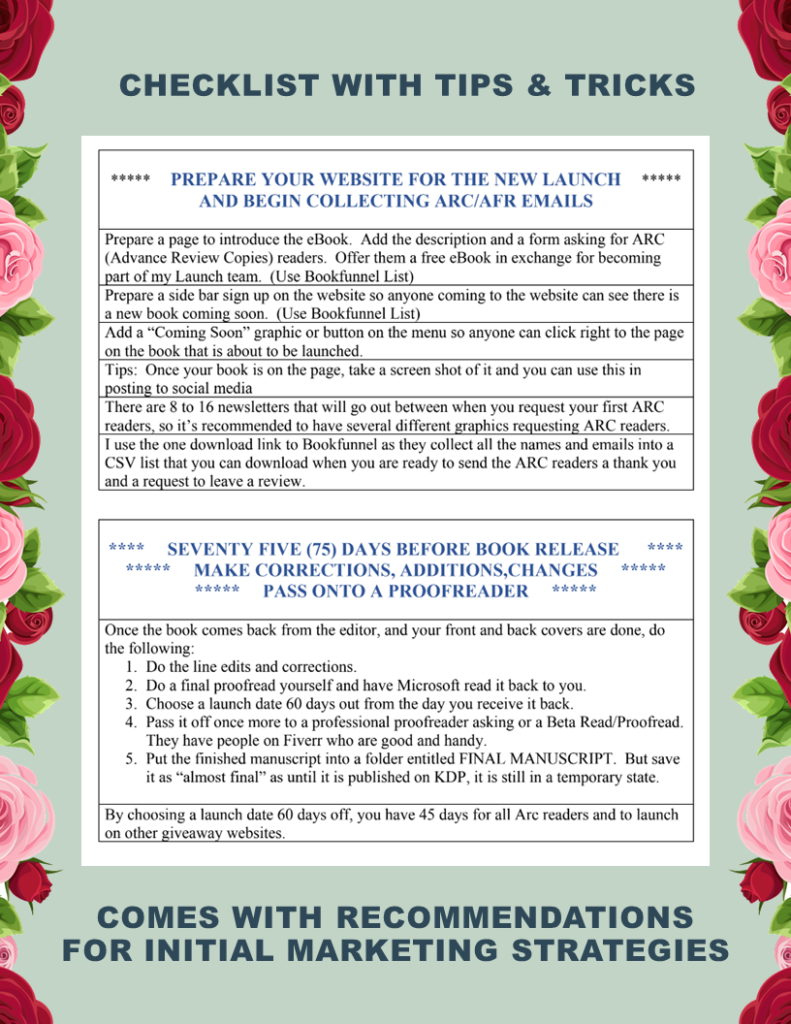
 In Layer 8, I do a read-back. In Microsoft Word, I use the Read-Aloud feature that is contained on the Review Tab. By listening to the book read aloud by someone else, it doesn't skip over mistakes like I do as the author. By the time I'm finished with Layer 7, I've read and reread this book too many times to trust my eyes to spot every error.